




10 min read
Biomechanics is the science of how mechanical forces act on and are produced by the human body during movement. For fitness coaches, it's the difference between knowing what a client is doing wrong and knowing why — and exactly what to do about it.
Every time a client squats, sprints, or lifts overhead, a complex interaction of forces is working across bones, joints, muscles, and tendons. How those forces are distributed determines whether the movement is efficient and safe or whether it's quietly building toward injury.
This guide covers the foundational biomechanics concepts coaches actually use: kinematics vs. kinetics, Newton's laws in practice, lever systems, the kinetic chain, and how to apply all of it to technique coaching, exercise selection, and injury prevention.
The way those forces are distributed, absorbed, and produced determines whether the movement is efficient, powerful, and safe, or whether it creates unnecessary stress on structures not designed to bear it.
Biomechanics is the science that explains this. It answers questions coaches face every session:
- Why does this client's knee cave inward when they squat?
- Which foot position optimizes force transfer during a deadlift?
- Why does changing the bar path during a bench press reduce shoulder pain?
- How does altering a running gait reduce the impact forces reaching the knee?
None of those questions can be answered with intuition alone. They require an understanding of how forces, levers, momentum, and joint mechanics interact in the human body.
This guide gives coaches and fitness professionals the foundational biomechanics knowledge that translates directly into better coaching decisions.
Also read, Biomechanical Analysis
What Is Biomechanics?
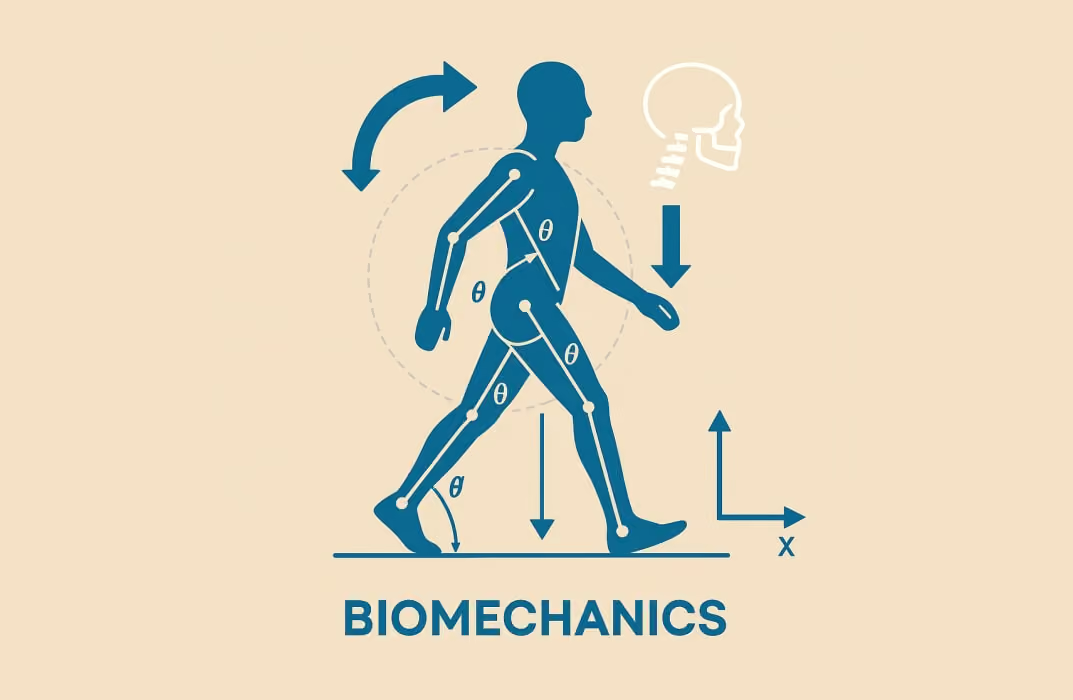
The term comes from the Greek roots bios (life) and mechane (machine or tool). Biomechanics is the application of mechanical principles to biological systems. For the human body, it examines how mechanical forces act on the body (such as gravity, ground reaction force, or a barbell load) and how the body generates forces through muscular contraction and structural leverage to produce movement.
Aristotle studied animal locomotion as early as 300 BCE, observing how muscles and joints work together to produce controlled motion.
Leonardo da Vinci applied his engineering understanding to analyze walking mechanics and muscle function in the fifteenth century. Isaac Newton's laws of motion in the seventeenth century provided the mathematical framework for modern biomechanics.
The field accelerated dramatically in the twentieth century as force plates, electromyography (EMG), and high-speed cameras enabled precise measurement of movement and forces rather than just observation.
Today, motion capture systems, 3D modeling software, wearable sensors, and artificial intelligence have made biomechanical analysis accessible beyond research labs.
Sports performance centers, rehabilitation clinics, and increasingly coaches working with general populations all draw on biomechanical principles to make better decisions about how clients should move and train.
Read more about Corrective Exercises
Biomechanics vs. Kinesiology: Key Differences
These two terms are often used interchangeably in fitness settings, but they describe different scopes of study:
In practice: biomechanics is a subdiscipline of kinesiology. A coach who understands both has a complete picture of how training affects the body mechanically, physiologically, and neurologically.
The Two Core Branches: Kinematics and Kinetics
All biomechanics, regardless of context, is organized around these two foundational categories.
Kinematics: Describing Motion
Kinematics is the study of motion without reference to the forces causing it. It answers the question "how is this body moving?" using parameters like displacement (how far the body or a segment has moved), velocity (how fast it is moving), acceleration (how quickly speed is changing), and joint angles (the degree of rotation at each joint during the movement).
A kinematic analysis of a squat, for example, describes the path the barbell travels, the depth achieved, the knee and hip angles at various points in the descent and ascent, and the trunk inclination angle. It does not explain why those angles occur or what forces produced them. It simply describes what happened.
Examples of kinematic variables coaches use: Stride length and cadence in running. Joint flexion and extension angles during a lift. Trunk lean during a hinge movement. Bar path during a press. These parameters guide technique cues by describing what the movement looks like and whether it matches the ideal pattern for efficiency and safety.
Kinetics: Understanding Forces
Kinetics is the study of the forces that cause motion. It answers "why is this body moving this way?" and "what forces are being produced and absorbed?" Kinetic parameters include ground reaction force (the force the ground exerts back on the body), joint torque (the rotational force at each joint), muscle force, joint reaction force (the force one joint surface exerts on another), and momentum.
A kinetic analysis of the same squat reveals how the ground pushes back against the lifter's feet, how much torque the hip and knee extensors generate to overcome the load, and how much compressive and shear force the knee and lumbar spine experience at each point in the movement.
Kinetics explains injury mechanisms. Anterior cruciate ligament tears typically involve excessive knee valgus combined with minimal knee flexion at landing, creating high shear forces across the knee joint that the ACL cannot resist. This is a kinetic explanation.
Understanding it allows coaches to identify the kinematic patterns (the valgus collapse visible on a video) that correspond to dangerous kinetic events (the high ligament shear force that cannot be seen but can be calculated).
Types of Biomechanics
The field spans several domains, each focused on a distinct biological context.
Sports and exercise biomechanics applies mechanical principles to athletic performance and exercise technique. It is the most directly relevant domain for coaches and personal trainers. The goal is to optimize technique for performance, efficiency, and injury prevention. This includes analyzing a sprinter's running mechanics, a powerlifter's squat form, a swimmer's stroke efficiency, or a baseball pitcher's throwing motion.
Clinical and rehabilitation biomechanics applies movement analysis to injury assessment, post-surgical rehabilitation, prosthetics and orthotics design, and gait analysis for people with movement disorders. Physical therapists, orthopedic surgeons, and rehabilitation specialists in this domain use biomechanical analysis to understand how injury or disease has altered movement and to restore it.
Occupational biomechanics studies how the physical demands of work environments affect the musculoskeletal system. Ergonomics, the design of tools and workstations to match human movement capacity, is a direct application. Understanding why certain lifting postures or repetitive movement patterns can lead to injury over time is an aspect of occupational biomechanics.
Developmental biomechanics examines how movement patterns and mechanical properties of the musculoskeletal system change across the lifespan, from infant motor development through aging-related changes in bone density, muscle mass, and joint mechanics.
Comparative biomechanics studies movement across different species, examining adaptations in locomotion, feeding, and other motor behaviors. It informs robotics and evolutionary biology and has generated insights into optimal human movement by comparing it to that of other animals.
Core Principles of Biomechanics for Coaches
Newton's Three Laws of Motion
These laws are the mechanical bedrock of everything that happens during exercise.
Newton's First Law: Inertia: A body at rest stays at rest, and a body in motion stays in motion at constant velocity, unless acted upon by a net external force. In lifting, this means a barbell sitting on the floor will not move until a lifter applies force to it. During a movement, the barbell will tend to continue in whatever direction it is moving. A lifter decelerating a bench press at lockout must apply force opposing the bar's upward momentum. Inertia explains why heavier loads require more force to initiate and control movement.
Newton's Second Law: Acceleration: Force equals mass multiplied by acceleration (F = ma). This law explains the relationship between load, acceleration, and the forces muscles must produce. To move a heavier barbell, the muscle must produce more force (or accept a slower acceleration). To accelerate a lighter barbell to its maximum, the muscle produces high force despite the low external load. This principle underpins velocity-based training, in which bar speed is monitored as a proxy for the force applied.
Newton's Third Law: Action and Reaction: For every action there is an equal and opposite reaction. When a lifter pushes down on the floor during a squat, the floor pushes back up with equal force. This ground reaction force is what propels the lifter and barbell upward. When feet are planted on a stable surface, more of that reaction force can be directed into moving the load rather than being dissipated. This is why stable stance and foot contact are mechanically important, not just for stability but for force transmission.
The 5 Core Principles of Biomechanics Every Coach Should Know
Force, Torque, and Moment Arms
Force is a push or pull that can change the state of motion of an object. In the human body, muscles generate force through contraction. The force a muscle can produce depends on its cross-sectional area, its length (length-tension relationship), the speed of contraction, and its angle of pull relative to the bone it is moving.
Torque (also called moment of force) is the rotational effect of a force applied at a distance from a pivot point (a joint). Torque is calculated as force multiplied by moment arm, where moment arm is the perpendicular distance from the joint center to the line of force action.
This is why exercise technique matters mechanically. Changing a client's trunk angle in a squat changes the moment arm of the load relative to the hip and knee joints, altering the torque demand at each joint. A more upright trunk posture in a squat reduces hip extensor torque demand and increases knee extensor torque demand. A more inclined trunk does the opposite. Neither is universally correct. The optimal trunk angle for a given client depends on their anatomy, strength profile, and the specific adaptation they are training for.
This is also why the same load can stress different joints differently. A barbell placed higher on the back versus lower changes moment arms at the hip and knee, explaining why high-bar and low-bar squats feel different and recruit different muscle groups to different extents despite using identical loads.
Levers in the Human Body
The musculoskeletal system is a system of levers.
Every lever has three components:
- a fulcrum (the pivot point, which in the body is a joint),
- a force arm (the distance from the joint to where force is applied, typically where a muscle attaches to bone), and
- a resistance arm (the distance from the joint to where the load is located).
The three classes of levers differ in the arrangement of these three components.
First-class levers place the fulcrum between the force and the resistance. The skull on the atlas vertebra (the top of the spine) is the body's most cited example of a first-class lever. When the neck extensors contract to lift the head, the atlas joint is the fulcrum, the neck extensors apply force behind it, and the weight of the face and anterior skull is the resistance ahead of it.
Second-class levers place the resistance between the fulcrum and the force. These produce a mechanical advantage (the force arm is always longer than the resistance arm), allowing them to move large loads with relatively small muscle forces. Rising onto the toes is the classic example: the ball of the foot is the fulcrum, body weight (the resistance) acts between the fulcrum and where the calf muscles attach to the heel (the force application point).
Third-class levers place the force between the fulcrum and the resistance. This is the most common lever arrangement in the human body. Elbow flexion is an example: the elbow joint is the fulcrum, the bicep attaches to the radius close to the elbow (force application close to the fulcrum), and the weight of the forearm and any load held in the hand is the resistance at the far end. Third-class levers operate at a mechanical disadvantage (short force arm, long resistance arm), requiring muscles to produce far more force than the load they move.
This is why the bicep must produce many times the force of the weight being curled to complete the movement.
The practical implication: most muscles in the body are at a mechanical disadvantage relative to the loads they move. This is the normal state of musculoskeletal design, optimized for range of motion and movement speed at the expense of force efficiency.
Center of Gravity and Stability
The center of gravity (also called the center of mass) is the point at which the body's mass is considered to act. For a standing human, it lies approximately at the level of the second sacral segment, between the hips. The position of the center of gravity changes constantly as the body moves and segments shift.
Stability depends on the relationship between the center of gravity and the base of support (the area bounded by the body's outermost points of contact with the ground). Three principles govern stability:
The lower the center of gravity relative to the base of support, the more stable the body. This is why a squat position is more stable than standing on one leg.
The larger the base of support, the greater the stability. A wider stance provides a larger base of support, which is why athletes adopt wider stances during high-force contacts.
The more directly the center of gravity falls over the center of the base of support, the more stable the position. A lifter whose center of gravity is near the edge of their base of support (leaning forward with weight on the toes, for example) is inherently less stable than one whose center falls centrally over the base.
These principles explain why coaching stance width, foot position, and bar path alignment are biomechanically meaningful rather than simply aesthetic preferences.
The Kinetic Chain: Open and Closed
The kinetic chain concept describes how body segments are mechanically linked, so that movement at one joint affects movement at adjacent joints up and down the chain.
A closed kinetic chain (CKC) is one in which the distal segment (the end of the limb) is fixed against an external resistance. In lower-body terms, the foot is planted, and the ground provides a reaction force. Squats, deadlifts, and lunges are closed kinetic chain exercises. Because multiple joints are loaded simultaneously and movement at one joint produces movement at all others, CKC exercises develop coordinated multi-joint strength and functional stability.
An open kinetic chain (OKC) allows the distal segment to move freely in space. A leg extension machine exercise, for example, has the foot free. Each joint can move independently without necessarily affecting adjacent joints. OKC exercises allow isolation of specific muscles and are widely used in rehabilitation settings where the goal is to strengthen a specific muscle without loading other joints.
The kinetic chain concept also explains how restrictions at one joint can lead to compensation at adjacent joints. When ankle dorsiflexion is limited, the knee, hip, and lumbar spine will compensate during a squat by adopting alternative strategies (heel rise, knee valgus, trunk lean) that transfer load to structures not designed to carry it in that pattern. Identifying the original restriction rather than just the compensatory pattern is the biomechanical analysis that drives effective corrective programming.
Biomechanics in Fitness Coaching: Practical Applications
Injury Prevention Through Movement Analysis
The most direct biomechanics-based coaching application is preventing movement patterns that concentrate excessive force on vulnerable structures.
Knee valgus during squatting and landing is a kinematic pattern (observable on video or in person) that corresponds to increased medial compartment loading and anterior cruciate ligament stress, both kinetic events that cannot be directly observed but are well-established in the research literature.
A coach who recognizes valgus as a biomechanical risk factor and understands the hip weakness, ankle mobility limitation, or neuromuscular pattern that drives it can intervene before injury occurs.
Similarly, excessive lumbar flexion during a deadlift or Romanian deadlift concentrates shear force at the lumbar spine rather than the hip extensors (where it should be directed).
Coaching a neutral spine position is a biomechanical intervention: it changes how forces are distributed across the spinal segments.
The FitBudd guide on corrective exercise covers the assessment and exercise prescription process for addressing movement pattern faults rooted in biomechanical dysfunction.
Exercise Technique Coaching
Every coaching cue is fundamentally a biomechanical intervention. "Push the floor away" in a squat activates the posterior chain more fully by changing the force direction concept. "Keep the bar over the mid-foot" during a deadlift minimizes the moment arm of the load relative to the lumbar spine.
"Pull the elbows down and back" during a pull-up reduces the risk of shoulder impingement by positioning the glenohumeral joint optimally.
Understanding the mechanical reason behind a coaching cue allows coaches to generate new cues when standard ones do not work for a particular client, and to identify when a cue that works for most clients is actually producing a counterproductive pattern for someone with unusual anatomy.
Exercise Selection and Modification
Biomechanical principles guide exercise selection across three dimensions: muscle targeting, joint loading, and functional transfer.
Muscle targeting is determined by moment arms. Which muscle groups face the highest torque demand during a movement? This determines which muscles are primarily trained. Understanding this allows coaches to select exercises that target specific muscle groups and to predict which variations will shift emphasis.
Joint loading must be managed for clients with injury history or current pain. A coach who understands that knee flexion depth in a squat affects the ratio of quadriceps to posterior-chain loading, or that hand position on a pull-up bar changes the torque arm at the shoulder versus the elbow, can modify exercises to reduce load at a symptomatic joint while maintaining training stimulus for the target muscles.
Functional transfer requires that the force vectors, joint angles, and movement patterns of training exercises overlap with the demands of the target activity. Sport-specific exercise selection is a biomechanical decision: Does this exercise train the muscles at the joint angles and speeds at which they must perform in the sport?
Movement Assessment
A competent movement assessment is applied to biomechanics. When a coach observes a client performing an overhead squat and identifies excessive forward trunk lean, this observation leads to a biomechanical hypothesis:
- Is the movement limitation coming from ankle dorsiflexion restriction (which would force the trunk to lean to maintain balance),
- Hip flexor tightness (which would anterior-tilt the pelvis and create lumbar extension),
- Thoracic spine restriction (which would limit overhead reach and create compensatory trunk lean),
- Weakness in the posterior chain (which would cause the lifter to counterbalance by leaning forward)?
Each of these hypotheses has different corrective implications. Biomechanical reasoning is what converts a movement observation from a vague "something looks wrong" to a specific, actionable assessment that guides programming.
The FitBudd guide on personal training assessments covers the structured movement screening process that translates biomechanical observation into concrete programming decisions.
Equipment and Load Selection
Bar position, handle width, foot placement, and equipment choice all change biomechanics. The safety squat bar shifts the load forward relative to the spine, increasing trunk extensor demand.
A trap bar reduces the moment arm at the lumbar spine during a deadlift compared to a conventional barbell, often allowing greater loads with lower spinal risk.
A neutral grip during a pressing movement reduces shoulder internal rotation, thereby modifying the impingement risk profile compared with a pronated grip.
Understanding the biomechanical differences between equipment options allows coaches to match tools to clients rather than assuming every client should use the same implement.
Biomechanics in Real-World Training: Sport and Exercise Examples
The squat: Biomechanically, a squat requires the center of mass (lifter plus bar) to remain over the base of support (the foot) throughout the movement. This constraint means that as the hips descend and move backward, the trunk must lean forward proportionally. A lifter with longer femurs must lean more than one with shorter femurs for the same depth, which is a purely geometric consequence of maintaining balance. Understanding this means that coaching cues that demand an upright torso from a long-femur lifter will either lead to poor balance or prevent adequate depth, neither of which serves the lifter.
The deadlift: The moment arm of a loaded barbell relative to the lumbar spine is determined by how far the bar is from the spine horizontally at the start of the pull. Keeping the bar close to the body throughout the lift minimizes this moment arm, reducing the muscular force required from the erectors and decreasing spinal loading. Bar drift away from the body during a pull is a biomechanical inefficiency with both performance and injury implications.
Running mechanics: Ground contact time, stride length, cadence, footstrike pattern, and trunk lean are all kinematic variables. Ground reaction force, peak impact loading, joint torques at the knee and hip, and propulsive force generation are all kinetic variables. Both are relevant to injury prevention and performance optimization. A runner striking the ground with their foot far ahead of their center of mass (overstriding) generates a high braking force (kinetics) visible as a large contact angle and slow cadence (kinematics), increasing injury risk and reducing efficiency.
Overhead pressing: The shoulder's biomechanical vulnerability during pressing stems from the joint's geometry: a relatively shallow socket, a large range of motion, and a small subacromial space through which the supraspinatus tendon passes. Overhead pressing with internal rotation further narrows this space. Coaching scapular retraction and depression before pressing, using neutral-grip variations, and ensuring adequate thoracic extension are biomechanical interventions that protect the subacromial space during the movement.
Related reading - Drive Phase in Sprinting
Biomechanics and the Coach's Eye: Qualitative Analysis
Coaches rarely have access to force plates, EMG equipment, or motion capture systems. Most biomechanical analysis in coaching happens qualitatively: observing a client move, identifying deviations from optimal patterns, generating hypotheses about the mechanical cause, and testing those hypotheses with corrective cues or assessments.
Effective qualitative analysis requires a clear mental model of what optimal mechanics look like for a given movement, knowledge of the common deviation patterns and their mechanical causes, and a systematic approach to observing from different angles and at different points in the movement.
Viewing a squat from the front reveals frontal-plane deviations (knee valgus, lateral trunk shift, foot flare asymmetry). Viewing from the side reveals sagittal-plane deviations (depth, trunk angle, bar path). Viewing from behind reveals hip hinge depth and lateral weight distribution. A complete assessment uses all viewing angles.
For coaches building structured assessment and programming workflows that systematically capture movement quality data across a client roster, the FitBudd guide to creating workout plans explains how movement assessment findings inform program design decisions.
A Biomechanics Quick Reference for Coaches
Conclusion
Biomechanics is not an abstract academic discipline for fitness coaches. It is the underlying science of every movement observation, coaching cue, exercise prescription, and technique correction they make.
Understanding how forces act on and are produced by the body, how lever mechanics determine muscle demand across exercise variations, how the kinetic chain distributes restriction and compensation, and how Newton's laws govern every rep of every set gives coaches a decision-making framework that is rooted in how the body actually works.
The coaches who consistently apply biomechanical reasoning make better programming decisions, identify injury risks earlier, and provide more effective technique cues.
They can explain not just what a client should do but why, which is the difference between coaching that changes movement patterns long-term and coaching that only influences performance in the moment the cue is given.
FitBudd gives coaches the tools to translate biomechanical assessment findings into structured, delivered, and tracked programs: movement assessment documentation, exercise libraries with form guidance for every variation, and progress tracking that captures whether technique and capacity are improving over time. Start your free 30-day trial at FitBudd and build programs grounded in how the body actually moves.
%20to%20Become%20a%20Certified%20Personal%20Trainer-min.avif)