




10 min read
If you have ever wondered which exercise truly hits a muscle the hardest, you are not alone. Strength coaches, personal trainers, and athletes ask this question every day. This is where Electromyography becomes incredibly useful. It helps you understand how hard a muscle works during a movement, connecting the muscle to the brain and spinal cord .
Understanding the electromyography meaning is not only for scientists. It is also valuable for coaches who want better results for their clients, especially those with muscle disorders.
In this blog, you will learn what Electromyography is, how it works, why it matters, and how to use EMG data without making common mistakes.
What Is Electromyography (EMG)?
Electromyography (EMG) is a test that records the electrical activity of a working muscle. The test, called an electromyogram, produces waves or signals that reflect how strongly a muscle contracts during movement. Simply put, EMG measures muscle activation, helping coaches understand which muscles are truly working during an exercise.
When people ask what is EMG or what does EMG mean, the answer is simple: EMG is the shortened term for electromyography, while the electromyogram is the actual EMG measurement. Both terms are often used interchangeably in research, including nerve conduction studies, but coaches can now use EMG data confidently in real training. Understanding the meaning of EMG helps clarify EMG activity, especially when tracking specific muscles such as glutes, quads, or EMG for legs.
The purpose of electromyography goes beyond just measuring signals. Electromyography uses include comparing exercises, identifying weak activation, refining technique, and understanding movement efficiency.
Electromyography Medical Terminology Every Coach Should Know
Understanding key terms in Electromyography Medical Terminology helps you read research and interpret electromyographic activity in a practical, coach-friendly way.
By understanding these terms, coaches can interpret EMG measurement, whether from a surface EMG device, wearable tech, or research studies.
EMG measures how a muscle works, which helps with exercise selection, programming, and tracking EMG activity across different muscle groups. While EMG is not a guarantee of growth, it is a precise tool for understanding movement, what does an EMG measure, and how muscles respond under load.
How Electromyography Works
To understand EMG, you do not need an engineering degree. The process is simple once you break it down. EMG looks at the tiny electrical signals your muscles create when they contract. These signals help coaches understand real muscle effort during an exercise.
When a muscle contracts, your nervous system sends messages through motor units. These messages carry electrical impulses. EMG captures these impulses and turns them into readable data. This data appears as waves or spikes on a graph, indicating the activity of the same motor unit .
Here is how Electromyography works in a simple, coach-friendly flow to analyze muscle movement :
Step 1: Muscle contracts
Your brain tells a muscle to work, and motor units fire. The contraction produces electrical activity.
Step 2: Electrodes detect the signals
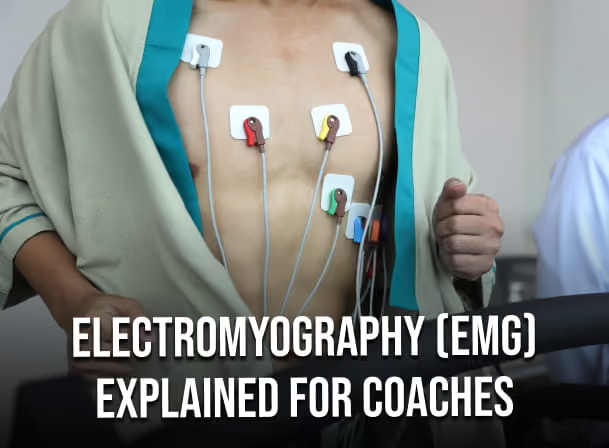
Surface electrodes sit on the skin above the muscle. They act like tiny antennas that pick up the electrical noise created during movement.
Step 3: Device amplifies the signal
Raw signals are very small. An electromyography device boosts them so the data becomes clear and measurable.
Step 4: EMG software converts the data
The system turns the captured activity into usable numbers or graphs. Coaches typically look at amplitude, timing, and overall EMG measurement patterns.
Step 5: You interpret the information
This is where coaching insight matters. The goal is to understand which muscles worked harder, when they worked hardest, and how activation changed during the movement.
This entire process helps you see electromyographic activity in real time. It shows how muscles behave during squats, presses, lunges, or sprints. Coaches use this information to refine technique, fix weak activation, and improve exercise selection.
In short, Electromyography measures the electrical output of your muscles. This simple understanding helps you connect EMG data with real training decisions.
Types of EMG Used in Coaching & Performance Settings
Coaches do not need to understand every scientific detail, but knowing the two main types of EMG helps you choose the right tool. Coaches do not need to understand every scientific detail, but knowing the two main types of EMG helps you choose the right tool for various contexts, including training, research, and nervous system disorder assessments.
Surface EMG (sEMG) – Most Common for Coaches
Surface EMG is the method you see in strength training studies, sports labs, and wearable devices. It uses small electrodes placed on the skin. These electrodes read the electrical signals from the muscles underneath.
What Surface EMG Measures
Surface EMG captures muscle activation levels, timing, and effort during movement. It helps you compare exercises, assess technique, and identify recruitment patterns related to muscle disease .
Pros of Surface EMG
- Non-invasive
- Easy to use
- Works well for most strength exercises
- Offers real-time feedback
- Pairs with modern wearable tech
Cons of Surface EMG
- Can pick up noise from nearby muscles
- Sensitive to electrode placement
- Not perfect for very deep muscles
Coaches rely on surface EMG because it is simple and effective. Most Electromyography device options available today use this method.
Intramuscular EMG (Needle EMG) – Medical or Research Use Only
Intramuscular EMG uses a thin needle inserted directly into the muscle. It gives extremely precise readings but is not used in coaching.
Why Coaches Do Not Use It
- Invasive
- Requires medical supervision
- Not practical in a gym
- Designed for diagnosing medical issues
Intramuscular EMG is valuable for clinical studies, but surface EMG is the tool coaches depend on. Both methods show electromyography measures, including those related to the peroneal nerve but surface EMG is the practical option for training settings.
Together, these two methods explain how an EMG device collects and interprets muscle activation data, including responses from the median nerve, for coaching and performance work.
What Does an EMG Measure Exactly?
EMG gives coaches more than just a number. It provides a detailed look at how a muscle behaves during movement. When you understand what an EMG actually measures, you can use the data to improve exercise selection, technique, and programming.
Muscle Activation Level
The most important metric is muscle activation. This shows how hard a muscle works during an exercise. Higher activation means the muscle is producing more force at that moment. Coaches use this information to compare similar exercises.
Motor Unit Recruitment
An EMG also helps you understand motor unit recruitment. When intensity increases, your body recruits more fibers. Stronger EMG signals often reflect more recruitment. This helps you see when a muscle struggles or when it is fully engaged, especially important for clients on blood thinners .
Muscle Fatigue
As you train, muscles experience fatigue. EMG shows this through changes in amplitude and frequency. Fatigue often appears when signals become less stable or when the pattern shifts. This helps you track effort across sets.
Strength Curve Patterns
EMG highlights strength curves. You can see which parts of a lift are hardest. This helps identify sticking points and moments of peak muscle tension. Coaches use this to adjust technique or choose better accessory work.
Timing and Activation Onset
Timing matters in explosive movements. EMG shows when a muscle starts firing. This is useful in sprinting, weightlifting, and high-speed training. Delayed activation can signal weakness, poor technique, or imbalance.
Together, these variables explain what does an EMG measure. They show how each EMG muscle behaves under load and help you understand real EMG activity during training. This information makes your coaching decisions more accurate and intentional.
The Purpose of Electromyography in Coaching
Many coaches see EMG as a scientific tool used only in labs. In reality, EMG gives clear, practical insights that help you understand how muscles behave during real training. When you know the true purpose of EMG, you can use it to make smarter and more efficient coaching decisions.
Understanding the Real Purpose of Electromyography
The main purpose of electromyography is to measure how active a muscle is during movement. It shows you when a muscle works hardest, when it switches on, and how effort changes through a lift. This helps you identify inefficiencies and opportunities to improve performance.
Correcting Technique
EMG shows if the right muscles are working at the right time. For example, if an athlete relies on their lower back instead of glutes during a hinge, the EMG data will reveal it. This helps you refine technique with confidence.
Comparing Exercises
Coaches often want to know which exercise best targets a muscle. EMG helps provide clarity. It shows differences in muscle activation between movements like squats, lunges, hip thrusts, and split squats. This guides better exercise selection.
Optimizing Programming
EMG helps you reduce junk volume. If an exercise produces low activation for a target muscle, you may replace it with a more effective option. When you understand muscle activation patterns, including results from a nerve conduction study you can build more efficient programs.
Identifying Weak Activation
If a muscle is not firing properly, EMG helps you spot the issue. This is helpful for athletes with imbalances or clients who struggle to “feel” certain muscles. Once identified, you can fix the activation problem with targeted drills.
In short, the major uses of electromyography in coaching revolve around clarity and precision. EMG cuts through guesswork and helps you make informed decisions that improve performance and technique.
To apply these insights more effectively in real-world coaching, using fitness software for personal trainers such as FitBudd can help streamline programming, tracking, and client progress.
What Are EMGs Used For? (Real-World Examples for Coaches)
EMG is more than a scientific measurement. It is a practical coaching tool. When used correctly, it helps you understand how muscles behave in real training situations. Here are the most valuable ways coaches use EMG data.
Exercise Comparison
One of the most popular uses of EMG is exercise comparison. It helps coaches see which movements produce higher activation for a specific muscle.
Examples:
- Hip thrust vs squat for glutes
- Lunge vs step-up for quads
- RDL vs leg curl for hamstrings
Higher EMG activity in an exercise does not guarantee hypertrophy, but it helps you choose movements that better match an athlete’s goals, especially for those on blood thinners .
Understanding Sticking Points
Every lift has a sticking point. EMG helps you see where activation drops or where compensations appear. This helps you program accessories that target weak ranges or improve control.
Identifying Muscle Activation Issues
Some athletes struggle to feel certain muscles working. EMG helps you see if a muscle is actually underactive or if it is firing late. This is valuable for glutes, lats, and hamstrings, where activation can vary widely between individuals.
Tracking Fatigue and Neuromuscular Efficiency
When an athlete becomes fatigued, their EMG patterns change. Coaches can use these patterns to gauge recovery, readiness, or technique breakdown.
Examples include:
- Declining EMG amplitude across sets
- Changes in firing timing
- Uneven activation between limbs
These insights, including those from a nerve conduction study, help you adjust workload or modify session intensity.
In all these examples, EMG helps you understand what are EMGs used for in real training. It gives coaches a clearer view of true muscle effort and helps guide smarter decisions backed by measurable EMG activity.
How to Read EMG Data as a Coach (Without Needing a PhD)
Reading EMG data doesn’t have to be complicated. You don’t need a PhD to understand what the signals mean. Let's explore some factors you have to keep in mind:-
Amplitude: How Strong the Signal Is
Amplitude shows how hard a muscle is working at any moment. Higher amplitude usually means higher effort or more motor unit recruitment. Coaches often compare amplitude between exercises to see which movement creates stronger EMG activity.
Peaks vs Average Activation
Peaks show the highest moment of muscle activation during a rep. Average activation shows overall effort across the entire movement. Peaks can be impressive, but average activation gives a clearer picture for programming decisions.
Normalized EMG
Normalized EMG compares activation to the athlete’s maximum voluntary contraction. This makes EMG data more fair and reliable. Without normalization, signals can look different even if effort was the same.
Interpreting High, Moderate, and Low EMG
High EMG means the muscle works hard at that moment. Moderate EMG shows controlled effort. Low EMG usually means another muscle is doing most of the work. These insights help coaches adjust technique or choose better exercises.
Common Misinterpretations to Avoid
Many coaches overestimate what EMG can tell them. High EMG does not guarantee more muscle growth. Low EMG does not mean the exercise is useless. EMG shows activation, not long-term adaptation. Understanding this helps you avoid common mistakes when interpreting electromyographic activity or EMG measurement patterns.
EMG in Exercise Selection: What Coaches Should ACTUALLY Rely On
When it comes to choosing exercises, EMG can be helpful but it shouldn’t be your only decision-maker. Let's explore some factors:-
EMG Does Not Guarantee Hypertrophy
Many coaches assume a higher EMG signal means faster muscle growth. This is not always true. EMG shows activation at a moment in time, while hypertrophy depends on volume, tension, recovery, and consistency. Use EMG as a guide, not a prediction tool.
High EMG vs Long-Term Muscle Gain
An exercise may show high EMG muscle activation but still be limited by range of motion, stability, or loading. Another exercise might show moderate EMG but allow better progressive overload. This is why EMG findings must be combined with actual training demands.
Combine EMG With Biomechanics
Do not rely only on EMG activity. Look at joint angles, force curves, individual mechanics, and training goals. An exercise with moderate EMG might still be the best option because it fits the athlete’s structure and strength curve.
Use EMG When It Matters Most
EMG becomes more valuable when:
- You compare similar exercises
- You refine technique
- You identify weak activation
- You troubleshoot performance issues
When EMG Data Does Not Matter Much
You do not need EMG for every exercise decision. Some movements work well regardless of the EMG score because they offer strong loading potential, simplicity, and safety. Deadlifts, rows, push-ups, and squats fall into this category.
Using EMG correctly means treating it as one tool, not the entire training plan. This helps coaches stay focused on real performance and avoid overthinking isolated numbers.
Limitations Coaches MUST Know
While EMG is a powerful tool, it’s not perfect. Coaches need to understand its limitations to interpret data accurately and avoid misleading conclusions during training or assessments.
Skin Impedance Affects Signal Quality
Sweat, body hair, skin texture, and even lotion can interfere with EMG readings. When the signal has to pass through inconsistent skin surfaces, the data becomes less reliable. This is one reason EMG looks “cleaner” in labs than in real gyms.
Electrode Placement Issues
Small changes in placement can create huge changes in readings. Moving the electrode even one or two centimeters can shift the signal toward a different part of the muscle. This makes comparisons tricky unless placement is consistent.
Differences Between Studies
EMG research varies by technique, devices used, normalization process, population tested, and exercise setup. Two studies may show different activation levels for the same movement. Coaches must interpret EMG studies with context, not absolute certainty.
Noise and Movement Artifacts
When athletes move explosively or under heavy load, the electrode may shift slightly. This creates noise and signal distortion. Some EMG spikes are not real muscle activation but movement artifacts.
Genetic Differences in Muscle Activation
People naturally recruit muscles differently. One athlete may show high glute EMG during squats, while another relies more on quads or erectors. These differences come from anatomy, limb length, training history, and neural patterns.
Beginners vs Advanced Athletes
Beginners show inconsistent EMG patterns because their technique is unstable. Advanced athletes produce cleaner and more predictable signals. Coaches must consider training level before drawing conclusions from electromyographic activity.
Understanding these limitations helps you use EMG wisely. It keeps you from overvaluing numbers and ensures you use EMG as a supporting tool not the ultimate decision-maker.
How to Read EMG Data (Coach-Friendly Breakdown)
Understanding EMG activity may look intimidating at first, but once you know what each signal means, it becomes one of the most useful tools for coaching.
Here’s a simple breakdown.
Signal Amplitude (How Much the Muscle Is Working)
This is the height of the EMG waveform.
Higher amplitude = more motor units firing = more muscle activation.
Coaches typically use amplitude to understand:
- Which exercise activates a muscle more
- Whether a client is “feeling” the target muscle
- How fatigue increases over sets (amplitude often rises as muscles tire)
This helps you decide when to cue, when to deload, and when to switch exercises.
Frequency (How Fast the Muscle Fires)
Frequency shows the speed of muscle fiber firing.
Higher frequency = more rapid activation = explosive intent.
You’ll see higher frequency in:
- Sprints
- Jumps
- Power cleans
- Fast concentrics
If frequency drops significantly, it may indicate fatigue or reduced intent.
Onset Timing (Which Muscle Fires First)
This tells you the timing of activation, especially in multi-joint movements.
For example:
- If hamstrings fire too late during sprinting, athletes may risk injury.
- If core muscles activate late during squats, stability suffers.
Timing patterns help you refine technique and injury prevention strategies.
Pattern Recognition (Smooth vs. Choppy Activation)
A smooth EMG pattern usually means coordinated movement.
A choppy or irregular pattern may suggest:
- Poor technique
- Poor motor control
- Compensation from other muscles
- Early fatigue
This helps coaches correct movement quality instead of only chasing load.
How Coaches Can Use EMG in Real Training Sessions
Now that you understand the basics of electromyography, here’s how you can apply EMG activity directly inside training sessions. These practical methods make the tool valuable for strength coaches, physiotherapists, and sports trainers.
Use EMG to Identify the Target Muscle During an Exercise
Sometimes athletes “feel” the wrong muscle.
With EMG, you can instantly confirm whether the EMG muscle you want is actually firing.
Examples:
- Glute bridges turning into hamstring-dominant movements
- Rows becoming upper-trap dominant
- Squats shifting from quads to back extensors
A quick EMG measurement shows exactly where activation is highest so you can fix form or adjust cues.
Use EMG for Technique Correction
Small changes in technique can drastically change EMG activity.
Examples:
- Foot angle adjustments changing quad vs. adductor activation
- Wrist position altering biceps vs. brachialis recruitment
- Torso angle shifting glute vs. hamstring firing
This helps coaches refine technique based on data—not guesswork.
Use EMG to Monitor Fatigue Across Sets
As the athlete gets tired, EMG amplitude usually increases while frequency drops.
This helps you decide:
- When to stop a set
- When the athlete is near mechanical failure
- When to reduce load
- Whether they’re recovering well across the session
It’s a smart tool for regulating intensity.
Use EMG to Compare Exercises During Programming
If you’re choosing between two movements—like hip thrust vs. RDL, or leg extension vs. squat—EMG can show which exercise provides more activation for the target muscle.
This is useful for:
- Exercise substitution
- Accessory selection
- Muscle-specialization blocks
- Prehab and rehab planning
Use EMG for Rehab Progress Tracking
For injured athletes, electromyography measures the return of normal activation patterns.
You can track:
- How much strength a recovering muscle regains
- When asymmetries improve
- Whether compensations decrease over time
This gives objective progress markers during rehab.
EMG in Exercise Selection: What Coaches Should ACTUALLY Rely On
Many coaches look at electromyography and think, “Whichever exercise has the highest EMG must be the best.”
But that’s not how smart programming works.
EMG is a tool, not a ranking system. Below is the coach-friendly way to use EMG without misinterpreting it.
EMG Does NOT Equal Muscle Growth
High EMG activity shows a muscle is working hard in that moment.
But hypertrophy depends on:
- Mechanical tension
- Consistent training volume
- Exercise technique
- Range of motion
- Fatigue management
A hip thrust may show 150–200% MVIC for the glutes, but squats often outperform it in long-term growth studies.
Why?
Because squats load the glutes through a larger range of motion and create more mechanical tension.
High EMG vs. High Hypertrophy
Limitations Coaches MUST Know
Understanding the limitations of Electromyography (EMG) is just as important as understanding how it works. EMG tests are a powerful tool, but they are extremely sensitive.
Without knowing its constraints, coaches can easily misinterpret EMG activity signals and draw incorrect conclusions about exercise effectiveness or muscle movement.
Below are the key limitations explained in a clear, coach-friendly way, including considerations for conditions like amyotrophic lateral sclerosis and muscle disease.
Skin Impedance
One of the biggest factors affecting EMG measurement accuracy is skin impedance—the resistance electrical activity signals face while passing through the skin. Elements like sweat, hydration, hair, body lotion, and even skin temperature can reduce signal quality.
A sweaty athlete may show weaker EMG activity, while a dehydrated athlete may show inconsistent muscle contraction patterns. Hairy areas can also prevent surface electrodes from sticking properly, creating noise or false spikes.
This means two sessions with identical effort can produce very different EMG readings simply because of skin conditions, electrical stimulation, or other factors affecting control muscle movement.
Electrode Placement
EMG tests are highly sensitive to electrode placement—even being off by 1–2 cm can completely change the reading. Placing an electrode slightly higher on a skeletal muscle can produce an entirely different activation pattern. Positioning the EMG device near a tendon may reduce the amplitude, while placing it close to another muscle can cause “signal contamination,” where the electromyographic activity picks up activity from adjacent muscles.
For coaches, this means that accuracy depends heavily on consistent and precise clinical electromyography setup. Proper placement is also essential for evaluating nerves like the median nerve, ulnar nerve, radial nerve causing loss, sciatic nerve, femoral nerve, tibial nerve causing loss, and peroneal nerve, especially in athletes taking blood thinners or recovering from muscle weakness caused by injury or muscle degeneration.
Differences Between Studies
EMG tests research is not standardized, which makes comparing studies difficult. Different studies may use varying loads, rep speeds, electrode types, warm-up routines, participant experience levels, and even different needle EMG or other electrical medical device processing methods.
Some use surface electrodes, while others use intramuscular EMG. Because of this, a movement that appears to have “high EMG activity” in one study might show moderate activation in another. Coaches should avoid basing training decisions solely on isolated study results or nerve conduction studies.
Movement Artifacts
During dynamic exercises, movement itself can distort EMG measurement signals. These distortions—called movement artifacts—occur when electrodes shift, cables move, the skin stretches, or sweat loosens the adhesive. Even rubbing against clothing can cause false spikes or unexpected drops in the signal.
For example, during hinge movements like the RDL, stretching of the posterior chain skin can increase noise and artificially elevate electromyographic activity. Coaches must recognize that not every spike reflects true muscle contraction or muscle movement.
Genetic Differences in Muscle Activation
Athletes do not recruit skeletal muscles the same way. Genetic factors like muscle fiber type distribution, tendon insertion angles, limb lengths, and natural coordination patterns influence EMG activity. Some athletes naturally have better mind–muscle connection, while others rely more on peripheral nerves to coordinate control muscle movement.
This means two people performing the same movement with identical form can show very different EMG readings. Because of these biological differences, EMG tests and nerve conduction study findings should never be assumed to apply universally.
Beginners vs. Advanced Lifters
Experience level significantly affects EMG measurement. Beginners often show higher EMG activity because they compensate with stabilizers and lack movement efficiency.
They may exhibit inconsistent activation patterns and poor motor control, which can inflate readings. Advanced lifters, on the other hand, demonstrate more refined muscle contraction, smoother technique, and better intramuscular coordination.
This difference means that a beginner’s “high EMG activity” doesn’t necessarily represent better muscle movement it often reflects inefficient movement or muscle weakness caused by technique errors.
Final Thoughts
Electromyography is a valuable tool for understanding how muscles behave during different movements, but it’s not a magic shortcut for better training. It shows which muscles fire and when, not how much growth or strength an exercise will produce.
When used correctly, EMG can help coaches refine technique, fix activation issues, compare variations, and make programming more precise. But it should never replace biomechanics, progressive overload, or real-world performance feedback.
Think of EMG as a support tool, not the foundation of your training system. Use it when you need clarity not as a constant requirement.
EMG is a tool, not a training philosophy.
%20to%20Become%20a%20Certified%20Personal%20Trainer-min.avif)