





10 min read
For coaches, effectively assessing a client’s movement quality is the essential first step. The benefit of functional movement and performance training lies in its ability to improve daily life activities, prevent injuries, and enhance overall performance, providing practical advantages that extend beyond the gym. Evaluating functional capacity moves beyond simple strength or cardiovascular metrics, such as cardiovascular fitness. It focuses on how efficiently and safely an athlete performs real-world, dynamic tasks. A successful program requires defining functional ability and capacity early to identify and correct limiting factors. This comprehensive guide, combined with the right personal trainer software, will equip coaches with the necessary principles and practical tests to manage client data effectively. Mastering the evaluation of functional movement and performance training guarantees safer, faster, and more sustainable results.
Defining Functional Ability and Capacity
The terms functional ability and capacity are often used interchangeably, but they represent distinct concepts in athlete evaluation. Understanding this distinction is key to choosing appropriate testing and corrective strategies. Functional capacity refers to the total potential output of the athlete’s system. It is the ceiling of what the athlete can physically achieve.
Assessments of functional ability and capacity should be tailored to individual fitness levels to ensure that testing and corrective strategies are appropriate for each person's unique needs and goals.
What Is Functional Capacity? A Working Definition
Functional capacity refers to an individual's ability to perform the fundamental physical tasks required by their sport, occupation, daily life, or fitness goals. It is not a single quality. It is the integrated expression of several interdependent physical qualities working together within real movement patterns.
These interdependent qualities include:
Mobility: The available range of motion at each relevant joint, including the ankles, knees, hips, thoracic spine, and shoulders, under active muscular control. Mobility differs from passive flexibility, which is the range of motion without motor control.
Stability: The ability to control and resist unwanted movement at a joint, particularly under load or during dynamic tasks. Core, hip, and scapular stability are the most clinically relevant for general fitness populations.
Strength: The capacity to produce force through a movement pattern at a level appropriate to the task.
Balance and proprioception: The ability to maintain postural control and detect body position in space, particularly on single limbs or during dynamic transitions.
Motor control and coordination: The nervous system's ability to sequence and time muscle activation appropriately within a movement pattern, including both bilateral symmetry and the ability to control asymmetrical loads.
Endurance: The capacity to sustain a movement pattern or physical task over time without significant degradation in form or force output.
Functional capacity evaluation does not test these qualities in isolation. It tests how they function together within integrated movement patterns, which is what makes it more relevant to training program design than isolated joint testing.
Why Functional Capacity Evaluation Matters for Program Design
The case for evaluating functional capacity before programming rests on three arguments that experienced coaches recognize immediately.
It Reveals What Training Can and Cannot Include Safely
A client with a score of 1 on the deep squat component of the FMS, indicating an inability to perform the movement within normal range without compensation, should not be loading a barbell squat. Loading a dysfunction does not strengthen it. It reinforces the compensatory pattern, transfers stress to structures that were not designed to handle it, and increases injury risk at the exact points where the kinetic chain is weakest.
Identifying which movement patterns are not yet competent allows coaches to make deliberate programming choices: temporarily substitute the compromised pattern with a more accessible regression, introduce targeted corrective work to address the underlying restriction, and reintroduce the movement as capacity improves.
It Establishes an Objective Baseline for Tracking Progress
Without a baseline assessment, progress in functional movement quality is invisible. A client who began with severe knee valgus collapse in a squat and has since developed clean bilateral mechanics has made meaningful progress. Without the initial documentation, neither coach nor client can see or quantify that improvement.
Objective movement data collected at the start of a program and repeated every four to eight weeks provide evidence that functional training is working, which builds client confidence and strengthens the coaching relationship. As the FitBudd complete personal training assessment blueprint demonstrates, regular reassessment is essential for adjusting programs in response to actual progress rather than estimated progress.
It Protects Coaches Professionally
Coaches who begin training clients without assessing movement quality assume liability for any injuries that occur in patterns they could have identified as problematic. A documented assessment process demonstrates professional due diligence, creates a record of informed programming decisions, and signals to clients that their safety is the starting point of every coaching relationship.
The Core Assessment Tools for Functional Capacity
Several validated screening and testing tools are available to coaches for evaluating functional capacity. Understanding what each tool measures, and what it does not measure, allows coaches to build an assessment protocol appropriate to their client population.
The Functional Movement Screen (FMS)
The Functional Movement Screen is the most widely used systematic movement screening tool in fitness and sports medicine. Developed by Gray Cook, the FMS comprises seven fundamental movement tests, each scored on a scale of 0 to 3, for a maximum composite score of 21.
Scoring system:
- 3: Movement completed correctly, meeting all criteria, without compensation
- 2: Movement completed but with visible compensation or faulty form
- 1: Inability to complete the movement pattern
- 0: Pain reported during the movement (immediate referral to medical professional)
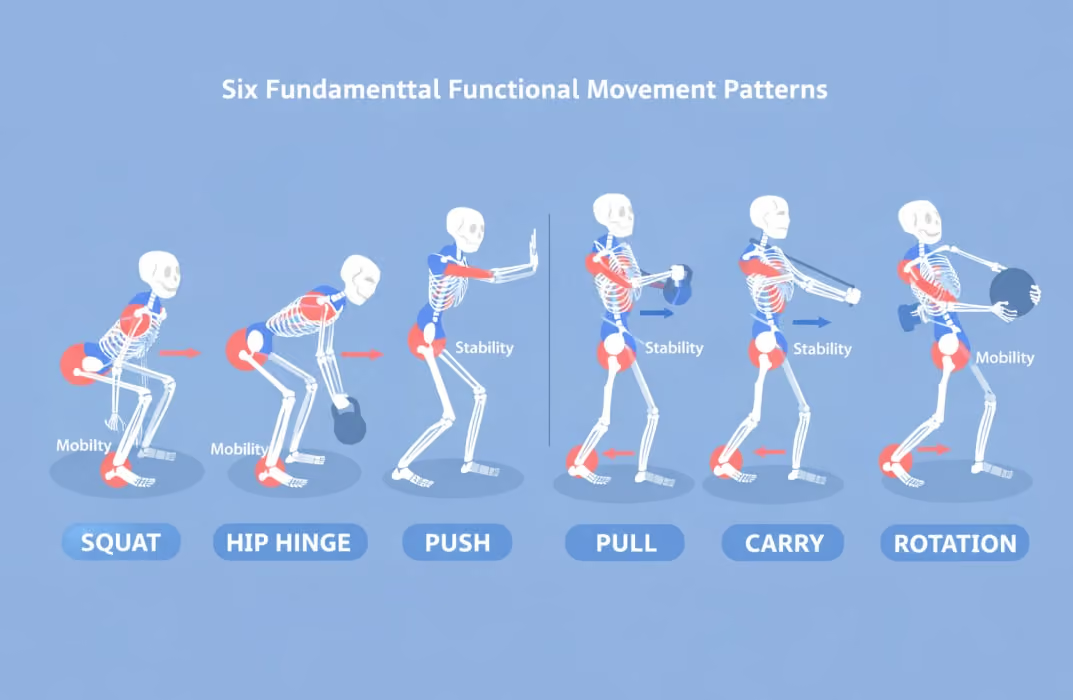
The seven tests:
1. Deep Squat. The athlete stands shoulder-width apart, holds a dowel overhead with arms at 90 degrees, and squats as deeply as possible while maintaining the dowel directly overhead and keeping the heels flat. This single test assesses bilateral hip, knee, and ankle mobility simultaneously, along with shoulder, thoracic spine, and core stability. Research has found that poor deep squat performance increases an athlete's likelihood of scoring poorly on the full FMS composite by 3.56 times, making it a high-value rapid screen in time-constrained settings.
2. Hurdle Step. The athlete steps over a hurdle set at tibial tuberosity height while maintaining a single-leg stance on the other leg. This test steps through and assesses mechanics, single-leg stability, hip mobility, and pelvic control during locomotion. Asymmetries between left and right sides are a key finding.
3. In-Line Lunge. The athlete places the feet in a tandem stance on a board, with the rear knee touching the back of the front heel, and performs a lunge while holding a dowel vertically. This evaluates hip mobility, knee stability, ankle stability, and thoracic rotation under asymmetrical load.
4. Shoulder Mobility. Both hands make fists and are placed behind the back, one above and one below. The distance between the fists is measured. This assesses combined shoulder internal and external rotation, as well as thoracic and scapular mobility. A clearing test for shoulder impingement pain is also included.
5. Active Straight Leg Raise. In supine, the athlete raises one straight leg as high as possible while the opposite leg remains flat. This tests active hip flexion mobility, hamstring length, and core stability under unilateral demand.
6. Trunk Stability Push-up. The athlete performs a single push-up from a position modified by gender and age. The goal is to observe whether the trunk remains a rigid unit or sags or extends before the extremities move. This tests trunk stability during anterior loading.
7. Rotary Stability. On hands and knees, the athlete extends the opposite arm and leg simultaneously while maintaining a flat back. This test measures multiplanar trunk stability and motor control during diagonal loading patterns.
Using FMS results: The goal is not to achieve a perfect 21. A higher priority is identifying the most significant movement problem, which the FMS system terms the "weakest link," and addressing that first. A symmetrical score of all 2s may be preferable to a higher total that masks a significant asymmetry between left and right sides.
Modern sports science recognizes that the FMS is best used as a framework for identifying corrective exercise priorities rather than as a reliable injury predictor in isolation. Its predictive value for injury is inconsistent across populations, as a 2025 meta-analysis in Sports Medicine confirmed. Its value for guiding exercise selection and corrective programming, however, remains well-supported and widely applied.
The Overhead Squat Assessment
The overhead squat assessment is a foundational tool in NASM's corrective exercise model and one of the most efficient single screens available to coaches. The athlete stands shoulder-width apart, raises both arms overhead, and performs a full squat, which the coach observes from the front and side.
What the overhead squat reveals at a glance:
From the front view:
- Knee valgus collapse (knees caving inward): suggests weak hip abductors and external rotators, often combined with overpronation at the foot
- Feet turning out excessively: commonly indicates limited ankle dorsiflexion or shortened hip external rotators
- Asymmetry between the left and right sides: suggests unilateral restriction or weakness
From the side view:
- Excessive forward trunk lean: indicates limited ankle dorsiflexion, tight hip flexors, or weak core
- Heels rising: indicates limited ankle mobility
- Arms falling forward: suggests limited thoracic mobility or shoulder mobility restriction
- Low back arching: indicates limited hip mobility and core stability
Each compensation point to specific tight and weak muscles, which then direct the corrective exercise strategy. The overhead squat assessment does not tell the coach why compensation exists, but it directs subsequent targeted testing. NASM recommends reassessing every four to six weeks to track changes in movement quality in response to corrective programming.
The Y-Balance Test
The Y-Balance Test assesses dynamic balance and stability by measuring how far an athlete can reach in three directions (anterior, posteromedial, and posterolateral) while standing on a single leg. Results are normalized to limb length, and the composite reach distance provides a measure of lower extremity functional movement and stability.
The Y-Balance Test is particularly valuable for:
- Identifying side-to-side asymmetries in single-leg stability
- Tracking rehabilitation progress after lower extremity injury
- Assessing return-to-sport readiness after ankle sprains, ACL injuries, and hip injuries
- Monitoring balance improvements in older adult populations where fall risk is a concern
Research has found that anterior reach asymmetry above approximately 4 centimeters between limbs is associated with increased injury risk in athletes, though, as with the FMS, multifactorial models incorporating additional variables outperform single-test cutoffs for injury prediction.
Posture and Static Alignment Assessment
Before any dynamic movement testing, observing a client's static posture provides context for how their structure is likely to behave under load. Coaches observe from anterior, lateral, and posterior views, using a plumb line reference or grid.
Key findings at each segment:
Feet and ankles: Excessive pronation, supination, or toe-out positioning at rest often correlates with compensation patterns during squatting and lunging movements.
Knees: Varus (bowed) or valgus (knock-kneed) positioning at rest signals existing structural bias in the lower extremity kinetic chain.
Hips and pelvis: Anterior pelvic tilt (hips tipped forward, lower back arched) is one of the most common postural deviations in sedentary clients, indicating tightness in hip flexors and relative weakness in the glutes and abdominals. Posterior pelvic tilt, though less common, has different programming implications.
Thoracic spine and shoulders: Kyphosis (rounded upper back) and forward head posture are extremely prevalent in desk-based workers and signal the need for thoracic mobility work and posterior chain activation before any overhead loading.
Static posture alone does not tell the full story, since many clients with apparently poor static posture move well under load, and vice versa. It provides initial hypotheses that dynamic screens then confirm or modify.
Strength and Endurance Performance Tests
Movement screens identify whether a pattern is competent. Strength and endurance tests quantify the performance capacity within that pattern. Both are necessary for building a complete picture.
Plank hold: Measures isometric trunk endurance. The standard protocol holds a forearm plank position until form breaks. A baseline of 60 seconds is a reasonable initial target for most general population clients. Time progressions tracked over eight weeks provide clear evidence of improvements in core endurance.
Push-up test: assesses upper-body pressing endurance and trunk stability under dynamic loading. The number of full push-ups completed with consistent form (no knee support, full range of motion, no hip sag) before form breaks provides both a baseline metric and an ongoing progress marker.
Bodyweight squat test: Performing squats at a controlled tempo for a set period assesses lower-body endurance and movement pattern durability under fatigue. More informative than a single-rep movement screen because it reveals how form holds up as the set progresses.
Single-leg balance test (eyes open and closed): A simple but informative proprioceptive screen. How long can the client maintain a single-leg stance without touching down or significantly swaying? Eyes-closed testing removes visual compensation and isolates vestibular and proprioceptive input. Significant asymmetry between legs, or inability to hold for 30 seconds with eyes open, signals that balance work is a priority.
Grip strength: A validated proxy for overall musculoskeletal health, particularly in older clients. Measured with a hand dynamometer and compared against normative values for age and sex.
Step test (cardiovascular): A three-minute step test provides a simple estimate of cardiovascular fitness by measuring post-exercise heart rate. Useful for establishing a baseline of aerobic capacity without specialized equipment.
Building a Functional Capacity Assessment Protocol
Not every client requires every test. A systematic approach to selecting assessment components based on the client's goals, health history, training experience, and available time yields a more practical and useful evaluation than running every possible screen.
Phase 1: Health and Lifestyle Intake (Before Any Physical Testing)
Begin every assessment with a PAR-Q (Physical Activity Readiness Questionnaire) and a detailed health history intake. Identify:
- Contraindications to specific movement patterns (prior injuries, surgeries, joint replacements, pregnancy)
- Current medications that may affect heart rate, balance, or effort perception
- Training history and current activity level
- Lifestyle factors affecting recovery and adaptation (sleep, occupation, stress)
Any positive PAR-Q response requires medical clearance before physical testing proceeds. This is not optional.
Phase 2: Static Posture Observation (5 minutes)
Observe the client in standing from anterior, lateral, and posterior views. Note dominant postural patterns (anterior pelvic tilt, forward head, thoracic kyphosis, foot pronation). These observations become hypotheses that dynamic screening will confirm or modify.
Phase 3: Movement Screening (15 to 20 minutes)
For most general population clients, a practical screening protocol includes:
- Overhead squat assessment (observe from front and side)
- Single-leg squat on each leg (observe from the front)
- Active straight leg raise (each side)
- Shoulder mobility test (each side)
- Plank hold (observe for any trunk sag or compensation)
For athletes or higher-performance clients, the full seven-test FMS provides more granular data across all fundamental movement patterns.
For clients with specific injury histories, the Selective Functional Movement Assessment (SFMA) provides a more clinically rigorous diagnostic screen to identify whether movement dysfunction is mobility-based or stability-based, which directly informs corrective exercise selection.
Phase 4: Performance Testing (10 to 15 minutes)
Select two to four performance tests appropriate to the client's goals:
- Push-up test for upper body endurance and strength baseline
- Plank hold for core endurance
- Bodyweight squat or wall sit for lower body endurance
- Single-leg balance for proprioception
- Step test for cardiovascular baseline if aerobic fitness is a goal
Document all results immediately. Do not rely on memory. A standardized assessment template or coaching platform provides the structure for consistent documentation and allows easy comparison at reassessment.
Phase 5: Results Review and Programming Translation
Within 24 to 48 hours of completing the assessment, translate findings into clear programming decisions:
- Which movement patterns are competent and can be loaded progressively
- Which patterns show compensation and require corrective intervention before loading
- Which corrective exercises address the specific restrictions identified
- Which performance tests establish baselines for tracking progress
- When to schedule the first reassessment (typically four to six weeks)
Translating Assessment Findings into Program Design
The purpose of a functional capacity evaluation is not the score. It is the programming decisions the score informs. Here is how assessment findings translate to concrete training choices.
Finding: Poor Deep Squat (Score of 1 or 2 on FMS)
Possible causes: Limited ankle dorsiflexion, restricted hip flexion, tight hip flexors, weak core, restricted thoracic mobility.
Programming response:
- Substitute barbell back squat with goblet squat (reduced load on spine, chest-up cue naturally assists thoracic extension)
- Add ankle dorsiflexion mobility work: banded ankle mobilization, calf stretching, heel-elevated squatting
- Include hip flexor stretching and thoracic extension mobility work in warm-ups
- Retest the overhead squat at four weeks before introducing the barbell variation
Finding: Knee Valgus on Single-Leg Squat
Possible causes: Weak hip abductors and external rotators, weak VMO, overpronation at the foot.
Programming response:
- Introduce glute activation work: clamshells, lateral band walks, and single-leg glute bridges before lower body sessions
- Add VMO isolation: terminal knee extension, narrow-stance leg press
- Consider orthotics or footwear modification if pronation is severe
- Program single-leg exercises with a mirror or coach cueing to reinforce neutral knee tracking
Finding: Significant Left-Right Asymmetry (More Than One Point Difference on Any FMS Test)
Programming response:
- Address the weaker side with unilateral corrective work before loading bilateral patterns
- Use unilateral exercises (single-leg press, split squats, single-arm carries) in training to address the asymmetry under load
- Do not allow the stronger side to compensate for the weaker side in bilateral patterns
Finding: Excellent Movement Competency Across All Screens (All 2s and 3s, No Pain, No Significant Asymmetry)
Programming response:
- This client is ready for progressive loading across all fundamental patterns
- Establish performance baselines (push-up max, plank hold, squat 1RM) and build a periodized program with progressive overload
- Continue reassessing every six to eight weeks to monitor for any compensation patterns that develop as load increases
Corrective Exercise as the Bridge Between Assessment and Training
When assessment findings reveal movement deficiencies, corrective exercise is the intervention that bridges the gap between current capacity and training readiness. Corrective exercise is not the same as physical therapy. It is a proactive, performance-focused approach to addressing movement restrictions, muscle imbalances, and motor control deficits before they become injuries or training barriers.
The NASM Corrective Exercise Continuum provides a systematic framework:
Inhibit: Address overactive, tight muscles through foam rolling and soft tissue work targeted at the specific tissues identified in the assessment as overactive. If the assessment reveals tight hip flexors contributing to anterior pelvic tilt, hip flexor foam rolling and static stretching address the inhibitory phase.
Lengthen: Apply static or dynamic stretching to the overactive muscles to restore optimal length-tension relationships.
Activate: Target underactive or inhibited muscles with isolated activation exercises. If weak glutes are contributing to knee valgus, glute activation with clamshells and glute bridges precedes any integrated movement.
Integrate: Introduce integrated movement patterns that require the corrected muscles to fire correctly within the whole-body movement. This is where the corrective sequence transfers into functional improvement.
The FitBudd guide to corrective exercise definition, examples, and uses covers this framework in practical depth, including specific exercise selections for the most common movement dysfunctions.
Functional Capacity Evaluation Across Different Populations
The same assessment tools apply across populations, but interpretation and program response differ meaningfully depending on client characteristics.
General Population Adults
The primary concern is identifying movement dysfunctions that could lead to injury under progressive loading. Deep squat quality, shoulder mobility, and single-leg stability are the highest-priority screens. Most adults in the general population exhibit some degree of mobility restriction, particularly in ankle dorsiflexion and thoracic extension, due to sedentary occupations.
Older Adults (60+)
Single-leg balance assessment becomes critically important. Falls are the leading cause of injury-related death in adults over 65, and balance deficits are highly treatable with appropriately designed training. The sit-to-stand assessment (number of unassisted sit-to-stands from a standard chair in 30 seconds) is a validated functional capacity test for older adults that measures combined lower-body strength, balance, and mobility in a directly functional context.
Athletes
Sport-specific performance tests supplement the general movement screening. A basketball player benefits from a vertical jump assessment. A sprinter benefits from single-leg hop tests. A tennis player benefits from change-of-direction agility testing. The FMS or SFMA provides the foundation, and sport-specific tests quantify performance within the demands of their sport.
Clients Returning from Injury
Functional capacity evaluation is essential before clearance to resume full training. The evaluation should confirm that the rehabilitated structure has regained symmetrical movement quality, adequate strength, and normal proprioceptive function relative to the unaffected side. An asymmetry of 10-15% or more in strength or functional tests between the injured and uninjured sides is a common benchmark used in clinical decision-making for return to sport.
Reassessment: The Feedback Loop That Drives Results
An assessment conducted once at the beginning of a program provides a baseline. Reassessment conducted every four to eight weeks provides the feedback loop that makes the program adaptive and responsive to actual client progress.
Reassessment serves several functions:
It confirms that corrective interventions are working. If a client began with a deep squat score of 1 and four weeks of ankle mobility work and goblet squatting has improved it to a 2, the corrective approach was effective. If it has not improved, the coach should reconsider whether the restriction is ankle-, hip-, or thoracic-based.
It identifies new patterns that emerge as the load increases. Compensation patterns sometimes only appear when load increases to the point where the nervous system can no longer maintain movement quality. A client who displayed a perfect overhead squat at bodyweight may show significant compensation at their first loaded session. Periodic reassessment catches these emerging patterns before they become entrenched.
It provides motivating evidence of progress. Clients who can feel a difference in how they move, and can see objective data confirming that their movement quality has improved develop stronger confidence in the training process. This directly supports adherence and retention.
It informs periodization decisions. Once a client's functional capacity has improved to the point where all primary patterns are competent (all scores of 2 or 3, no significant asymmetry), they are ready to transition to a higher-load, lower-corrective programming phase. Reassessment signals this transition. The personal trainer assessments guide covers how to structure these ongoing assessments efficiently within a coaching practice.
Common Mistakes Coaches Make in Functional Capacity Evaluation
Skipping the assessment entirely: The most expensive mistake. Programming for a client without knowing their movement quality is essentially gambling that their compensations will not cause injury and will not limit their results. The investment of 30 to 45 minutes in a thorough initial assessment prevents weeks or months of injury-related setbacks later.
Using the FMS as an injury-prediction tool rather than a corrective guide: The FMS was designed to identify movement dysfunctions and guide exercise selection, not to definitively predict which athletes will be injured. Using a composite score of 14 as a binary injury risk cutoff, without considering individual movement patterns and context, misrepresents what the tool was designed to do.
Loading dysfunction immediately: Identifying that a client has poor overhead mobility during the assessment and then prescribing overhead pressing in the first session is a programming contradiction. Assessment findings must directly influence exercise selection from session one.
Not documenting results: Undocumented assessments produce no trackable data, no professional record, and no basis for evidence-based programming adjustments. Every assessment finding should be recorded with sufficient detail to allow meaningful comparison at future reassessments.
Assessing infrequently: A single initial assessment with no follow-up is inadequate. Movement quality changes in response to training, and programming must respond to those changes. Building reassessment checkpoints into every program structure ensures the training always reflects the client's current capacity, not their capacity at intake.
Over-correcting at the expense of training: Some coaches spend so much time on corrective exercise that clients never get a meaningful training stimulus. Corrective work should address the most significant limiting patterns, then progressively shift toward integrated training as capacity improves. Most clients need corrective work alongside their training, not instead of it. The FitBudd guide on creating workout plans for your clients covers how to integrate corrective work into a complete program structure without sacrificing training effect.
Conclusion
Evaluating functional capacity is the first act of high-quality coaching. It establishes the foundation on which everything else is built: exercise selection, load progression, corrective programming, and the evidence-based relationship between assessment findings and client results.
The tools are not complicated. The overhead squat assessment can be completed in three minutes. A basic FMS can be administered in twenty minutes. A plank hold, push-up test, and single-leg balance test add another ten. In 30 to 45 minutes, a coach has an objective, documented picture of how a client moves, where their limitations are, and what the program must prioritize to keep them safe and build them progressively.
Without this picture, every programming decision is a guess. With it, coaching becomes precise. Corrective exercises are chosen for a reason. Exercises are regressed or progressed based on actual capacity. Reassessments confirm that the work is producing the intended changes.
For coaches who want to deliver that level of precision across every client, FitBudd provides the platform to document assessments, track movement quality over time, build corrective exercise sequences alongside training programs, and manage the full coaching workflow in one place. Start your free 30-day trial at FitBudd and build coaching practices built on evidence, not estimation.
%20to%20Become%20a%20Certified%20Personal%20Trainer-min.avif)