




10 min read
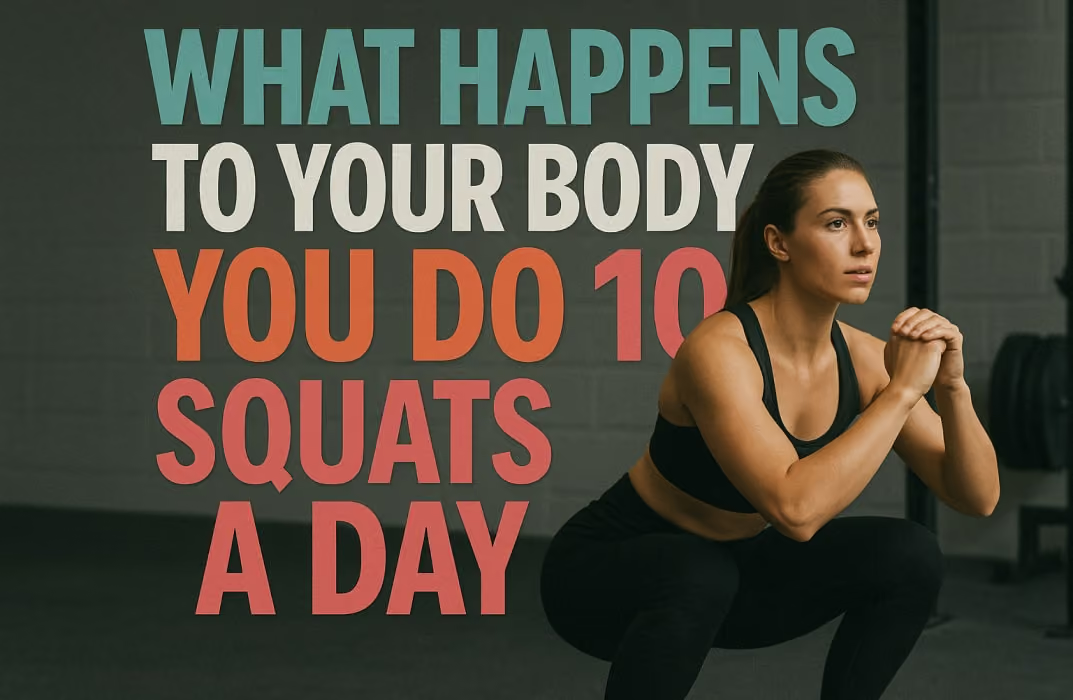
Can something as simple as 100 squats a day actually transform your body? The answer, backed by research, is a qualified yes but the results depend on where you're starting from, how you do them, and what else you're doing alongside them.
In one notable study on adolescent boys in Japan, participants who completed 100 bodyweight squats per day experienced a 4.2% decrease in body fat, a 3.2% increase in quadriceps muscle thickness, and a 16% increase in quad strength. They also saw improvements in vertical jump height.
Whether your goal is building stronger legs, burning extra calories, or just creating a consistent fitness habit, the 100 squats a day challenge has become one of the most popular bodyweight fitness challenges for good reason. In this guide, we break down exactly what happens to your body the good, the bad, and everything in between so you can decide if this challenge is right for you.
What Is the 100 Squats a Day Challenge?

The 100 squats a day challenge is straightforward: you perform 100 bodyweight squats every single day, typically for 30 consecutive days. There is no required equipment, no gym membership, and no strict rules about when or how you complete your daily reps just get to 100 within a 24-hour period.
How It Works
You can complete your 100 squats all at once or break them into smaller sets throughout the day. Popular approaches include:
- 5 sets of 20 squats spread across the day
- 10 sets of 10 squats at the top of every hour
- 4 sets of 25 squats in the morning and evening
- 2 sets of 50 squats if you have more endurance
The key is consistency. You do them every day for the full 30 days.
Who Is It For?
This challenge works best for beginners and intermediate exercisers who want to build a daily movement habit and improve lower-body strength. If you are already an experienced lifter who regularly squats heavy weights, bodyweight squats alone may not provide enough stimulus for noticeable gains though the endurance and habit-building benefits still apply.
8 Science-Backed Benefits of Doing 100 Squats a Day
1. Builds Lower-Body Muscle and Strength
Squats are one of the most effective compound exercises for your lower body. They target your quadriceps, glutes, hamstrings, and calves simultaneously, making them incredibly efficient for building muscle and strength.
Research shows that performing 100 bodyweight squats daily can increase quad muscle thickness by 3.2% and quad strength by up to 16% over a period of several weeks. The greatest gains tend to occur in untrained individuals, while experienced exercisers may see more modest improvements without adding external resistance.
2. Burns Calories and Supports Fat Loss
Squats are a compound movement that engages multiple large muscle groups, which makes them effective calorie burners. The number of calories you burn doing 100 squats depends on your body weight, pace, and intensity:
Note: Higher intensity variations (jump squats, weighted squats) can burn significantly more.
Over a full month, doing 100 squats daily adds up to roughly 1,000-2,000 extra calories burned. While that alone will not cause dramatic weight loss, combined with a calorie deficit and other activities, it contributes meaningfully to fat loss. Research from the Japanese study also showed a 4.2% decrease in body fat among participants.
3. Improves Blood Sugar and Metabolic Health
One of the lesser-known benefits of daily squats involves blood sugar regulation. A study found that performing 100 squats per day broken up into 10 squats every 45 minutes significantly improved participants' ability to control blood sugar levels.
This happens because building new muscle increases the body's capacity to absorb and use glucose from the bloodstream. For anyone concerned about metabolic health, insulin sensitivity, or managing blood sugar, this is a compelling reason to add daily squats to your routine.
4. Strengthens Your Core and Improves Posture
Squats are not just a leg exercise. To maintain proper form during a squat, your abdominal muscles, obliques, and lower back muscles must all engage to stabilize your spine. Over time, this builds significant core strength.
Stronger core muscles translate directly to better posture, which can reduce back pain, improve breathing, and even enhance digestion. If you spend long hours sitting at a desk, daily squats can help counteract the postural problems associated with a sedentary lifestyle.
5. Boosts Functional Fitness and Flexibility
We use squat-like movements every day sitting down, standing up, picking things up off the floor, climbing stairs. By performing 100 squats daily, you are strengthening the exact movement patterns your body relies on for everyday life.
Regular squatting also improves hip mobility and ankle flexibility over time, reducing stiffness and making it easier to move comfortably. Your joints, ligaments, and tendons all adapt and strengthen, reducing your risk of injury during daily activities.
6. Enhances Mental Health and Mood
Exercise releases endorphins the "feel-good" hormones that reduce stress, improve mood, and promote feelings of happiness. Committing to a daily 100-squat habit gives you a reliable mood boost and a sense of accomplishment each day.
Many challenge participants report that the mental benefits were just as valuable as the physical ones. The discipline of showing up daily, even on days when motivation is low, builds self-confidence and mental resilience that extends far beyond fitness.
7. Builds Discipline and Workout Consistency
As fitness expert Noah Tenenbaum, MS in Applied Physiology and Kinesiology, notes: "While not necessary for most active lifters, it can be a great way to help build the habit of exercise." The 30-day structure provides a clear, achievable goal that helps beginners establish a regular fitness routine.
The simplicity of the challenge no equipment, no gym, no complex programming removes the most common barriers to exercise. Once you have built the habit of daily movement, it becomes much easier to expand into more comprehensive training programs.
8. Requires Zero Equipment
You do not need a barbell, a squat rack, or a gym membership. All you need is your body, a small amount of floor space, and a few minutes of your day. This makes the 100 squat challenge one of the most accessible fitness challenges available, whether you are at home, in a hotel room, or at the office.
What Does the Research Say?
It is important to note that the Japanese study was conducted on adolescent boys, so results may vary for people of different ages, sexes, and fitness levels. However, the directional findings reduced body fat, increased muscle, improved strength are consistent across multiple studies on bodyweight resistance training.
100 Squats a Day: Before and After Results
Week 1-2: What to Expect
During the first two weeks, expect significant muscle soreness (especially in the first few days), improved muscular endurance, and a growing sense of routine. Your legs may feel fatigued, and you might find it difficult to complete all 100 in one session. This is completely normal.
By the end of week two, the soreness will subside significantly, and you will likely be able to perform more consecutive squats without resting.
Week 3-4: Visible Changes
This is when most people begin to notice visible changes. Your legs and glutes will appear more toned and defined. Your endurance will be notably improved many participants report being able to complete all 100 squats in a single session by this point.
You may also notice improvements in other physical activities, such as a lower heart rate during runs or increased ease climbing stairs.
Real Results from Real People
Here are documented results from people who completed the 30-day challenge:
- Brenda reported that her "chicken legs" looked more filled out with visible muscle definition. She gained 3/4 of an inch on her glute circumference and 1/2 inch on her left thigh.
- Shannon went from doing 25 squats per set to 60 consecutive squats by day 30. Her glutes appeared visibly "raised up more" and her legs also increased in size.
- In the popular Buzzfeed 30-day squat challenge, one female participant added almost an inch to her glute circumference, while a male participant reported being able to perform heavier weighted squats at the gym after the challenge.
- Another participant noted that their quads looked significantly more defined, and their resting heart rate during runs trended downward over the 30 days.
How Many Calories Do 100 Squats Burn?
The calorie burn from 100 squats varies depending on your body weight, pace, squat depth, and whether you add weight. On average:
- A moderate-paced bodyweight squat session of 100 reps takes about 10-15 minutes
- A person weighing 150 lbs burns approximately 35-45 calories from 100 standard bodyweight squats
- Adding jump squats or weighted squats can double or triple the calorie burn
- Over 30 days, 100 daily bodyweight squats burn an additional 1,050-1,950 calories total
While the direct calorie burn from squats is modest, the real metabolic benefit comes from building muscle mass. The more muscle you carry, the higher your resting metabolic rate meaning you burn more calories even when you are sleeping or sitting at your desk.
Muscles Worked During Squats
Primary Muscles
- Quadriceps (front of thigh): The main drivers of the upward push from the bottom of the squat
- Gluteus maximus (buttocks): Responsible for hip extension as you stand up
- Adductors (inner thigh): Stabilize the knees and assist with hip movement
Secondary Muscles
- Hamstrings (back of thigh): Assist with knee flexion and hip extension
- Core (abdominals and obliques): Stabilize your spine throughout the movement
- Erector spinae (lower back): Maintain an upright torso position
- Calves (gastrocnemius and soleus): Stabilize the ankle joint
- Hip flexors: Engage during the descent
Squats are a true compound movement, engaging muscles across your entire anterior chain and making them one of the most efficient bilateral exercises available.
Potential Risks and Downsides
While the benefits are compelling, there are legitimate risks to be aware of before starting a daily squat routine.
Overuse Injuries
Doing 100 squats every single day does not give your muscles, joints, and connective tissues adequate time to recover. Over time, this can lead to overuse injuries particularly in the knees, hips, and lower back. If you experience sharp pain, persistent soreness beyond normal muscle fatigue, or joint swelling, stop and consult a healthcare professional.
Training Plateaus
Bodyweight squats provide meaningful resistance for beginners, but research shows that muscle-building benefits plateau after approximately 4-8 weeks of consistent bodyweight training. At that point, your muscles have adapted to the stimulus, and 100 bodyweight squats no longer create enough mechanical tension to drive further growth.
To continue progressing, you will need to incorporate progressive overload adding weight (dumbbells, a barbell, or a weighted vest), increasing squat depth, or switching to more challenging squat variations.
Muscle Imbalances
Squats primarily target the front of your legs (quadriceps) and glutes. Without complementary exercises for the posterior chain such as deadlifts, hip thrusts, hamstring curls, and calf raises you risk developing muscle imbalances that can increase injury risk and affect movement quality. Understanding the stimulus to fatigue ratio of your training can help you balance volume and recovery.
How to Do 100 Squats a Day: Proper Form Guide
Proper form is critical to getting results and avoiding injury. Here is a step-by-step breakdown of the bodyweight squat.
Step-by-Step Squat Form
- Stand with feet shoulder-width apart, toes pointed slightly outward (15-30 degrees)
- Engage your core by bracing your abdominals as if someone were about to push you
- Initiate the movement by pushing your hips back and bending your knees simultaneously
- Lower your body until your thighs are at least parallel to the floor (or as deep as your mobility allows)
- Keep your chest up and your back flat throughout the movement avoid rounding forward
- Ensure your knees track over your toes (they can go past your toes that is a myth)
- Drive through your heels to stand back up, squeezing your glutes at the top
- Fully extend your hips and knees at the top before starting the next rep
Common Mistakes to Avoid
- Knees caving inward: Push your knees out in line with your toes
- Rising on your toes: Keep your weight in your heels and midfoot
- Rounding your lower back: Maintain a neutral spine by keeping your chest up
- Shallow depth: Aim for at least parallel (thighs level with the floor) for full muscle activation
- Rushing through reps: Control the descent (2-3 seconds down) for maximum benefit
30-Day Squat Challenge Schedule
If you are new to squats, jumping straight to 100 on day one is not recommended. Use this progressive schedule to build up safely:
Post-Challenge Progression: After completing the 30-day challenge, continue building strength by either increasing daily volume (150 squats), adding weight, or transitioning to a structured strength and conditioning program that includes progressive overload and complementary exercises.
5 Squat Variations to Keep It Interesting
Mixing in variations prevents boredom, targets muscles from different angles, and helps you avoid plateaus.
Sumo Squats
Stand with a wider-than-shoulder-width stance and toes turned out at about 45 degrees. This variation places more emphasis on the inner thighs (adductors) and glutes. Lower until your thighs are parallel to the floor, then drive back up.
Jump Squats
Perform a standard squat, then explode upward into a jump at the top. Land softly with bent knees and immediately lower into the next rep. Jump squats add a plyometric element that increases calorie burn and develops power. Start with 10-20 per session and gradually increase.
Goblet Squats
Hold a dumbbell or kettlebell at chest height while squatting. This front-loaded position encourages an upright torso and deeper squat depth while adding resistance. An excellent next step when bodyweight squats become too easy.
Pulse Squats
Lower into a squat and, instead of standing fully, pulse up and down within the bottom few inches of the movement. This keeps constant tension on the muscles and is a serious burn. Try replacing 10-20 of your daily reps with pulse squats.
Bulgarian Split Squats
Place one foot on a bench or chair behind you and squat on the front leg. This unilateral variation develops balance, addresses left-right strength imbalances, and is one of the most effective single-leg exercises available. It also introduces asymmetrical training principles that help build balanced strength across both sides of your body.
Tips for Getting the Best Results
Break It Into Sets
You do not have to do all 100 squats consecutively. Splitting them into smaller sets throughout the day is equally effective and far more sustainable, especially for beginners. Research suggests that spreading reps throughout the day (such as 10 squats every 45 minutes) may even provide superior metabolic benefits.
Add Progressive Overload
Once 100 bodyweight squats feel comfortable, your muscles need a greater challenge to continue adapting. Options include holding dumbbells or a weighted vest, slowing down your tempo (3-4 seconds per rep), adding squat variations, or increasing daily volume. Understanding the principle of supercompensation can help you time your training and recovery for maximum gains.
Pair with Proper Nutrition
Your results will be significantly better if you support your training with proper nutrition. Prioritize adequate protein intake (0.7-1g per pound of body weight) to support muscle repair and growth. If fat loss is your goal, maintain a modest calorie deficit. Stay hydrated, and consider increasing your carbohydrate intake slightly on training days for energy.
Include Rest and Recovery
While the challenge calls for daily squats, listen to your body. If you experience joint pain, extreme fatigue, or persistent soreness, take a rest day. You can also incorporate active recovery methods such as stretching, foam rolling, or light walking on particularly sore days. Even doing 100 squats three days per week has been shown to produce increases in strength and muscle size.
The Bottom Line
Doing 100 squats a day is a simple, accessible, and research-backed challenge that can deliver real results especially for beginners. You can expect improvements in lower-body strength, muscle definition, endurance, posture, and even mental well-being. The research shows meaningful decreases in body fat and increases in muscle size and strength.
However, it is not a magic bullet. For sustained long-term progress, you will eventually need to add progressive overload, incorporate complementary exercises to prevent muscle imbalances, and support your training with proper nutrition and recovery.
If you are looking for a starting point to build a consistent fitness habit, the 100 squats a day challenge is one of the best places to begin. And when you are ready to take your training further, explore our online workout programs and structured leg workout schedules to keep progressing toward your goals.
%20to%20Become%20a%20Certified%20Personal%20Trainer-min.avif)