


10 min read
Bilateral exercises train both limbs at the same time through the same movement (squat, bench press, deadlift, overhead press, row). They allow the heaviest loading and build the most absolute strength, which is why they form the foundation of most strength programs
If you have ever performed a squat, bench press, or deadlift, you have done a bilateral exercise. These foundational movements, where both sides of your body work together simultaneously, form the backbone of nearly every serious strength training program.
But bilateral exercises are more than just "the basics." Research shows they are the most effective way to develop absolute strength, produce maximum force, and load your muscles with the highest possible resistance. A 2023 meta-analysis published in Frontiers in Physiology confirmed that bilateral exercises allow significantly greater total loading compared to unilateral alternatives, making them essential for anyone pursuing strength, muscle growth, or athletic performance.
In this guide, you will learn exactly what bilateral exercises are, how they differ from unilateral exercises, 15 of the best bilateral exercises with proper form cues, and a complete workout program you can start using today.
What are Bilateral Exercises?
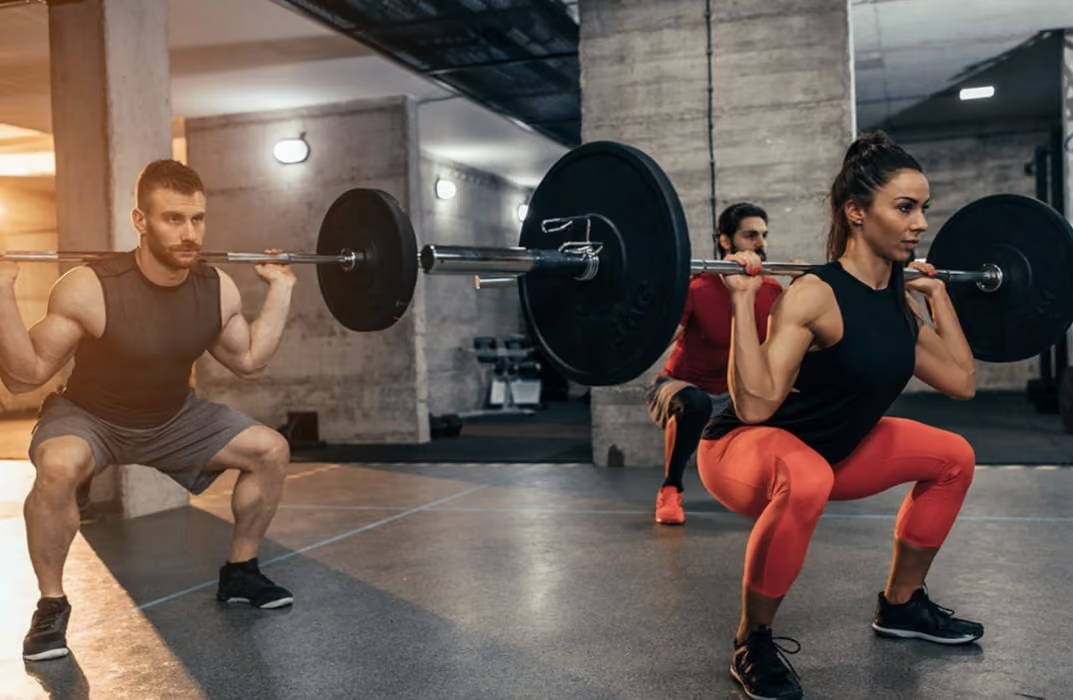
A bilateral exercise is any movement where both limbs, or both sides of the body, work together at the same time to perform the same movement pattern. Squats, bench presses, deadlifts, overhead presses, and barbell rows are all bilateral exercises.
In training terminology, "bilateral" comes from the Latin "bi" meaning two and "latus" meaning side, so a bilateral movement is one performed on two sides at once. The opposite is a unilateral exercise, where one limb works at a time.
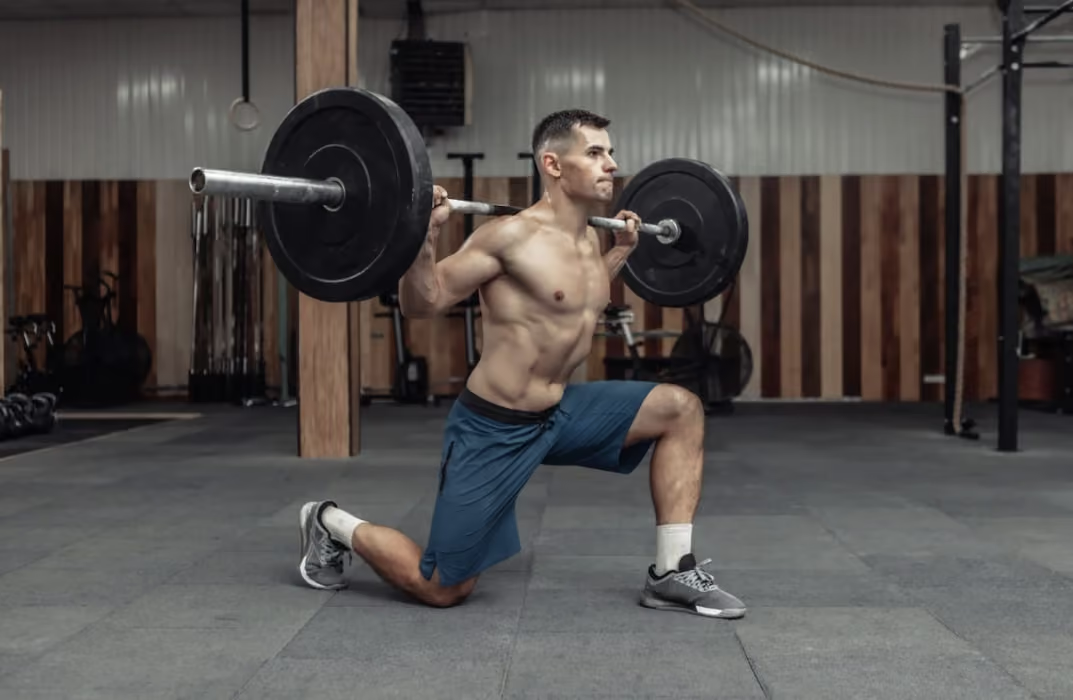
During a bilateral exercise, both limbs share the load and work in symmetry. For example, in a barbell back squat, both legs bend, extend, and produce force at the same time. In a bench press, both arms push the barbell upward together.
Examples of bilateral exercises include squats, deadlifts, bench presses, overhead presses, barbell rows, pull-ups, hip thrusts, and leg presses. These movements are the primary drivers of strength and muscle development in most training programs because they allow you to lift the heaviest loads and recruit the most muscle mass.
Bilateral exercises contrast with unilateral exercises, where only one limb works at a time (such as a single-leg squat, a one-arm dumbbell row, or a lunge).
Bilateral vs Unilateral Exercises: Key Differences
Understanding the differences between bilateral and unilateral exercises helps you decide when and how to use each type in your training. Here is a side-by-side comparison:
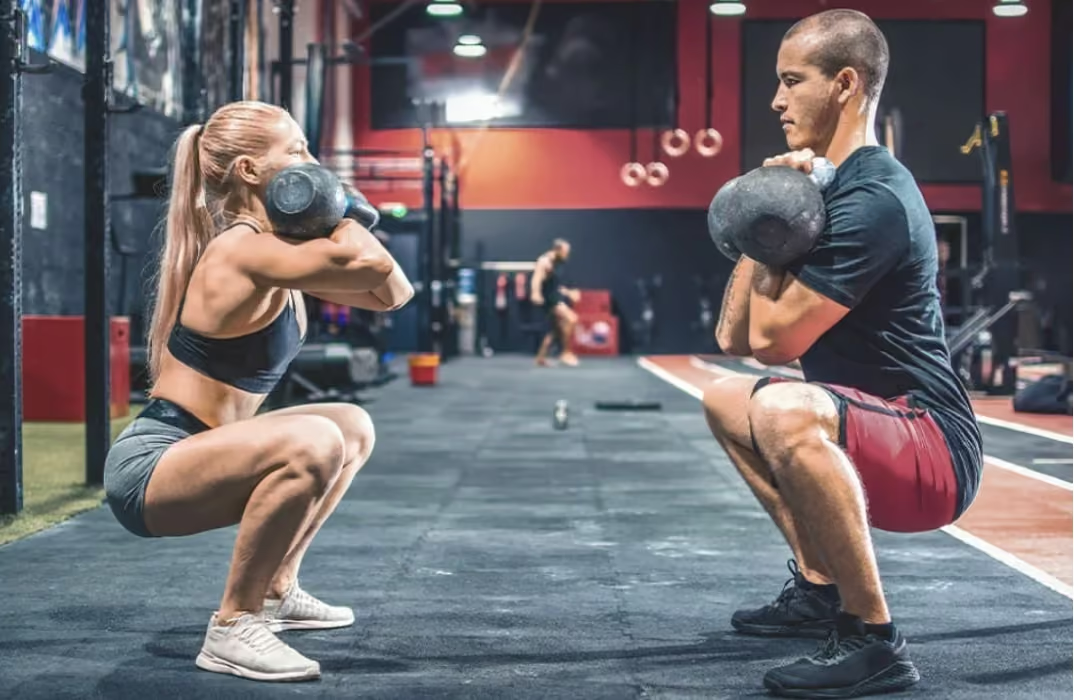
Research from a 2023 meta-analysis found no significant difference between bilateral and unilateral resistance training for overall physical performance measures. However, bilateral training showed a clear advantage for developing absolute strength, while unilateral training produced better unilateral jump performance. The takeaway is that both types should be included in a well-rounded training program.
7 Key Benefits of Bilateral Exercises
-min.avif)
1. Develop Greater Bilateral and Absolute Strength
Bilateral strength is the maximum force you can produce with both limbs working together, and bilateral exercises are the most effective way to build it. When both limbs work together, they produce significantly more total force than one limb working alone, which is what allows you to load heavier and develop absolute strength.
2. Allow Heavier Loading
Because both limbs share the resistance and your base of support is wider, bilateral exercises allow you to lift more total weight than any unilateral alternative. You can squat significantly more than you can single-leg press, and you can bench press far more than you can single-arm dumbbell press.
This matters because progressive overload (gradually increasing the load over time) is the foundation of long-term strength and muscle growth. Bilateral exercises make it easier to load progressively in small, measurable increments.
3. Build Motor Control and Movement Patterns
Bilateral exercises are excellent for developing fundamental movement patterns like the squat, hinge, push, and pull. Because both sides move symmetrically, there is less balance demand, which allows you to focus on learning proper movement mechanics without the added complexity of single-limb stability.
This makes bilateral exercises particularly valuable for beginners who are still developing their movement competency. Mastering a bilateral squat before progressing to lunges or pistol squats builds a solid foundation of motor control.
4. More Time-Efficient
Training both limbs simultaneously means you complete each exercise in half the time compared to training each side individually. A set of barbell squats works both legs at once, while a set of Bulgarian split squats requires you to perform a full set on each leg separately.
For lifters with limited training time, a program built primarily around bilateral exercises delivers maximum training stimulus in the shortest possible time.
5. Greater Stability and Balance Under Load
The symmetrical loading pattern of bilateral exercises distributes weight evenly across both sides of the body. This creates a wider, more stable base of support, which allows you to maintain balance even under very heavy loads.
This stability advantage is why bilateral exercises are safer for beginners and why they allow advanced lifters to push closer to their true strength limits without balance being the limiting factor.
6. Higher Hormonal Response
Research shows that compound bilateral exercises (especially squats and deadlifts) produce a greater acute hormonal response, including increases in testosterone and growth hormone, compared to smaller isolation or unilateral movements. This is largely because bilateral compound movements recruit more total muscle mass and create greater systemic stress on the body.
While the long-term significance of acute hormonal fluctuations is debated in the scientific community, the greater total muscle recruitment from bilateral exercises is an undeniable advantage for overall muscle and strength development.
7. Easier to Learn for Beginners
Bilateral exercises have a lower balance and coordination demand compared to unilateral exercises, making them more accessible for new lifters. A person learning to squat with both feet on the ground faces a much gentler learning curve than someone attempting a pistol squat or a walking lunge with dumbbells.
Starting with bilateral movements allows beginners to build strength, confidence, and movement quality before introducing more complex unilateral variations.
What Is the Bilateral Deficit?
The bilateral deficit is a well-documented phenomenon in exercise science where the total force produced by both limbs working together during a bilateral exercise is less than the sum of force each limb can produce independently during unilateral exercises.
For example, if your right leg can produce 100 units of force in a single-leg press and your left leg can also produce 100 units, you might expect to produce 200 units during a bilateral leg press. However, research consistently shows that the actual bilateral output is typically 5-25% lower than the combined unilateral total, meaning you might only produce 160-190 units in the bilateral version.
Why does this happen? The bilateral deficit is believed to result from neural inhibition. When both limbs contract simultaneously, the nervous system slightly reduces the activation to each individual limb, possibly as a protective mechanism or due to interhemispheric communication limitations in the brain.
What does this mean for your training? The bilateral deficit does not mean bilateral exercises are inferior. The total load you can handle bilaterally is still significantly higher than what you can handle unilaterally, even if the per-limb force is slightly reduced. However, it does highlight the value of including unilateral training in your program to maximize each limb's individual force production capacity.
Bilateral facilitation is the opposite of the bilateral deficit: it occurs when the force produced by both limbs working together is greater than the sum of what each limb can produce alone. Instead of losing output when both sides fire at once, the athlete gains it.
Research shows this effect in athletes whose sport is built around simultaneous two-limb action, such as weightlifters, powerlifters, rowers, and cyclists. Years of training the nervous system to fire both limbs together appears to remove the neural inhibition that causes the deficit in untrained lifters, and in some cases reverses it entirely.
Bilateral deficit vs bilateral facilitation at a glance:
What this means for your training. If your bilateral numbers lag behind your single-limb numbers, that is normal and it is not a reason to abandon bilateral lifts. Consistent practice of the squat, deadlift, and press pattern shifts you toward facilitation over time. The effect is specific to the movements you train, so bilateral facilitation in the squat does not automatically transfer to the bench press.
15 Best Bilateral Exercises (With Form Cues)
Bilateral Lower Body Exercises
1. Barbell Back Squat Primary muscles: Quadriceps, glutes, adductors | Secondary: Hamstrings, core, erector spinae
The back squat is widely considered the king of all bilateral exercises. It loads the entire lower body and core through a full range of motion under heavy resistance.
How to perform it:
- Position a barbell across your upper traps (high bar) or rear deltoids (low bar)
- Stand with feet shoulder-width apart, toes slightly turned out
- Brace your core, push your hips back, and bend your knees simultaneously
- Descend until your thighs are at least parallel to the floor
- Drive through your full foot to stand back up, keeping your chest tall throughout
The barbell back squat engages the anterior chain muscles heavily, making it one of the most efficient compound movements available.
2. Front Squat Primary muscles: Quadriceps, glutes | Secondary: Core, upper back, adductors
The front squat shifts the load to the front of the body, which increases quadriceps emphasis and demands more upper back and core engagement to maintain an upright torso.
How to perform it:
- Rest the barbell across the front of your shoulders in a clean grip or cross-arm grip
- Keep your elbows high and chest tall throughout the movement
- Squat to full depth, maintaining an upright torso
- Drive up through your heels
3. Conventional Deadlift Primary muscles: Glutes, hamstrings, erector spinae | Secondary: Quadriceps, traps, forearms, core
The deadlift is the ultimate test of total-body strength. It recruits more total muscle mass than almost any other exercise, making it exceptionally effective for building posterior chain strength and overall size.
How to perform it:
- Stand with feet hip-width apart, shins touching the barbell
- Hinge at the hips and grip the bar just outside your knees
- Brace your core, flatten your back, and push through the floor
- Stand fully upright, locking your hips and knees at the top
- Lower the bar under control by hinging at the hips first
4. Romanian Deadlift (RDL) Primary muscles: Hamstrings, glutes | Secondary: Erector spinae, core, adductors
The Romanian deadlift focuses on the hip hinge pattern with minimal knee bend, which places maximum stretch and tension on the hamstrings and glutes. It is one of the best exercises for developing posterior chain strength and flexibility.
How to perform it:
- Hold a barbell at hip height with a shoulder-width grip
- With knees slightly bent (and locked in position), hinge forward at the hips
- Lower the barbell along your legs until you feel a deep stretch in your hamstrings
- Squeeze your glutes to drive your hips forward and return to the starting position
- Keep the bar close to your body throughout the movement
5. Leg Press Primary muscles: Quadriceps, glutes | Secondary: Hamstrings, adductors
The leg press allows heavy bilateral loading with back support, making it an excellent choice for building leg strength and size without the spinal loading demands of squats.
How to perform it:
- Sit in the leg press machine with your back flat against the pad
- Place feet shoulder-width apart on the platform
- Lower the platform by bending your knees toward your chest
- Press through your full foot to extend your legs without locking your knees
6. Barbell Hip Thrust Primary muscles: Glutes | Secondary: Hamstrings, core, adductors
The hip thrust is the most effective bilateral exercise for isolating and maximizing glute activation. It allows heavy loading through the full range of hip extension.
How to perform it:
- Sit on the floor with your upper back against a bench and a barbell across your hips
- Plant your feet flat on the floor, about shoulder-width apart
- Drive through your heels to lift your hips until they are fully extended
- Squeeze your glutes hard at the top and hold for one second
- Lower under control
7. Standing Calf Raise Primary muscles: Gastrocnemius, soleus
The bilateral standing calf raise develops the lower leg muscles that contribute to ankle stability, jumping power, and running performance.
How to perform it:
- Stand on a raised surface (step or calf raise machine) with the balls of your feet on the edge
- Rise up onto your toes by contracting your calves
- Lower slowly until you feel a full stretch in the calves
- Use a controlled tempo (2 seconds up, 3 seconds down)
Bilateral Upper Body Exercises
8. Barbell Bench Press Primary muscles: Pectorals, anterior deltoids, triceps | Secondary: Core, serratus anterior
The bench press is the most popular bilateral upper body exercise and the standard measure of pushing strength. It allows the heaviest loading of any chest exercise.
How to perform it:
- Lie flat on a bench with feet planted on the floor
- Grip the bar slightly wider than shoulder width
- Unrack the bar and lower it to your mid-chest with control
- Press the bar back up to full arm extension
- Keep your shoulder blades retracted and squeezed together throughout
9. Overhead Press (Standing) Primary muscles: Anterior and lateral deltoids, triceps | Secondary: Core, upper traps, serratus anterior
The standing overhead press builds shoulder and upper body pressing strength while demanding significant core stability. It is a true test of full-body pressing power.
How to perform it:
- Stand with feet shoulder-width apart, bar at collarbone height
- Brace your core and glutes
- Press the bar straight overhead, moving your head slightly back as the bar passes your face
- Lock out with arms fully extended and the bar directly over your midfoot
- Lower under control to the starting position
For more shoulder-specific pressing variations, see our guide to the best dumbbell shoulder exercises.
10. Bent-Over Barbell Row Primary muscles: Lats, rhomboids, middle traps | Secondary: Rear deltoids, biceps, erector spinae, core
The barbell row is the primary bilateral pulling exercise for the upper back. It builds thickness across the entire back and improves pulling strength for deadlifts.
How to perform it:
- Hinge forward at the hips with a slight knee bend until your torso is roughly 45-60 degrees from the floor
- Grip the bar shoulder-width apart
- Pull the bar to your lower ribcage, driving your elbows behind your body
- Squeeze your shoulder blades together at the top
- Lower under control
11. Pull-Up / Lat Pulldown Primary muscles: Lats, biceps | Secondary: Rhomboids, middle traps, rear deltoids, forearms
Pull-ups are the gold standard bilateral bodyweight exercise for the upper back and lats. For those who cannot yet perform pull-ups, the lat pulldown machine provides the same movement pattern with adjustable resistance.
How to perform it (Pull-Up):
- Grip the bar with hands slightly wider than shoulder width, palms facing away
- Hang with arms fully extended
- Pull yourself up until your chin clears the bar, driving your elbows down and back
- Lower under control to a full hang
12. Dumbbell Shoulder Press (Seated) Primary muscles: Anterior and lateral deltoids, triceps | Secondary: Upper traps, core
While dumbbells introduce some independent limb movement, the seated dumbbell press is still a bilateral exercise because both arms perform the same movement simultaneously. The dumbbells allow a greater range of motion than a barbell and are more shoulder-joint friendly.
How to perform it:
- Sit on a bench set to 80-85 degrees
- Hold dumbbells at shoulder height with palms facing forward
- Press both dumbbells overhead until arms are fully extended
- Lower under control to ear level
13. Barbell Curl Primary muscles: Biceps brachii, brachialis | Secondary: Brachioradialis, forearms
The barbell curl is the classic bilateral arm exercise. Using a barbell allows both arms to work together to curl heavier weight than dumbbell alternatives.
How to perform it:
- Stand with feet hip-width apart, holding a barbell with an underhand grip at arm's length
- Curl the bar upward by flexing your elbows, keeping your upper arms stationary
- Squeeze your biceps at the top
- Lower under control
Bilateral Core Exercises
14. Plank Primary muscles: Rectus abdominis, transverse abdominis | Secondary: Obliques, erector spinae, shoulders, glutes
The plank is a bilateral isometric exercise that builds core endurance and stability. Both sides of the body work equally to maintain a rigid, neutral spine position.
How to perform it:
- Place forearms on the floor with elbows directly under shoulders
- Extend your legs behind you, supporting your weight on your toes
- Maintain a straight line from head to heels
- Brace your core and squeeze your glutes
- Hold for time (30-60 seconds for beginners, 60-120 seconds for intermediate)
15. Hanging Leg Raise Primary muscles: Rectus abdominis, hip flexors | Secondary: Obliques, forearms
The hanging leg raise is one of the most challenging bilateral core exercises. Both legs work together to raise against gravity while your upper body stabilizes.
How to perform it:
- Hang from a pull-up bar with a shoulder-width grip
- With legs together, raise them until they are parallel to the floor (or higher for advanced)
- Lower under control without swinging
- Avoid using momentum; keep the movement controlled and deliberate
When to Use Bilateral Exercises in Your Training
For Building a Strength Foundation
If you are a beginner or early intermediate lifter, bilateral exercises should make up the majority of your training program (70-80% of your exercise selection). The squat, bench press, deadlift, overhead press, and row provide a complete foundation of movement patterns and strength that more advanced exercises can later build upon.
For Maximum Muscle Growth
Bilateral compound exercises are the most effective way to achieve progressive overload, which is the primary driver of long-term muscle growth (hypertrophy). A 2024 systematic review found no significant difference in muscle growth between bilateral and unilateral exercises when volume was equated, but bilateral exercises are more time-efficient for accumulating that volume.
For hypertrophy-focused programs, build your training around bilateral compounds and supplement with unilateral isolation exercises to address weak points. Understanding the stimulus to fatigue ratio of each exercise helps you select the most efficient movements for growth.
For Athletic Performance
Athletes benefit from both bilateral and unilateral exercises. Bilateral exercises build the raw strength foundation that supports power, speed, and force production, while unilateral training develops the single-leg stability and anti-rotation strength needed for most sports.
A well-rounded athletic program uses bilateral exercises as primary movements and adds unilateral and asymmetrical training exercises as accessories to develop sport-specific qualities.
Sample Bilateral Workout Program
Here is a simple 3-day bilateral-focused full-body program. Each session targets all major movement patterns using bilateral exercises.
Allow at least 48 hours between sessions to take advantage of supercompensation, the body's process of recovering and adapting to become stronger than before.
Common Bilateral Exercise Mistakes to Avoid
Compensating with your dominant side. One of the biggest drawbacks of bilateral exercises is that your stronger side can compensate for your weaker side without you noticing. Over time, this creates muscle imbalances. Pay attention to whether one side is working harder than the other, and periodically include unilateral exercises to identify and correct imbalances.
Neglecting unilateral work entirely. While bilateral exercises should form the core of most strength programs, a program with zero unilateral work can lead to hidden strength imbalances, reduced joint stability, and decreased performance in sports that require single-limb actions. Include at least 2-3 unilateral exercises per week as accessories.
Using too much weight at the expense of form. Because bilateral exercises allow heavier loading, lifters often push the weight beyond what they can control with proper form. This is especially dangerous on exercises like the squat and deadlift where spinal loading is high. Master the movement pattern with moderate weights before chasing heavy numbers.
Ignoring full range of motion. Loading heavy on bilateral exercises tempts many lifters to cut depth on squats, bounce reps off the chest on bench press, or shorten the pull on deadlifts. Full range of motion recruits more muscle fibers and builds strength through the complete movement arc. Never sacrifice range of motion for more weight.
Skipping the warm-up. Bilateral compound exercises like squats and deadlifts place significant stress on muscles, joints, and connective tissues. Always perform 2-3 warm-up sets with progressively increasing weight before your working sets to prepare the joints and activate the target muscles.
The Bottom Line
Bilateral exercises are the foundation of effective strength training. They allow you to lift the heaviest loads, build the most absolute strength, develop fundamental movement patterns, and train with maximum time efficiency. Movements like the squat, bench press, deadlift, and overhead press have earned their place as the cornerstones of resistance training for good reason.
For most lifters, bilateral exercises should make up 60-80% of their total training volume, supplemented with unilateral and isolation exercises to address specific weak points and muscle imbalances. The sample workout program above gives you a complete, ready-to-use framework for building strength with bilateral movements.
Whether you are a beginner building your first strength foundation or an advanced lifter chasing new PRs, bilateral exercises will remain the most important tools in your training arsenal. For a complete training framework that incorporates both bilateral and unilateral work, explore our guide to strength and conditioning principles.
%20to%20Become%20a%20Certified%20Personal%20Trainer-min.avif)