



10 min read
Most athletic movements are not symmetrical. A basketball player jumping off one foot to lay the ball in. A soccer player planting one leg to change direction at full sprint. A tennis player is loading one shoulder to generate racket speed. A running back absorbing contact from an angle that no training drill perfectly replicates.
Yet the majority of traditional strength-training programs are built around bilateral exercises, in which both sides of the body work simultaneously and equally. Barbell squats, bench presses, deadlifts. These movements are genuinely valuable and should remain core components of any serious program.
But if your programming stops there, you are leaving significant performance gains on the table and exposing your athletes to preventable injury risk.
Asymmetrical training fills that gap. It mirrors the unpredictable, uneven demands of sport in a controlled environment, building the kind of strength, stability, and coordination that carries over to game situations where the barbell never follows you.
This guide covers everything coaches and trainers need to know: a precise definition of asymmetrical training, the research-backed benefits, the best exercises by category, common programming mistakes, and how to integrate it properly into an athlete's existing training block.
What Is Asymmetrical Training? A Clear Definition
Asymmetrical training refers to any exercise approach in which one side of the body bears more load, works in a different position, or moves independently from the other side. This uneven demand forces the body to stabilize, coordinate, and produce force under conditions that better replicate real athletic movement.
There are three primary ways asymmetry is introduced in training:
- Unilateral loading involves performing an exercise with one limb while the other remains still or lightly engaged. Examples include single-leg Romanian deadlifts, single-arm dumbbell rows, and pistol squats. One side bears all the work and must also maintain stability.
- Uneven bilateral loading involves both sides of the body working simultaneously but with different levels of resistance. Holding a heavy kettlebell in one hand during a carry, or performing a deadlift with an asymmetric grip, falls into this category. The stance is bilateral, but the loading is not.
- Split-stance or staggered positioning involves placing one foot in front of the other, or at a different height, without full unilateral isolation. Examples include Bulgarian split squats, lunges, and staggered-stance press variations. Both legs contribute, but in fundamentally different ways.
Understanding the distinction among these three forms is important for programming. Each creates different demands and serves different performance goals, which is why a well-designed asymmetrical training block uses all three rather than defaulting to a single type.
For a complete understanding of how asymmetrical training compares to its counterpart, the FitBudd guide to bilateral exercises provides a thorough breakdown of when and why bilateral loading remains essential.
Why Asymmetrical Training Matters for Athletes
Sport is asymmetrical by design. Most athletes spend years developing dominant-side strength and skill without deliberately building the non-dominant side to match. This creates compensatory patterns that reduce efficiency, limit power output, and significantly raise injury risk over time.
The case for asymmetrical training is not that it replaces bilateral work. It is that bilateral work alone does not prepare athletes for the full range of demands they face. Asymmetrical training addresses the gaps.
7 Science-Backed Benefits of Asymmetrical Training
1. Corrects Inter-Limb Strength Imbalances
Bilateral exercises allow the dominant side to compensate for the weaker side without either the athlete or the coach noticing. The barbell moves, the reps get done, and the imbalance grows silently. A 2022 study in the Journal of Sports Science found that athletes who incorporated unilateral work twice per week reduced inter-limb strength gaps by over 25% in 12 weeks compared to those who trained exclusively bilaterally.
Asymmetrical training forces each side to produce its own force without support. Weaknesses become visible immediately and can be addressed directly. This is one of the most important injury-prevention strategies in athletic programming.
2. Builds Deep Core Stability and Anti-Rotation Strength
Every asymmetrical exercise challenges the core in a fundamentally different way than bilateral movement. When the load is uneven, the spine must resist lateral flexion and rotation rather than simply brace against axial compression. This builds anti-rotation and anti-lateral-flexion strength that protects the spine and directly transfers to athletic performance.
Sprinting, changing direction, throwing, and absorbing contact all require the core to resist rotation under high velocity. Single-arm carries, offset loaded lunges, and suitcase deadlifts train exactly this capacity in a way that a barbell squat cannot replicate.
See the FitBudd guide to strength and conditioning principles for how this fits within a broader performance framework.
3. Improves Balance and Proprioception
Balance is not just a physical quality. It is a neuromuscular skill that requires the central nervous system to process feedback from the muscles, joints, and vestibular system simultaneously. Asymmetrical training, particularly single-leg work, places a higher demand on proprioception than any bilateral exercise.
The body is forced to recruit stabilizing musculature around the ankle, knee, and hip that remains relatively underutilized during traditional bilateral lifts. Over time, this builds the dynamic balance that allows athletes to control their body position under fatigue, during contact, or when forced into unfamiliar positions.
4. Enhances Single-Leg Power and Force Production
Most athletic explosive actions originate from one leg. The push-off in a sprint. The plant and cut on a change of direction. The takeoff in a jump. Bilateral strength training builds raw force capacity, but it does not specifically develop the single-leg explosive power that determines performance in these moments.
Exercises like single-leg box jumps, Bulgarian split squat jumps, and lateral bounding develop the stretch-shortening cycle and rate of force development in each leg independently.
Athletes who train this quality consistently produce more force through one leg, which directly translates to faster acceleration and more powerful direction changes on the field or court.
5. Reduces Injury Risk by Addressing Movement Compensation
Strength imbalances are one of the leading contributors to non-contact injuries in sport. When one limb is significantly stronger than the other, the body compensates during high-speed or high-load movements by shifting the demand away from the weaker side. This creates predictable overuse patterns and acute injury risk at the joints and tissues that absorb the extra demand.
Asymmetrical training identifies and directly targets these weaknesses before they become injuries. It also develops the stabilizing musculature around the hip, knee, and ankle that acts as the first line of defense against ligament stress during cutting and landing movements.
6. Mimics Real Sport Demands More Directly
Running is asymmetrical. Tackling is asymmetrical. Cutting is asymmetrical. Handling contact while maintaining body position is asymmetrical. The training environment should prepare athletes for these realities, not just for clean bilateral lifts in controlled conditions.
Asymmetrical training, when properly programmed, exposes athletes to controlled instability and uneven loading that closely mirrors the forces they encounter during competition. The body learns to organize itself under less-than-ideal conditions, which is precisely what sport demands.
7. Allows Effective Training at Lower Overall Loads
One underappreciated benefit of asymmetrical training is the training stimulus it delivers without requiring maximal loads. Because stability demands are higher, lighter weights feel significantly more challenging. This allows athletes to build strength and coordination with less joint and nervous system stress, which is particularly valuable during high competition-volume periods, deload phases, or return-to-play progressions.
Asymmetrical Training vs. Unilateral Training: What Is the Difference?
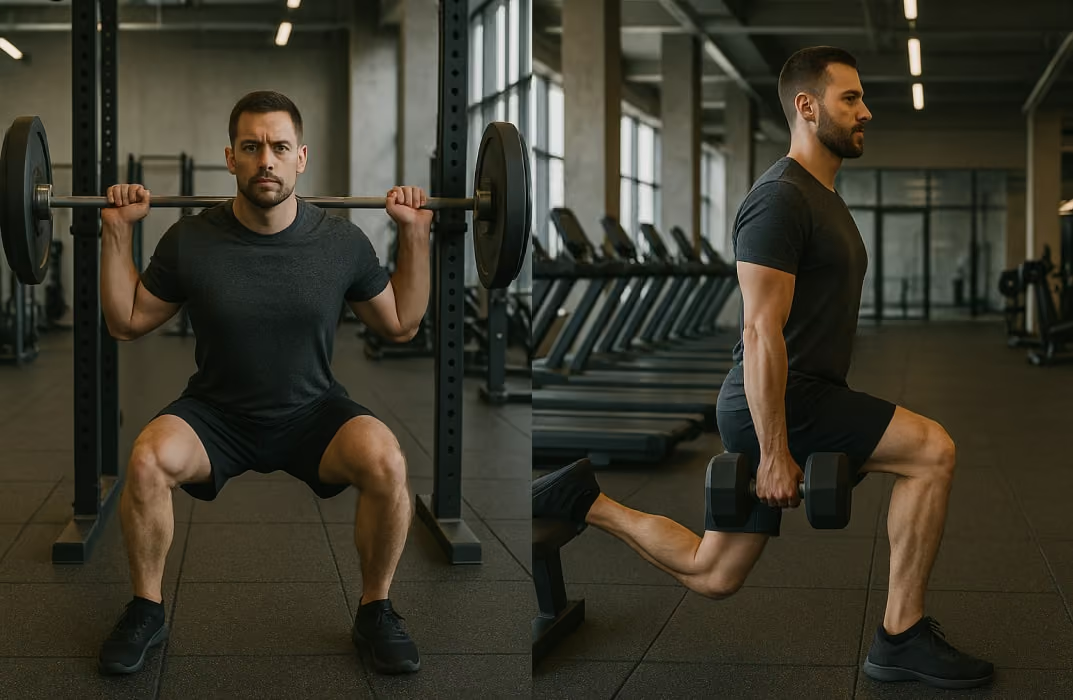
These two terms are often used interchangeably, but they are not identical. Understanding the distinction helps coaches program more intentionally.
Unilateral training specifically refers to exercises performed with one limb at a time, with the opposite limb either resting or providing minimal support. Single-leg deadlifts, single-arm presses, and pistol squats are purely unilateral.
Asymmetrical training is the broader category. It includes unilateral exercises as well as those in which both limbs are involved, but the loading or positioning is uneven. A suitcase carrier uses both legs to walk but loads only one side of the upper body.
A Bulgarian split squat uses both legs but in a fundamentally asymmetrical position. These are asymmetrical but not strictly unilateral.
In practical programming, both approaches serve the same overarching goal: training the body to produce and manage force under uneven, sport-realistic conditions.
The Best Asymmetrical Training Exercises by Category
Lower Body: Single-Leg Strength and Power
Bulgarian Split Squat: The gold standard of asymmetrical lower body training. The rear foot is elevated on a bench, placing most of the load on the front leg. This builds quad strength, hip flexor flexibility, and single-leg stability simultaneously. Program with dumbbells, a barbell, or a safety bar. Start with 3 sets of 8-10 reps per side.
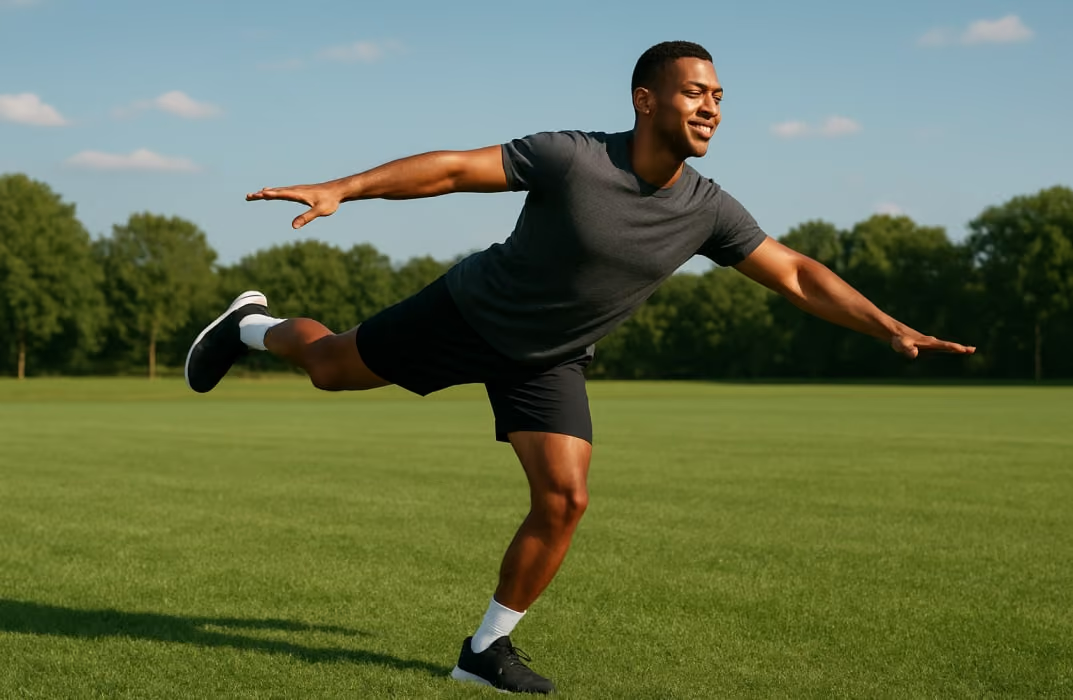
Single-Leg Romanian Deadlift: One of the most effective exercises for developing single-leg posterior chain strength and hip stability. The athlete hinges forward on one leg while the other extends behind for balance. The demand on the glute and hamstring of the working leg is substantial, and the balance challenge recruits the stabilizing musculature around the knee and ankle. Use a dumbbell or kettlebell. Program with 3 sets of 8 reps per side, prioritizing control over load.
Lateral Lunge The lateral lunge trains the frontal plane of movement, which is heavily involved in defensive change-of-direction and lateral cutting. One leg steps wide while the other remains straight, loading the inner thigh, glute medius, and quad of the working leg. Add a kettlebell for progressive loading.
Single-Leg Box Jump: Develops explosive single-leg power and the rate of force development needed for sprinting, jumping, and cutting. Start from a controlled standing position, drive through one leg, and land softly on the box with both feet. Progress by increasing box height and reducing ground contact time.
Step-Up with Knee Drive: A functional single-leg exercise that builds the hip extension strength required for acceleration and stair-climbing. Step onto a stable platform, drive through the heel, and bring the opposite knee up to hip height at the top. Use dumbbells for additional load.
Upper Body: Single-Arm Strength and Shoulder Stability
Single-Arm Dumbbell Row: One of the clearest ways to identify and address strength asymmetry in the upper back. Performed bent over with one hand on a bench, the working arm pulls the dumbbell to the hip. Any strength difference between sides is immediately obvious. Focus on full scapular retraction and avoiding trunk rotation.
Single-Arm Overhead Press: Standing single-arm overhead pressing challenges not just the shoulder but the entire lateral chain and core. The trunk must resist lateral flexion to keep the spine aligned while pressing overhead. Dumbbell and kettlebell variations both work well. Use a shoulder-width stance initially, then progress to a split stance for added instability.
Alternating Dumbbell Bench Press: A hybrid approach where both arms work but alternate rather than pressing simultaneously. While one arm presses, the other holds the weight in a neutral position. This creates a rotational anti-stability challenge through the chest and shoulder while maintaining bilateral positioning.
Renegade Row: Combines a push-up position with single-arm rowing. The plank position demands full-body anti-rotation stability while the rowing arm works. One of the most complete upper-body asymmetrical exercises available and an excellent finisher for upper-body sessions.
Core: Anti-Rotation and Lateral Stability
Suitcase Carry: The simplest and most underrated asymmetrical core exercise. Hold a heavy dumbbell or kettlebell in one hand and walk for a set distance or time while keeping the trunk perfectly upright. The lateral flexion force created by the single-sided load demands constant engagement of the lateral core and quadratus lumborum on the opposite side. Progress by increasing load or distance.
Single-Arm Pallof Press: A cable anti-rotation exercise performed from a standing or half-kneeling position. The cable pulls the arms laterally while the athlete resists the rotation and presses straight out from the chest. Effective at isolating the obliques and transverse abdominis without loading the spine.
Offset Loaded Plank: A standard plank with one arm elevated on a plate or small riser, or with a weight plate balanced on one forearm. The uneven positioning creates a rotational challenge that the core must resist throughout the hold. Simpler to set up than equipment-based anti-rotation work and highly effective.
Windmill: A kettlebell exercise where one arm presses overhead while the opposite hand reaches toward the floor, requiring a full lateral hip hinge. Demands shoulder stability, hip flexibility, and core strength simultaneously. Particularly useful for overhead sport athletes such as throwers and swimmers.
Loaded Carries and Sport-Specific Patterns
Farmer Carry (Unilateral Variation): One kettlebell or dumbbell held in one hand, arms by the side, walking for distance or time. Builds grip strength, shoulder stability, and the lateral core in a highly transferable pattern. Keep the shoulder packed and resist any lateral trunk lean toward the loaded side.
Single-Arm Overhead Carry: The load is pressed overhead on one side while the other arm remains free. The overhead position demands rotator cuff stability and significantly increases core demand compared to a standard carry. Walk slowly with a controlled pace and focus on keeping the ribcage from flaring.
Rotational Medicine Ball Slam: Load the body asymmetrically through rotation. Standing with feet shoulder-width apart, rotate with the hips and slam the medicine ball to the floor at an angle, simulating the rotational pattern of throwing, swinging, and hitting. Alternate sides of each set. Particularly relevant for athletes in racket and throwing sports.
How to Program Asymmetrical Training Correctly
Asymmetrical training complements bilateral training, not replaces it. The most common programming mistake coaches make is swinging too far in one direction, eliminating heavy bilateral work in favor of exclusively unilateral exercises, or ignoring asymmetrical work entirely because bilateral lifts feel more productive.
The goal is integration, not substitution.
Start with assessment: Before prescribing asymmetrical exercises, evaluate each athlete's current inter-limb strength balance. A single-leg squat test, a single-leg balance test (eyes open and eyes closed), and a comparison of dominant vs. non-dominant leg single-leg press output will reveal the gaps. Formal personal training assessments provide the baseline data needed to program asymmetrical work with intention rather than guesswork.
Use asymmetrical exercises as secondary movements: In most blocks, bilateral exercises such as squats, deadlifts, and presses should serve as the primary compound movements. Asymmetrical and unilateral work typically slots into the secondary or accessory position within a session. For example, a session might begin with barbell back squat as the primary lift, followed by Bulgarian split squats, single-leg RDLs, and a suitcase carry.
Start light and prioritize movement quality: Asymmetrical exercises reveal weaknesses that may not be visible in bilateral work. Many athletes initially struggle with coordination, balance, and stability more than with load. Begin with bodyweight or minimal resistance and focus entirely on position and control before adding weight.
Progress both sides equally but address the weaker side first: Always start each exercise set with the non-dominant or weaker side. Complete all reps on that side before moving to the stronger side. Match the volume and load to whatever the weaker side achieved rather than letting the dominant side set the standard.
Include all three forms of asymmetry over time: Rotate through unilateral loading, uneven bilateral loading, and split-stance positioning across different training blocks. Each type creates different demands and targets different performance qualities.
For a complete framework on building structured athlete programs that incorporate asymmetrical training intelligently, the FitBudd guide to creating workout plans clients will love and stick to provides a practical step-by-step approach.
Common Mistakes Coaches Make With Asymmetrical Training
Training only the dominant side: Some coaches and athletes unconsciously gravitate toward the stronger side and load it more aggressively. This reinforces rather than corrects the existing imbalance. Always lead with the weaker side and match volumes.
Ignoring form breakdown under fatigue: Asymmetrical exercises place higher stability demands on the joints. When technique degrades, the injury risk that asymmetrical training is designed to reduce can actually increase. Reduce the load before allowing the form to break down.
Replacing bilateral work entirely: Athletes who switch fully to unilateral and asymmetrical training lose access to the heavy bilateral loading that drives maximal strength adaptations. Both training styles are necessary in a complete performance program.
Progressing load before control: Adding weight to a single-leg exercise that the athlete cannot yet perform cleanly at bodyweight accelerates the development of compensation patterns that can cause injury. Earn the load by demonstrating clean, stable single-limb mechanics first.
Skipping the weaker side: Athletes naturally prefer to train their stronger side. Left to their own devices, they will often skip the weaker side or reduce the quality of effort. Coaches must actively structure sessions to address the non-dominant side with equal or greater attention.
Sample Asymmetrical Training Block for Athletes (4 Weeks)
This block is designed to complement, not replace, a primary bilateral strength program. It can be added to two sessions per week within an existing training plan.
Weeks 1 to 2: Focus on movement quality. Use lighter loads and longer rest periods. Identify the weaker side for each exercise and log the performance gap.
Weeks 3 to 4: Increase load by 5 to 10% on exercises where form is solid. Reduce rest periods by 15 seconds on carry and core exercises. Begin noting whether the strength gap between sides is narrowing.
After four weeks, reassess single-leg balance, single-leg squat depth, and any inter-limb strength differences recorded in Week 1. The data will guide decisions for the next block.
Asymmetrical Training and Injury Rehabilitation
Beyond performance development, asymmetrical training plays an important role in injury rehabilitation and return-to-sport programming. When an athlete injures one side of the body, they cannot train that side under full load. But they can and should continue training the uninjured side.
Research demonstrates a phenomenon called cross-education, in which unilateral strength training of one limb produces strength gains in the opposite, untrained limb via neural pathways. Training the healthy limb during rehabilitation can reduce strength loss on the injured side by 30-40% compared with complete rest.
This makes asymmetrical loading not just a performance strategy but a practical injury management tool that responsible coaches should understand and apply.
It underscores the importance of individualized program design: clients recovering from unilateral injuries require programs tailored to their specific situation rather than generic bilateral progressions.
The FitBudd guide to creating a personal trainer workout plan template outlines how to build individualized programs that account for these specific client needs.
Conclusion
The strongest athletes are not necessarily the ones who can move the most weight bilaterally. They are the ones who can produce force, absorb force, and maintain body control across a full range of positions, speeds, and directions, including the messy, unpredictable ones that sport constantly creates.
Asymmetrical training builds that capacity. It corrects the imbalances that bilateral training masks, develops core stability that transfers to cutting and contact, and builds single-limb strength and coordination that drive real athletic performance.
The programming principle is simple: keep your bilateral lifts as the strength foundation, use asymmetrical training to fill the gaps and address weaknesses, and reassess regularly to track the progress between sides.
For coaches building personalized athlete programs that integrate asymmetrical training within a complete weekly structure, FitBudd provides the tools to create, assign, and track customized training blocks across your entire client base. Start your free 30-day trial at FitBudd and see how top coaches are delivering elite-level programming at scale.
Also read: Bilateral Exercises- Definition, Examples, and Uses
%20to%20Become%20a%20Certified%20Personal%20Trainer-min.avif)