
What happens in a Hyrox race?
Athletes complete sixteen segments in a set order, on the clock throughout, with no scheduled breaks.
- SkiErg opens the race and catches people out because the adrenaline is still high. Going hard here costs you on the sled that follows.
- Sled push is the station first-timers fear most, and it rarely breaks them. Short, choppy steps and a low body angle move the sled better than long strides.
- Sled pull punishes grip and lower back more than the push does. Athletes sit back into the rope rather than pulling with the arms.
- Burpee broad jumps are where the race turns. It is the longest station for most people, and chest-to-floor plus a two-footed landing are the standards judges call most.
- Rowing is the only station where you sit down, which makes it feel like recovery. It is not. Pacing here protects the three stations still to come.
- Farmers carry allows you to set the kettlebells down inside the marked rest zones, and stopping outside them costs you.
- Sandbag lunges require the trailing knee to touch the ground each rep. Most people underestimate how much this station takes out of the final run.
- Wall balls close the race, and research recorded the highest heart rate, blood lactate, and perceived exertion of the entire course here. Breaking the reps into planned sets from the start beats going until failure.
How heavy are the weights in each division?
Movements stay identical across divisions. Only the loads and repetitions change.
Sled weights include the sled itself, which is why the numbers look higher than the plates would suggest. Run distances, station distances, and rep counts are the same for everyone in the individual divisions.
What are the divisions, and which should you enter?
- Open is the default for a first race. Standard loads, no qualifying time, and the division most people finish in.
- Pro uses heavier sleds and a heavier wall ball. Entry usually costs the same as Open, so the upgrade buys harder work, not a pricier ticket.
- Doubles splits the station work between two athletes while both partners run the full 8km. One works while the other rests, which makes it the gentlest entry point for a first-timer.
- Relay divides the course between four athletes, each taking two runs and two stations. It has the lowest barrier to entry of any format and is the cheapest per person.
- Age group divisions run from 40 upward in five-year bands, and the Pro division added 60 to 64 and 65 to 69 bands for the 2025/26 season.
Is Hyrox a running race or a strength race?
It is a running race with stations attached, and that is the thing most newcomers get wrong. In the first peer-reviewed study on the format, athletes finished a simulated race with a median time of 86.5 minutes (Brandt et al., 2025). Running accounted for 51.2 minutes, compared with 32.8 minutes across all eight stations combined.
The same study found faster finishing times correlated with higher VO2max and greater endurance training volume. Hand grip strength and muscle mass percentage showed no correlation with performance. The two heaviest stations, sled push and sled pull, were completed fastest of any station on the course.
Athletes also spent 79.5% of the race between 90 and 100% of maximum heart rate. That is a long time at an intensity most people can hold for a few minutes, which is why pacing often decides the outcome more than strength.
A 2025 scoping review of hybrid fitness competitions identifies that fixed sequence as the defining structural difference from CrossFit. Preparation can therefore target a known test rather than an unknown one.
That gap between gym strength and race readiness shows up constantly in beginner posts:
My leg strength/conditioning definitely needs work, and I'm not used to many of the movements/exercises in Hyrox (e.g., I've never done skierg in my life, and I very rarely do sled pushes or pulls, etc.).
Reddit, r/hyrox
The athlete writing that benches 100kg and deadlifts 150kg. Strength was never his problem.
What are the rules, and what happens if you break one?
Penalties come in three forms. A no-rep means a judge does not count a repetition and you repeat it, while a time penalty is added to your finishing time. Disqualification ends your race, and only Race Directors can issue one.
Most movement faults carry a flat 15-second penalty after a single warning. Entering or leaving the transition area through the wrong arch costs two minutes, and so does spitting or clearing your nose onto the floor. Completing one station out of order costs three minutes, and doing it more than once ends your race.
From the 2026/27 season, failing to complete a station in full is an automatic disqualification rather than a time penalty. Your timing chip detects several penalties rather than a judge watching you, which means a course walk before your wave is worth more than it sounds. The official rulebook is published each season and is the final word on any of this.
What happens on race day?
You collect your bib and timing chip before your wave, drop your bag, and line up in a pen with athletes in your category. Timing is chip-based, so the clock starts when you cross the mat, not when the countdown ends. Arrive earlier than feels necessary, because venues are large and bib-collection queues are the most common reason people reach the start line stressed.
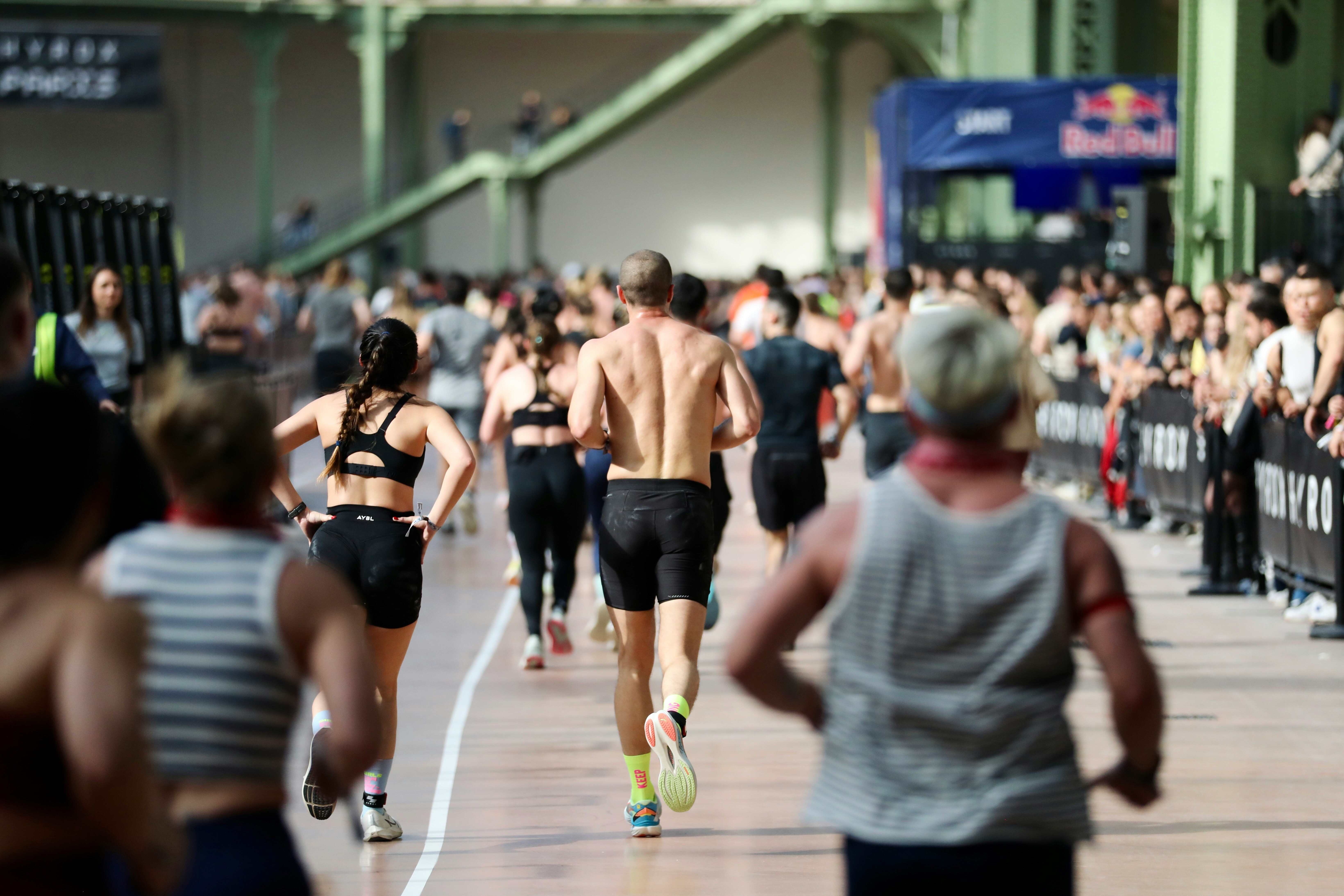
Between every run and station sits a transition area called the roxzone. Time spent in it counts toward your finishing time, and marshals direct the flow through it.
This is where many first-timers lose minutes without noticing. Walking the roxzone at a stroll across sixteen transitions adds up to a meaningful chunk of a finishing time. It is also the cheapest thing in the whole race to improve.
How long does it take to train for a Hyrox?
Eight weeks is enough for someone already training three or four times a week. Twelve weeks is a more realistic floor from a standing start, and the limiting factor is almost always running volume rather than strength.
The session that matters most is compromised running. You run immediately after station work, so your legs learn what a 1km run feels like when they are already fatigued. Athletes who only ever run fresh arrive at race day with a pace target that falls apart by the fifth run.
Building both qualities at once creates known tension, since endurance work can blunt strength adaptation when you stack the two carelessly. Knowing how to structure concurrent training keeps the two goals from canceling each other out over a twelve-week block.
What is a good Hyrox finish time?
Elite athletes finish under 60 minutes, and the sub-60 mark is the informal benchmark serious competitors chase. Research on recreational athletes recorded a median of 86.5 minutes. Most first-timers land somewhere between 90 minutes and two hours.
A useful way to read your own time is to split it. Compare your first four runs against your last four, because the gap between them tells you more than the total does. A small gap means you paced well, and a large one means the stations are costing you more than the clock suggests.
How much does it cost, and how do you get a ticket?
Individual entry typically runs from around $80 to $150 in the United States and roughly £80 to £135 in the United Kingdom. Doubles and relay entries cost less per person, since more athletes share one course entry. Spectator tickets are sold separately and are not included in an athlete ticket.
Pricing is dynamic rather than fixed. Prices climb through tiers as spots fill, so registering early is cheaper and safer.
Popular races sell out months ahead, particularly in major cities. Tickets are released on the official event page for each race. The event calendar on hyrox.com is the only reliable place to check current pricing for a specific city.
What does Hyrox mean for gyms and trainers?
Affiliated training clubs have grown from around 5,000 to 13,000, so programming race-prep classes is now a live decision for most facilities rather than a niche one.
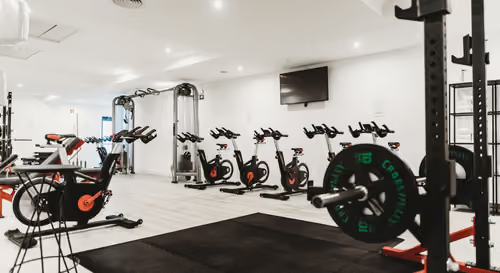
A gym needs a SkiErg, a rower, a sled, wall balls, kettlebells and sandbags to run sessions at full specification. Facilities without a sled can substitute prowler pushes, heavy carries or banded marches, which cover the movement pattern if not the exact load. A rower and a treadmill will carry most of a training block on their own.
The harder problem is delivery. A race-prep block runs across months, and mixed-ability groups rather than a single session, and the same class often holds a first-timer and someone chasing sub-70. Coaches who build, save, and deploy workout templates can scale one plan across a class without rewriting it each week.
What do Hyrox first-timers ask?
What does Hyrox stand for?
It is not an acronym. The name is a coined brand word rather than an abbreviation, and the company markets the format as "The World Series of Fitness Racing".
Can you do Hyrox if you cannot run 8km?
Yes, and many finishers walk part of the running segments. Doubles and relay formats reduce the running load further, which makes either a sensible first entry.
What is the difference between Open and Pro?
Pro uses heavier sleds, a heavier sandbag,g and a heavier wall ball. The running distances, station distances and rep counts stay the same, so the difference is load rather than volume.
Do you need to be fit to enter?
The Open division has no qualifying times, and the movements involve no Olympic lifting or gymnastics skills. Running capacity matters more than maximal strength for a first race.
How is Hyrox different from CrossFit?
CrossFit workouts vary constantly and reward technical skill, while Hyrox repeats the same eight stations, the same order, er and the same loads at every event. An athlete knows the whole test months in advance.
Is Hyrox harder than a marathon?
They are different tests rather than ranked ones. A marathon demands more sustained aerobic endurance, while Hyrox asks you to produce strength repeatedly at near-maximum heart rate.
Deciding whether to add race-prep classes to your timetable is easy. Building a twelve-week block that works for a group spanning first-timers and sub-70 athletes is where most gyms stall. Book a demo to see how coaches deliver and track multi-week programming for a full class through their own branded app.