Are You Earning Up to Your Potential?
Most personal trainers are undervaluing their time and skills. Our Personal trainer Revenue Calculator helps you find out what you should be making, and how to get there.
No guesswork. Just real numbers.
.webp)
Adduction and Abduction differ by one letter, which is why coaches and clients constantly mix them up.
Here is the fix, and it takes one line. To abduct someone is to take them away. Abduction takes the limb away from the midline. Adduction is the other one: it adds the limb back to the body. Once you have that, you never have to look it up again.
Everything below assumes you already know which is which, and covers what actually matters in a session: which muscles drive each pattern, what weakness looks like from across the gym floor, and how to program both without adding time.
Quick reference
What abduction and adduction actually mean
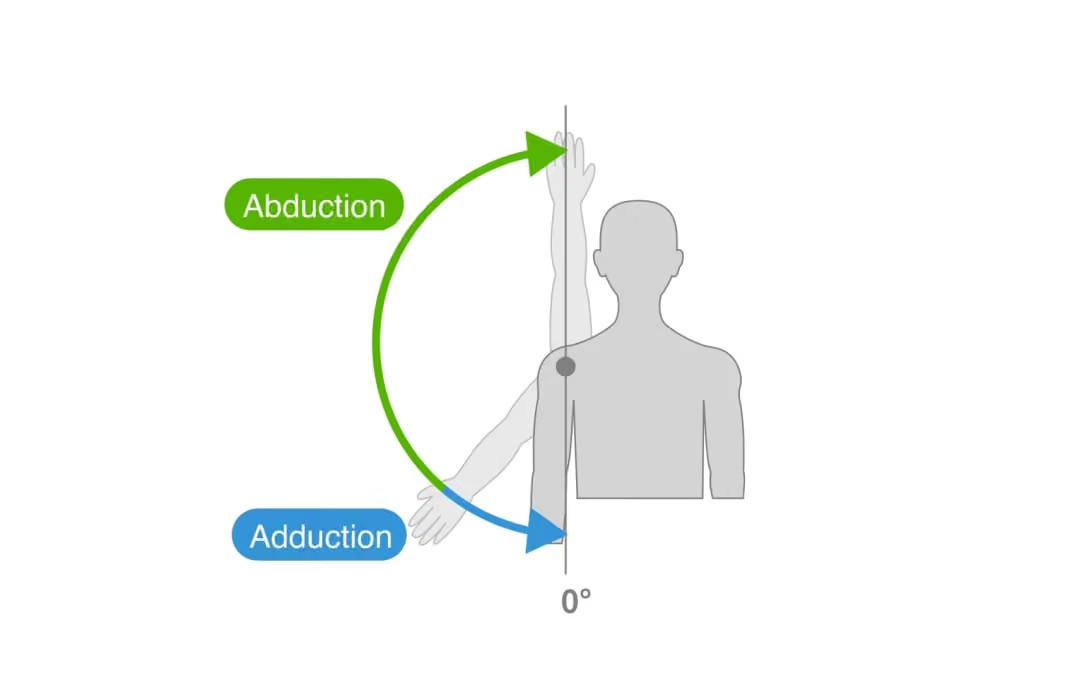
Abduction moves a body part away from the midline. Adduction moves it back toward the midline. Both occur in the frontal plane and involve the shoulder, hip, wrist, fingers, and toes.
One detail most guides get wrong, and it is worth knowing, because a client will eventually catch it. At the fingers and toes, the reference line is not the body's midline. Finger abduction and adduction are measured against the middle finger, and toe movements against the second toe. Spreading your fingers abducts all of them away from the third digit, even though some fingers move toward the body's center while doing it. If you teach the body-midline definition and then use spread fingers as the example, the example contradicts the rule.
At the wrist, the same movements have different names: radial deviation is abduction, ulnar deviation is adduction.
Abduction and adduction are textbook antagonist pairs at every joint where they occur. Each one lengthens as the other shortens, which is why training only one side of the pair reliably produces a control problem rather than just a strength gap.
💪 Got an idea for a brand? Let's bring it to life.
Launch your own fitness app with FitBudd in minutes!
💪 Got your brand name? Let’s bring it to life.
Launch your own fitness app with FitBudd in minutes!



88% trainers worldwide gave us 5 stars
Transform your fitness business with the power of your branded app on iOS and Android.
Try for FREEHip abduction vs adduction

Hip abduction moves the thigh away from the midline toward the side. Hip adduction brings the thigh back in, toward the opposite leg. The hip is where coaches see the largest imbalances between the two, and where clients most often confuse them.
The gluteus medius, gluteus minimus, and tensor fasciae latae drive hip abduction. The gluteus medius does most of the work, and its job is not only to lift the leg sideways. It stabilizes the pelvis every time a client stands on one leg. That is why hip abduction weakness usually shows up as a visual fault rather than a strength complaint: if the pelvis drops on the unsupported side during single-leg stance, the abductors are underperforming.
Worth being precise about what the abductors do in gait, because it is commonly described backward. The leg does not swing sideways when you walk. The gluteus medius works largely isometrically to stop the pelvis from dropping on the swing-leg side, which is the neutralizer role covered in the synergists guide. Weakness produces a characteristic pelvic drop that overloads the IT band and the knee on the stance side.
Hip adduction is driven by the adductor magnus, longus, brevis, gracilis, and pectineus, which run along the inner thigh. These are often dismissed as inner-thigh toning muscles. In reality,y the adductor magnus contributes meaningfully to hip extension from deep hip flexion, such as at the bottom of a heavy squat, and its extensor role diminishes as the hip approaches neutral. Adductor strains are most often reported during sprinting, kicking, and sudden changes of direction.
The two work as a stabilizing pair. During single-leg stance,e the abductors hold the pelvis level while the adductors resist the leg drifting too far out. Train one and neglect the other, and the hip loses frontal-plane control.
Quick coaching test
Have the client perform a slow lateral lunge. If the knee caves inward on descent, abductor control is the limiter. If they cannot decelerate the outward push or feel a groin pull, the adductors are. Recurring groin pain is worth treating as a programming problem before a rehab one.
Also read: Personal Trainer Assessments and Why You Need Them
The lateral lunge screen above is one test. The overhead squat assessment catches knee valgus alongside ankle, hip and thoracic restrictions in the same 30 seconds, which tells you whether the abductors are the actual limiter or just the visible one.
Leg abduction vs adduction
At the leg, abduction spreads the legs apart, and adduction draws them together. A single jumping jack shows both: the outward phase is abduction, the return is adduction.
Coaches often use "leg" and "hip" interchangeably here, and for programming purposes, they describe the same frontal-plane motion.
- Abduction drills: lateral band walks, side-lying hip raises, standing cable abduction, seated abduction machine
- Adduction drills: Copenhagen planks, sumo squats, cable adduction, ball squeezes
Lateral lunges and skater bounds load abduction eccentrically and adduction concentrically in the same rep, which is why they transfer well to field sports. If a client's frontal-plane control is poor to begin with, low-load activation work before the session yields more benefit than adding load.
Shoulder abduction and adduction
Shoulder abduction lifts the arm away from the body out to the side. Shoulder adduction brings it back down toward the torso.
The mechanics here are usually described as a handoff, and that is not what happens. The supraspinatus and middle deltoid work together throughout the range rather than one taking over from the other. For roughly the first 30 degrees, the scapula remains relatively still, a phase known as the setting phase. Past that point,t the scapula must upwardly rotate, driven by the trapezius and serratus anterior, at roughly one degree of scapular rotation for every two degrees of humeral movement.
This is why overhead pressing usually breaks down from poor scapular control rather than weak delts, and why the fault is visible well before the arm reaches shoulder height. A lateral raise is the textbook shoulder abduction exercise.
Shoulder adduction is driven by the pectoralis major, latissimus dorsi, and teres major. Chest flies, lat pulldowns, and straight-arm pulldowns are all shoulder-adduction exercises.
Because the shoulder adductors are large and heavily trained in most programs, while the abductors and rotator cuff are small and neglected, shoulder imbalance nearly always runs in the same direction: strong pressing and pulling, weakest stabilizing. Assessing it properly means looking at rotation as well, which the external rotation guide covers in detail.
Horizontal abduction and adduction
This is the pattern most abduction and adduction explainers leave out, and clients meet it every week in the gym.
With the arm raised to shoulder height, moving it backward away from the midline in the transverse plane is horizontal abduction. Bringing it forward across the body is horizontal adduction.
- Horizontal abduction: reverse fly, band pull-apart, rear delt row. Driven by the posterior deltoid, rhomboids, and middle trapezius.
- Horizontal adduction: chest fly, cable crossover, pec deck. Driven by the pectoralis major and anterior deltoid.
The practical point is that a reverse fly and a chest fly are not variations of the same movement. They are opposites in the transverse plane, and most programs run far more horizontal adduction volume than horizontal abduction, which is the mechanical reason for the rounded-shoulder presentation coaches constantly see.
Also read: Designing Effective Workout Programs for Different Fitness Goals
Horizontal adduction volume outweighs horizontal abduction in almost every program. This covers how to balance pushing and pulling across a training block rather than fixing it with one accessory exercise.
Scapular abduction and adduction
The scapula abducts and adducts, too, and the terms are usually taught as protraction and retraction, which is why coaches rarely connect them.
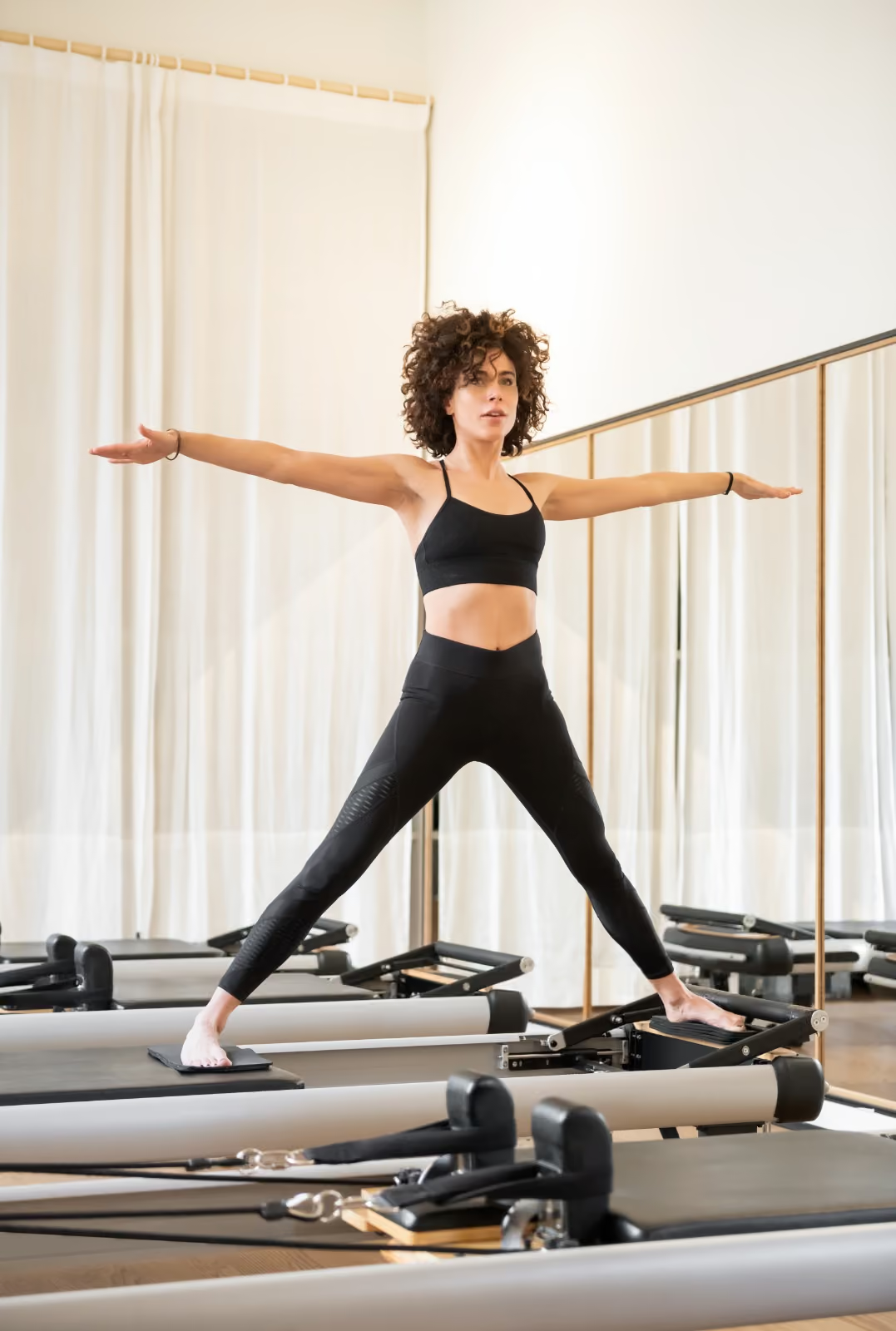
Scapular abduction is protraction: the shoulder blades slide apart around the ribcage, as at the top of a push-up or a bench press lockout. Scapular adduction is retraction: the blades draw together toward the spine, as in a row or a band pull-apart.
The serratus anterior is the main scapular abductor. The rhomboids and middle trapezius are the main adductors. Note that the serratus is often miscategorized as a shoulder abductor, which it is not. It moves the scapula, and its contribution to raising the arm overhead is through upward rotation rather than abduction of the humerus.
Exercises for both patterns
- Abduction: side-lying hip abduction, banded lateral walks, standing cable hip abduction, seated abduction machine, lateral raise, reverse fly.
- Adduction: Copenhagen plank, cable adduction, seated adduction machine, ball squeezes, chest fly, lat pulldown.
The Copenhagen plank is the most reliable adductor strengthener for field-sport athletes because it loads the muscle in a lengthened position, where strains actually occur.
If you program on machines, the hip abduction and adduction machines are the two most misused pieces of equipment in most gyms, usually loaded far too heavily and moved through a partial range. The weight machine programming guide covers setup and progression for both.
Four cues that matter more than exercise selection: control the eccentric rather than dropping out of the top position, progress load slowly because these are small muscles working in a short range, train both directions in the same block rather than alternating months, and stop the set when the pelvis or torso starts compensating rather than when the target muscle fatigues.
Also read: RIR (Reps in Reserve): The Complete Guide
Abduction and adduction work is small-muscle, short-range training where percentage-based loading falls apart. RIR gives you a way to prescribe intensity on accessory sets that clients can actually self-regulate.
What weakness looks like, and what it costs
Weak hip abductors manifest as knee valgus and pelvic drop and are associated with IT band syndrome and knee pain in runners through the stance-side overload described earlier.
Weak adductors show up as groin strains and poor lateral deceleration, most often in sports that involve sprinting, kicking, and cutting.
The pattern worth internalizing is that abduction faults are usually visible, whereas adduction faults are usually reported. You will spot a pelvic drop from across the room. You will only find an adductor problem when the client tells you their groin hurts, or when you specifically test deceleration. That asymmetry in how the two present is the reason adductor work gets programmed less: nothing prompts you to add it until something has already gone wrong.
In sport
- Running: abductors stabilize the pelvis; adductors contribute to force in push-off.
- Swimming: outward stroke phases are abduction; the recovery, pulling inward, is adduction.
- Court and field sports: cutting, defensive shuffles, and change of direction load abduction eccentrically and adduction concentrically in the same step.
- Cycling: adductors control the pedal stroke; abductors provide lateral stability at the hip.
- Gymnastics and martial arts: side kicks, straddle position,s and aerial control depend on both under load at end range.
How to actually get this into your programming
Accessory frontal-plane work is the first thing cut when a session runs long, which is why abduction and adduction deficits persist for months in clients who are otherwise progressing well. Three things fix that.
Test before you program
Run the lateral lunge screen on every new client and record which side limits. Two minutes, and it tells you which of the two patterns to prioritize instead of assigning both by default.
Put the accessory work first, not last
Banded lateral walks or a Copenhagen plank set before the main lift takes three minutes and never gets cut. The same work at the end of a session gets dropped roughly half the time.
Make it a template rather than a decision
If frontal-plane work is written into your program structure, it gets delivered whether or not you remember it that week. Building it once with an AI workout builder and reusing it across clients removes the recall problem entirely.
Retest at six weeks
Pelvic drop and lateral deceleration both change quickly with direct work. If nothing has changed, the issue is adherence rather than programming, and that is a different conversation.
For coaches running this across a full roster, the limiting factor is usually visibility rather than knowledge: you cannot correct a pattern you only see in the two in-person sessions a month. FitBudd delivers programs through your own branded app, with video submissions and logged sessions, so assessment findings and the work that follows sit in the same place.
Book a demo to see how movement screens and corrective blocks are assigned across a client base.



Meet the author
Ankit Uniyal
An SEO specialist and copywriting expert, Ankit Uniyal crafts content that boosts visibility, engagement, and growth.
Frequently Asked Questions

Yangzey Sherpa leads content strategy at FitBudd, overseeing content planning and execution across fitness-focused digital channels. With over five years of experience in SEO and content, she works closely with the fitness industry to ensure content aligns with the needs of coaches, trainers, and gym owners. Her role keeps her deeply connected to fitness business workflows, coaching models, and how professionals use digital platforms to grow.


Apra Pathak has worked closely within the fitness niche for several years, supporting personal trainers and fitness coaches through content and digital marketing initiatives. Her experience centers on understanding how fitness professionals build visibility, communicate value, and engage clients online. Through sustained involvement with fitness-focused platforms and audiences, she has developed a strong understanding of the digital needs and growth challenges faced by modern fitness businesses.

Aishwarya Mehra has been actively involved in fitness-focused digital marketing, working closely with brands and platforms that serve coaches, trainers, and fitness businesses. Her experience spans engagement-driven strategies designed specifically for fitness audiences. Through ongoing exposure to fitness campaigns and communities, she remains closely aligned with how fitness professionals attract, convert, and retain clients in digital environments.

Suchandra Das has contributed content within the fitness niche, working on resources designed for coaches, trainers, and fitness business owners. Her experience involves supporting fitness-related topics with clear, structured, and accessible content. Through consistent involvement with fitness-focused platforms, she has developed familiarity with coaching workflows, client communication, and the informational needs of fitness professionals.
FitBudd is a fitness technology platform built exclusively for coaches, personal trainers, gym owners, and fitness professionals. The platform supports fitness businesses through branded apps, white-labeled solutions, and websites designed around real coaching and training workflows. FitBudd works closely with the global fitness community, maintaining deep, ongoing involvement in the fitness industry.

Ankit Uniyal has worked extensively with fitness-focused content, supporting platforms that cater to personal trainers, gym owners, and fitness professionals. His experience includes optimizing and structuring content around fitness-related search behavior and user intent. Through continued involvement in the fitness niche, he has gained a strong understanding of how trainers and coaches build discoverability and authority online.

Saumya Mittal is the Co-Founder and CEO of FitBudd. Since 2021, she has been actively engaged in the fitness technology sector, collaborating with global fitness companies to foster digital growth and scalable operations. With over a decade of experience leading high-impact projects in engineering and operations, Saumya has a strong background in developing reliable and scalable systems. Through FitBudd, she is dedicated to addressing the evolving needs of fitness professionals worldwide.

Kinshuk Snehi has been closely involved in the fitness space for over four years. Through his work at FitBudd, he has contributed to shaping how fitness professionals build their online presence, attract clients, and scale sustainable coaching businesses. Deeply interested in the intersection of fitness, technology, and growth, Kinshuk brings a hands-on understanding of the challenges faced by modern trainers. His passion lies in building systems and strategies that support long-term consistency, both in fitness journeys and business growth.

Kanika Verma has been closely involved in building solutions for the fitness industry, working with platforms used by coaches and trainers globally. Her experience includes direct exposure to fitness coaching workflows and operational needs. Through sustained involvement in fitness-focused product development, she has developed a strong understanding of how fitness professionals manage clients, programs, and daily operations.

Tanya Sharma has worked on branding initiatives within the fitness niche, supporting fitness platforms and businesses with visual identity design. Her experience includes creating brand systems used by coaches, trainers, and fitness-focused products. Through ongoing involvement in fitness-related design projects, she remains closely connected to how fitness brands communicate trust and professionalism.

Niharika Sonavane has contributed to visual design projects within the fitness industry, supporting platforms and brands serving fitness professionals. Her experience spans creating digital assets used across fitness apps, websites, and marketing materials. Through continued work in the fitness niche, she remains closely aligned with the visual communication needs of coaches and fitness businesses.

Elesh Patel has worked extensively on marketing initiatives within the fitness niche, managing paid campaigns for fitness-focused products and services. His experience includes supporting platforms that target personal trainers, gym owners, and fitness creators. Through long-term involvement in fitness marketing, he remains closely connected to how fitness professionals discover and adopt digital tools.


Creative Fitness Challenges Ebook
Discover exciting challenges to boost your workouts and keep your fitness journey thrilling.
Download Now
Templates
These functional templates have the power to make any fitness trainer's life easier.
Subscribe To
Our Blog