Are You Earning Up to Your Potential?
Most personal trainers are undervaluing their time and skills. Our Personal trainer Revenue Calculator helps you find out what you should be making, and how to get there.
No guesswork. Just real numbers.
.webp)
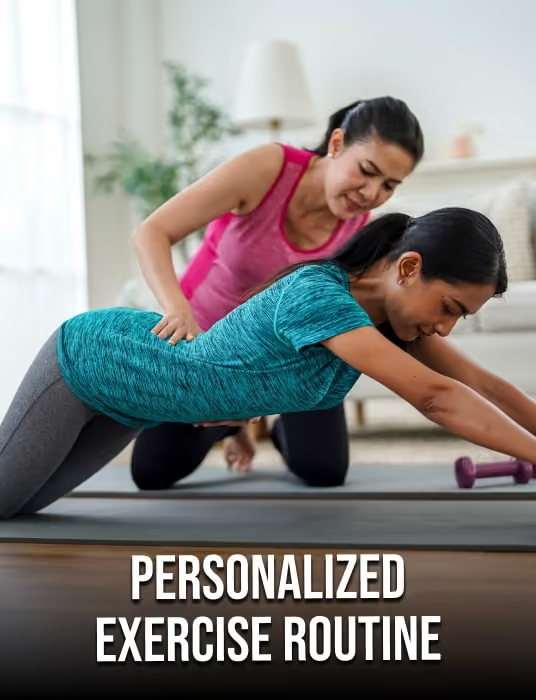
In the fast-evolving fitness world of 2026, the era of “copy-pasting” a celebrity’s workout is officially over. We now understand that a personalized exercise routine is the only way to achieve long-term results without falling into the cycle of burnout. Personalized workout plans are tailored to your individual needs, goals, and fitness level, ensuring every aspect of your routine is designed specifically for you. Key factors such as recovery, exercise selection, and balancing intensity are essential for making your personalized routine effective and sustainable. Everyone has a unique set of variables, from bone structure and muscle fiber type to daily work stress and sleep quality. By learning how to build a personalized training plan, you transition from “exercising” to “training” with specific intent and scientific backing. This guide provides the blueprint for creating a custom workout program that respects your biology, fits your lifestyle, and delivers health benefits like improved immune function and cognitive performance.
Why a Personalized Workout Plan Beats Generic Routines in 2026
The primary reason a personalized workout plan is superior is that it addresses your specific “Weak Links” rather than following a general average. Generic routines are designed for a theoretical “standard human,” which often leads to plateaus or overuse injuries for real individuals. In 2026, the focus has shifted toward autoregulation, which means your plan adjusts based on how your body feels each day. A personalized workout routine ensures that you are doing the right amount of work at the right intensity for your specific goals. This targeted approach saves you hours of wasted effort in the gym and produces visible changes much faster. Personalized plans also help you make progress more efficiently by tracking your improvements and adjusting your workouts as needed. Additionally, they allow for a variety of workouts such as circuit training, strength training, and cardio tailored to your individual needs and preferences.
Avoiding the "One-Size-Fits-All" Trap: The Science of Individual Response
Scientific research in 2025 and 2026 has confirmed that “non-responders” to certain exercises usually just have the wrong plan. Tailoring your approach to your unique needs and fitness goals is essential for optimal results.
- Biomechanical Fit: A custom workout program selects exercises that match your limb lengths, ensuring you don’t strain your joints unnecessarily and helping you improve body composition by targeting the right muscle groups.
- Volume Management: You may require more or fewer “sets and reps” than a generic plan provides to trigger muscle growth.
- Recovery Rate: Genetic factors influence how quickly your central nervous system recovers from heavy lifting, which a custom plan respects.
Lifestyle Integration: Matching Your Training to Your Stress Levels
Your personalized exercise routine must exist within the context of your actual life to be successful.
- Time Constraints: A plan that requires two hours daily is useless if you are a busy professional with only 45 minutes.
- Energy Management: If your job is physically demanding, your customizable workout programs should focus more on quality than extreme volume.
- Equipment Access: Your routine should be built around the available equipment and specific tools you have, whether in a garage or a commercial gym.
Starting a personalized plan is also an effective way to establish new habits, helping you integrate consistent routines into your fitness journey for better results and sustained motivation.
How Can I Build a Personalized Training Plan? (8-Step Framework)
Building a custom workout program requires a systematic approach to ensure you don’t miss any critical health components. This 8-step framework is used by top-tier 2026 coaches to deliver elite results to their clients worldwide. By following these steps, you move from guesswork to a data-driven strategy that guarantees physical adaptation. Personalized workout plans are designed to adapt as you progress, ensuring your training remains effective and engaging. The goal is to create a living document, a personalized plan that grows and evolves as your fitness level improves over time. Start with the “Self-Audit” phase to ensure your foundation is solid before you lift a single weight.
Step 1: Conducting a Biometric and Movement Assessment
Before you use an AI workout generator to build a personalized workout plan, you must know your starting point through a physical audit.
- Mobility Check: Assess your ankle, hip, and shoulder mobility to determine which exercises are safe for your body.
- Strength Baseline: Record your current abilities in basic movements like pushing, pulling, and squatting, considering your body weight as a factor in assessing strength and determining appropriate resistance for progression.
- Body Metrics: Use 2026 wearable tech to track your resting heart rate and HRV (Heart Rate Variability) for recovery data, and monitor lean muscle mass as part of your assessment to set specific fitness goals and track progress.
Step 2: Defining SMART Goals for Your Custom Workout Program
A personalized exercise routine without a clear destination is just a list of random activities.
- Specificity: Instead of “getting fit,” aim for specific goals like “gain muscle,” “lose weight,” or “increasing my squat by 20 pounds in 12 weeks” for better focus.
- Measurability: Ensure every goal in your customizable workout programs can be tracked with numbers or photos, such as monitoring weight loss progress or measuring changes in muscle mass.
- Achievability: Set goals that challenge you but are realistic within the context of your current lifestyle and schedule.
Step 3: Determining Training Frequency and "Recovery Budget"
Your weekly schedule must match your body’s ability to recover from the “systemic load” of training.
- The “Stress” Audit: Account for your work-life stress when deciding if you should train three or five days.
- Optimal Volume: In 2026, we prioritize hitting each muscle group twice weekly rather than once with extreme fatigue.
- Scheduling: As part of your training routine, plan to train at least 2-3 days a week, spacing your workouts to allow for proper recovery. Block out your sessions in your calendar as “non-negotiable appointments” to ensure long-term habit formation.
💪 Got an idea for a brand? Let's bring it to life.
Launch your own fitness app with FitBudd in minutes!
💪 Got your brand name? Let’s bring it to life.
Launch your own fitness app with FitBudd in minutes!



88% trainers worldwide gave us 5 stars
Transform your fitness business with the power of your branded app on iOS and Android.
Try for FREEStep 4: Selecting Primary and Secondary Movements
Every customizable workout program should lead with compound “anchor” lifts before moving into accessory movements for symmetry.
- The Big Rocks: Focus on multi-joint movements like squats, deadlifts, and bench press to build your primary strength foundation. Strength training and resistance training, often organized via professional personal trainer software, are foundational elements in any personalized exercise routine, supporting overall progress and efficiency.
- Assistance Work: Use isolation exercises to target weak points and improve your performance on the main lifts.
- Movement Variety: Include pushing, pulling, hinging, and carrying patterns to ensure you build a functional, balanced physique.
Step 5: Setting Repetition Ranges and Intensity (RPE)
In 2026, we use RPE (Rate of Perceived Exertion) to adjust the intensity of your sessions daily.
- Autoregulation: If your recovery data is low, lower the intensity to prevent burnout and systemic overtraining, while maintaining similar intensity across sets for consistency.
- Strength Focus: Use lower rep ranges (3-6) for your main compound lifts to build maximal strength.
- Hypertrophy Focus: Aim for moderate rep ranges (8-12) for accessory work to maximize muscle growth and detail.
Step 6: Allocating Rest and "Intra-Set" Recovery Time
The time you spend between sets is just as important as the time spent during the sets.
- ATP Recovery: Allow 3-5 minutes of rest for heavy strength work to ensure your muscles are fully recharged.
- Metabolic Stress: For fat loss or endurance, keep rest periods shorter (60-90 seconds) to maintain a higher heart rate and promote blood flow, which supports recovery and overall wellness.
- Quality Control: Rest long enough that your technique remains perfect on every single repetition of every set.
Step 7: Implementing Progressive Overload Patterns
A personalized workout routine only works if it forces your body to adapt by getting harder over time, with making progress as the main goal of progressive overload.
- The “2-for-2” Rule: If you can do two extra reps on your last set for two weeks, increase the weight.
- Beyond the Barbell: Progressive overload also includes slowing down your tempo, reducing rest periods, or improving your technical execution.
- Gradual Advancement: Aim for small, incremental gains of 1-5% each week to ensure sustainable, long-term physical progress.
Step 8: Periodic Review and "Pivot" Points
Every 6 to 8 weeks, your custom workout program requires a "Deload" or a "Pivot" to prevent burnout.
- Performance Audit: Review your logs to see which exercises are stalling and which are still providing results.
- The "Deload" Week: Reduce your volume by 50% for one week to allow your nervous system to fully recover.
- Phase Transition: After your review, adjust your goals and start a new block of training with updated targets.
Selecting Exercises for Your Personalized Workout Routine
Exercise selection is the “Art and Science” of your personalized exercise routine, determining how your body will change shape. You must prioritize movements that provide the “Highest ROI” (Return on Investment) for your specific physique goals. In 2026, the trend is toward “Functional Hypertrophy,” which builds muscle that is both aesthetic and useful. A well-rounded custom workout program includes a mix of compound movements for strength and isolation moves for detail. To promote overall health and recovery, personalized workout plans should also include cardio, supporting cardiovascular fitness and sustainable aerobic exercise as part of your weekly training split. Always choose exercises that you can perform with a full range of motion without experiencing joint pain.
Compound vs. Isolation: Building the Foundation of Your Plan
The hierarchy of exercise selection ensures that you spend your limited energy on the most effective moves.
- The Big Rocks: Focus 70% of your personalized workout plan on compound lifts like deadlifts, presses, rows, and push-ups. For efficiency, consider selecting one exercise per movement pattern (such as one push, one pull, one squat, etc.) to create a streamlined, effective routine.
- Detail Work: Use isolation exercises like bicep curls or lateral raises to “sculpt” specific areas of your physique.
- Structural Balance: Ensure you have an equal amount of “pushing” and “pulling” to maintain healthy posture and joint alignment.
Choosing Movements Based on Equipment Availability and Personal Preferences
Your personalized workout routine should be something you actually enjoy doing, as enjoyment drives long-term consistency.
- Gym vs. Home: Select customizable workout programs that utilize the specific dumbbells, cables, or machines you have access to.
- Movement Substitutions: If you hate back squats, a custom workout program allows you to swap them for Bulgarian split squats or substitute different upper-body exercises to better suit your preferences and goals.
- Skill Level: Beginners should choose stable movements, while advanced trainees can incorporate more complex, free-weight exercises and structured weight training for a challenge.
The "Biomechanical Fit" Audit for 2026
In 2026, we utilize a “Biomechanical Fit” audit to ensure every exercise in your personalized exercise routine matches your anatomy.
- Limb Length Factors: If you have long legs, your personalized workout routine might favor trap bar deadlifts over traditional barbell squats.
- Joint Range Assessment: Only select exercises that you can perform through a “pain-free active range” for your current mobility levels, while maintaining proper form to avoid injury.
- Tension Alignment: A high-quality custom workout program aligns the resistance of the weight with the strongest part of your muscle.
Structuring Your Customizable Workout Programs for Progress
The “skeleton” of your personalized exercise routine is the weekly split, which determines how often you stimulate your muscles. To prevent plateaus and keep making progress, it's important to mix things up by varying your workout routines, exercises, or intensity levels. In 2026, the focus is on “Frequency over Fatigue,” meaning it is better to hit a muscle twice with moderate intensity than once with extreme intensity. A well-structured, customizable workout program balances your “Training Stress” with your body’s ability to repair and grow stronger each week. Choosing the right split is not a permanent decision, but a seasonal one based on your current energy and goals. By organizing your week into a logical flow, you prevent “junk volume” and ensure every single set contributes to your progress. Sometimes, repeating the same workout can also be beneficial for tracking progress and measuring improvements over time.
The 3-Day Full-Body vs. 4-Day Split: Which is Right for You?
Selecting your training frequency is the most critical step in building a custom workout program that you can actually finish.
- 3-Day Full-Body Split: This is the gold standard for beginners or busy professionals who need maximum recovery time between sessions.
- 4-Day Upper/Lower Split: This allows for more "Specialization" on specific body parts and is ideal for intermediate trainees with more time.
- The "Busy Professional" Rule: If you consistently miss your fourth session, a 3-day personalized workout plan will actually produce better results.
Progressive Overload: Ensuring Your Plan Evolves as You Get Stronger
A personalized workout routine only works if it forces your body to adapt by getting harder over time.
- The “2-for-2” Rule: If you can do two extra reps on your last set for two weeks, increase the weight.
- Beyond the Barbell: Progressive overload also includes slowing down your tempo, reducing rest periods, or improving your technical execution.
- Data-Driven Tracking: Use your personalized exercise routine log to ensure you are making progress and lifting more today than you did last month.
To illustrate how progressive overload works, here’s a sample workout: For beginners, start with 3 sets of 10 squats, 10 push-ups, and 10 rows. Each week, add 1-2 reps or increase the weight slightly to keep challenging your body.
Periodization Strategies for 2026 Longevity
In 2026, the most effective customizable workout programs use periodization to prevent plateaus, manage long-term systemic fatigue, and support cardiovascular fitness as a key outcome.
- Linear Periodization: This involves a steady increase in weight while decreasing reps over several weeks to build maximal strength.
- Undulating Periodization: This modern strategy varies intensity and volume daily to keep the nervous system responsive and reduce injury.
- The “Deload” Phase: Every 4-6 weeks, a personalized training plan should intentionally reduce intensity to allow for full tissue repair and help prevent overtraining.
The Role of Recovery in a Custom Workout Program
In the advanced training culture of 2026, recovery is no longer seen as “doing nothing,” but as an active, strategic pillar of your fitness routine. You do not actually get stronger while you are lifting weights; you get stronger while your body is repairing the micro-tears during rest. A custom workout program that ignores the science of restoration will inevitably lead to “Overtraining Syndrome,” characterized by poor sleep and plateaued strength. By prioritizing the “Parasympathetic State” (rest and digest), you allow your hormones and nervous system to reset for your next session. True progress is the result of a perfect 1:1 ratio between high-intensity output and high-quality metabolic recovery, which delivers significant health benefits over time.
If you have any medical concerns about your recovery plan or experience discomfort during exercises, it is recommended to consult healthcare professionals to ensure your personalized exercise routine is safe and effective.
Active Recovery vs. Complete Rest: Balancing the Central Nervous System
Choosing between movement and total stillness depends on the level of “Systemic Stress” your personalized exercise routine has generated.
- Active Recovery: Engaging in low-intensity activities like Zone 2 walking or mobility flows helps you stay active, promotes blood flow, and increases blood circulation to flush out metabolic waste, aiding recovery and supporting overall health.
- Passive Rest: Complete days off are necessary when your HRV (Heart Rate Variability) signals that your “Fight or Flight” system is overtaxed.
- The “CNS” Rule: If your motivation is low and your grip strength has decreased, your personalized workout plan requires a passive rest day.
Sleep and Nutrition: The Silent Pillars of Your Fitness Routine
Even the most perfect personalized workout routine will fail if your "Biological Foundation" of sleep and nutrition is crumbling.
- Sleep Engineering: In 2026, aiming for 7-9 hours of sleep is a performance KPI because growth hormone is primarily released during deep sleep.
- Protein Pacing: Your custom workout program must be fueled by consistent protein intake to provide the amino acids needed for muscle tissue repair.
- Micronutrient Support: Tracking magnesium and electrolyte levels through your nutrition app ensures your muscles can contract and relax efficiently.
Monitoring Readiness with 2026 Wearable Technology
A modern personalized exercise routine uses biofeedback to determine if you should push hard or take a deload day.
- HRV Tracking: Heart Rate Variability is the ultimate "Nervous System Compass" used in every custom workout program to prevent burnout.
- Sleep Score Integration: If your restorative sleep is low, your customizable workout programs should automatically shift to a lower-intensity mobility session.
- RHR Trends: A rising Resting Heart Rate is a primary signal that your personalized workout routine is outpacing your current recovery capacity.
Scaling Your Expertise with FitBudd
In the professional landscape of 2026, a coach’s ability to grow is limited only by their systems for delivering a personalized exercise routine to every client. FitBudd empowers a fitness coach to efficiently deliver personalized workout plans, making it easier to provide expert guidance and tailored support to each client. FitBudd provides the specialized infrastructure that allows you to move beyond the “Time-for-Money” trap of 1:1 sessions and enter the world of high-ticket, scalable coaching. Instead of spending hours every Sunday manually updating spreadsheets, you can use the platform to automate the delivery of customizable workout programs that feel deeply personal to each user. This ensures that as your client list grows, the quality of your personalized training plan remains elite, professional, and results-oriented for everyone.
Using Data-Driven Insights to Adjust Client Programs Automatically
With FitBudd, you can move away from "Guess-Based Coaching" and start making decisions based on real-time biometric and performance data.
- Wearable Integration: Sync your clients' Apple Watch or Fitbit data directly into your dashboard to monitor their recovery and daily activity levels.
- Auto-Regulation Alerts: Receive instant notifications when a client’s performance trends suggest they need a deload or an increase in training intensity.
- Progress Visualization: Automatically generate professional charts that show a client’s strength increases and body transformations, proving the value of your personalized exercise routine.
Building a Library of Branded, Customizable Workout Programs at Scale
Your intellectual property is your greatest asset, and FitBudd helps you turn your coaching philosophy into a reusable, digital library.
- AI-Powered Program Builder: Create 4-week, 8-week, or 12-week customizable workout programs that can be assigned and personalized for new clients in seconds.
- Unlimited Exercise Video Vault: Upload your own high-definition videos to ensure your clients are following your specific form cues for every personalized exercise routine move.
- Hybrid Coaching Flexibility: Easily manage a mix of in-person, online-only, and hybrid clients through your own branded app, maximizing your revenue streams in 2026.
Launch Your Personalized Exercise Routine Journey
Building a personalized exercise routine is the ultimate investment in your long-term metabolic health and physical longevity. You have now learned that a custom workout program is far superior to any generic fitness template. By following our 8-step framework, you can align your training with your unique biological and lifestyle needs. Incorporating aerobic activity, such as cardio exercises and interval training, as well as outdoor sports like walks, hikes, or bike rides, can make your routine more enjoyable and sustainable while improving cardiovascular fitness. Consistency is much easier to maintain when your personalized workout plan actually fits your busy schedule. Remember that your fitness journey is a marathon of small, data-driven wins that lead to transformation. You have the tools and the knowledge to start building your own elite routine today.
Ready to Scale Your Coaching Brand?
If you are a professional trainer, you need the right technology to deliver these results. FitBudd allows you to create and manage thousands of customizable workout programs with total ease and precision. You can provide your clients with a branded experience that includes deep biometric and habit tracking. Do not let manual administrative work stop you from growing your global fitness coaching business. Join the thousands of elite coaches who are already using FitBudd as their primary fitness trainer software to change lives daily. Click the link below to start your free trial and launch your custom app.


Meet the author
FitBudd
Frequently Asked Questions

Yangzey Sherpa leads content strategy at FitBudd, overseeing content planning and execution across fitness-focused digital channels. With over five years of experience in SEO and content, she works closely with the fitness industry to ensure content aligns with the needs of coaches, trainers, and gym owners. Her role keeps her deeply connected to fitness business workflows, coaching models, and how professionals use digital platforms to grow.


Apra Pathak has worked closely within the fitness niche for several years, supporting personal trainers and fitness coaches through content and digital marketing initiatives. Her experience centers on understanding how fitness professionals build visibility, communicate value, and engage clients online. Through sustained involvement with fitness-focused platforms and audiences, she has developed a strong understanding of the digital needs and growth challenges faced by modern fitness businesses.

Aishwarya Mehra has been actively involved in fitness-focused digital marketing, working closely with brands and platforms that serve coaches, trainers, and fitness businesses. Her experience spans engagement-driven strategies designed specifically for fitness audiences. Through ongoing exposure to fitness campaigns and communities, she remains closely aligned with how fitness professionals attract, convert, and retain clients in digital environments.

Suchandra Das has contributed content within the fitness niche, working on resources designed for coaches, trainers, and fitness business owners. Her experience involves supporting fitness-related topics with clear, structured, and accessible content. Through consistent involvement with fitness-focused platforms, she has developed familiarity with coaching workflows, client communication, and the informational needs of fitness professionals.
FitBudd is a fitness technology platform built exclusively for coaches, personal trainers, gym owners, and fitness professionals. The platform supports fitness businesses through branded apps, white-labeled solutions, and websites designed around real coaching and training workflows. FitBudd works closely with the global fitness community, maintaining deep, ongoing involvement in the fitness industry.

Ankit Uniyal has worked extensively with fitness-focused content, supporting platforms that cater to personal trainers, gym owners, and fitness professionals. His experience includes optimizing and structuring content around fitness-related search behavior and user intent. Through continued involvement in the fitness niche, he has gained a strong understanding of how trainers and coaches build discoverability and authority online.

Saumya Mittal is the Co-Founder and CEO of FitBudd. Since 2021, she has been actively engaged in the fitness technology sector, collaborating with global fitness companies to foster digital growth and scalable operations. With over a decade of experience leading high-impact projects in engineering and operations, Saumya has a strong background in developing reliable and scalable systems. Through FitBudd, she is dedicated to addressing the evolving needs of fitness professionals worldwide.

Kinshuk Snehi has been closely involved in the fitness space for over four years. Through his work at FitBudd, he has contributed to shaping how fitness professionals build their online presence, attract clients, and scale sustainable coaching businesses. Deeply interested in the intersection of fitness, technology, and growth, Kinshuk brings a hands-on understanding of the challenges faced by modern trainers. His passion lies in building systems and strategies that support long-term consistency, both in fitness journeys and business growth.

Kanika Verma has been closely involved in building solutions for the fitness industry, working with platforms used by coaches and trainers globally. Her experience includes direct exposure to fitness coaching workflows and operational needs. Through sustained involvement in fitness-focused product development, she has developed a strong understanding of how fitness professionals manage clients, programs, and daily operations.

Tanya Sharma has worked on branding initiatives within the fitness niche, supporting fitness platforms and businesses with visual identity design. Her experience includes creating brand systems used by coaches, trainers, and fitness-focused products. Through ongoing involvement in fitness-related design projects, she remains closely connected to how fitness brands communicate trust and professionalism.

Niharika Sonavane has contributed to visual design projects within the fitness industry, supporting platforms and brands serving fitness professionals. Her experience spans creating digital assets used across fitness apps, websites, and marketing materials. Through continued work in the fitness niche, she remains closely aligned with the visual communication needs of coaches and fitness businesses.

Elesh Patel has worked extensively on marketing initiatives within the fitness niche, managing paid campaigns for fitness-focused products and services. His experience includes supporting platforms that target personal trainers, gym owners, and fitness creators. Through long-term involvement in fitness marketing, he remains closely connected to how fitness professionals discover and adopt digital tools.

Ultimate Marketing Guide for Fitness Trainers
Boost your business growth with these tried and tested marketing strategies. Free for you to download.
Download Now
Templates
These functional templates have the power to make any fitness trainer's life easier.
Subscribe To
Our Blog
.avif)