



10 min read
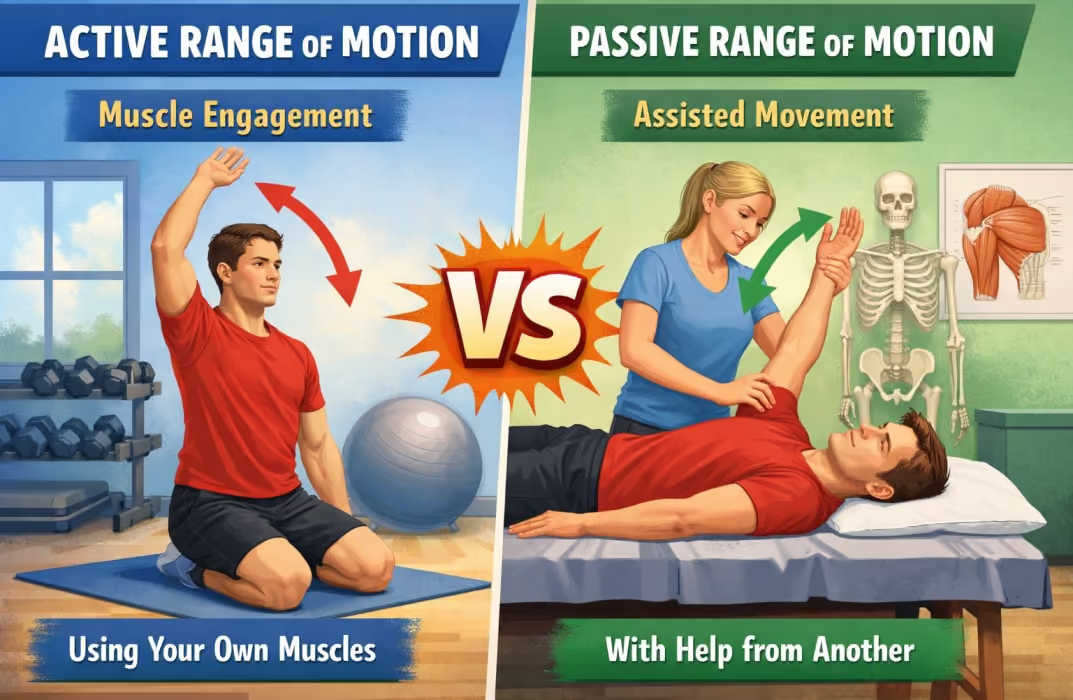
Active and passive range of motion are two different qualities - and confusing them leads to programs that stretch clients without actually improving how they move. Active range of motion (AROM) is what a joint can do under voluntary muscle control.
Passive range of motion (PROM) is what a joint can do when an external force moves it. A client can score well on passive flexibility and still have poor functional mobility. Understanding the difference between the two changes how you assess, warm up, load, and progress every client.
Passive range is about tissue length and joint structure. The active range is about neuromuscular control. A client can be extraordinarily flexible and have poor mobility. A client can appear stiff but have excellent functional movement quality. Flexibility is measured by how far you can be moved. Mobility is measured by how far you can move with control and purpose. These are not the same quality, and they do not respond to the same interventions.
For coaches, this distinction shapes every decision about warm-ups, programming, assessment, and injury prevention. This guide explains what AROM and PROM are, how the third category of active-assisted ROM fits in, what the ROM gap is and why it matters, when each type of motion should be used in practice, and how to build mobility programs that convert passive range into active functional control.
Defining the Three Types of Range of Motion
Active Range of Motion (AROM)
Active range of motion is the movement a joint can achieve when opposing muscles work together through voluntary contraction and relaxation, without any external assistance whatsoever.
When a client lifts their arm overhead as high as they can, that is their active shoulder flexion ROM. When they lift their straight leg off the floor without using their hands, that is their active hip flexion ROM. The movement is produced entirely by the muscles surrounding and crossing that joint. The nervous system must recruit and coordinate the appropriate motor units, and the muscles must generate sufficient force and control to move the limb through the range and hold it there.
AROM demonstrates functional mobility: the capacity to move with strength, stability, and motor control. This is the range that matters for athletic performance, daily function, lifting under load, and movement quality. If a client cannot actively control a joint position, they cannot safely train in that position.
The active range of motion is always less than the passive range of motion. This is a biomechanical certainty. To actively move a joint, the agonist muscles must produce force while the antagonists resist and decelerate. Creating movement against this co-contraction requires more from the system than simply being moved passively, which explains why active ranges never exceed passive ranges.
Passive Range of Motion (PROM)
Passive range of motion is the movement achieved at a joint when an external force produces the motion. The individual receiving the movement contributes no voluntary muscle effort. The muscles surrounding the joint are relaxed, and the joint is simply moved through its available range by the external force.
This external force can be a physical therapist or coach manually moving a limb, a partner applying a stretch, gravity pulling a body segment downward, a stretch strap looped around a foot, a continuous passive motion (CPM) machine, or the athlete's own hands pulling on the limb from the outside.
PROM represents the anatomical ceiling of a joint's movement capability. It reflects the structural properties of the joint itself, including the capsule, ligaments, cartilage, and the passive elastic properties of the surrounding soft tissue. Because no active co-contraction is required to stabilize the joint during passive movement, more range of motion is accessible than with voluntary effort alone.
Importantly, passive range does not represent a safe training range. Being passively moved through 120 degrees of hip flexion does not mean a client can squat through that range under load. The passive range tells you what the structures permit. The active range tells you what the neuromuscular system can actually control.
Active-Assisted Range of Motion (AAROM)
Active-assisted range of motion sits between AROM and PROM. The individual uses their own muscle effort to produce as much movement as possible, and external assistance makes up the remaining range that the muscles cannot achieve independently.
AAROM is used clinically when a client has some voluntary muscle control but lacks the strength, range, or motor patterning to complete the full movement on their own. It is also used progressively in rehabilitation, beginning with PROM when a client cannot move at all, advancing to AAROM as voluntary control returns, and eventually progressing to full AROM as strength and control develop.
In fitness practice, AAROM appears in assisted stretching protocols, partner-assisted mobility work, and certain yoga-based practices in which a teacher helps a student access a range just beyond their current active capacity. The goal in each of these contexts is not simply to reach a greater range, but to begin building familiarity and proprioceptive awareness in the range that the client is working toward actively owning.
The ROM Gap: The Most Useful Mobility Metric for Coaches
The difference between a client's PROM and AROM at any given joint is called the ROM gap. Understanding and measuring this gap is arguably the most practically useful mobility concept for fitness coaching.
The fundamental principle: a client can only safely train under load within their active range of motion. If PROM exceeds AROM by a large margin, there is a zone of passive flexibility that the neuromuscular system cannot control. This zone represents a structural range without stability. Moving a joint into this passive-only zone under load, fatigue, or high speed is precisely how many training injuries occur.
Two common presentations of the ROM gap:
Large gap (PROM far exceeds AROM): A client who is very flexible but has poor motor control. This client may score well on passive flexibility tests, perform well in static stretching, and feel like they have excellent mobility. But their active range reveals that they cannot stabilize or produce force through the full range their tissues permit. This is the hypermobile client who strains a hip flexor on a high kick, or the dancer who repeatedly sprains an ankle in positions they can passively reach but cannot actively decelerate through.
Small gap (PROM close to AROM): A client who appears stiff on passive testing but demonstrates excellent motor control and strength through their available range. This client has good neuromuscular ownership of their range. Their risk profile is lower because the ranges they train through are ranges they can control. The goal in coaching this client is to expand both PROM and AROM together, maintaining the small gap as the total range grows.
The practical implication for programming: Load should only be introduced within the ranges a client can actively control. A passive range without active control is not a training range; it is instability waiting to be loaded. Coaches who assess only passive flexibility, or who program overhead pressing for a client who cannot actively achieve full shoulder flexion without compensating, are building programs on an unstable structural foundation.
Why AROM Is Always Less Than PROM
This is an anatomical and neurophysiological certainty, not simply a guideline. Understanding why helps coaches apply the principle intelligently.
Co-contraction demands: When a joint moves actively, both the agonists (the muscles producing the movement) and antagonists (the muscles resisting and decelerating the movement) are working simultaneously. The antagonists apply braking force to protect the joint at the end range. This co-contraction reduces the effective range available compared to a joint that is simply moved passively with the surrounding muscles relaxed.
Neurological conservatism: The nervous system applies protective tension to joints at their functional boundaries. When joint capsule receptors, ligamentous mechanoreceptors, and Golgi tendon organs detect approaching end-range, the nervous system increases co-contraction and reduces agonist drive. This is a protective mechanism. The system says it does not have the motor-control infrastructure in place to safely allow the joint to move farther. Passive movement bypasses this constraint because no voluntary motor program drives it.
Strength requirements: Moving a limb actively through a range, particularly against gravity, requires the muscles to produce force against resistance throughout the motion. Passive movement has no such requirement. If a client lacks sufficient strength at a joint position, they cannot actively reach that range, regardless of what the passive structures permit.
This is why passive stretching alone, which increases tissue length and PROM, does not automatically produce improvements in functional movement quality. You can make a hamstring more elastic through static stretching without improving the client's ability to actively control hip flexion under load. The passive range expands; the active control remains the same; the ROM gap widens.
When to Use Each: Practical Application for Coaches
When to Use AROM Assessment and Training
Pre-session movement screening: Checking AROM at relevant joints before a training session reveals the client's functional capacity for that specific day. A quick active shoulder flexion check before overhead pressing, or an active hip flexion assessment before deadlifting, tells the coach what range the client can actually control in their current state. If AROM is reduced compared to baseline (due to fatigue, tightness, poor warm-up, or a developing issue), this is a signal to modify the session.
Dynamic warm-ups: All warm-up protocols should involve AROM work before loading. Dynamic movements like leg swings, hip circles, arm windmills, thoracic rotations, and deep squat holds actively move joints through their range while requiring muscular engagement. This primes the neuromuscular system, increases synovial fluid distribution in the joint capsule, elevates tissue temperature, and establishes the motor patterns the upcoming session will demand. Static stretching (PROM) before a training session can temporarily reduce force production capacity and should be limited in pre-training contexts.
Mobility training for performance: The entire goal of mobility training in a performance context is to expand AROM. Controlled Articular Rotations (CARs), loaded end-range exercises, active end-range isometrics, and strength-through-range training all work by progressively expanding the ranges the nervous system will permit under voluntary control. These are fundamentally AROM-building interventions.
Assessing readiness to progress loading: Before increasing load on any exercise, coaches should confirm the client has sufficient AROM to maintain form through the full intended range. A client who can squat to parallel passively but only to 70 degrees actively is not ready to be progressed on squatting volume until their active range catches up with their passive range.
Establishing a baseline and tracking progress: When assessing clients, measuring AROM at key joints (shoulder flexion and rotation, hip flexion and extension, ankle dorsiflexion, thoracic rotation) provides objective baseline data for tracking mobility progress over time. This is an integral part of any systematic personal training assessment.
When to Use PROM and Passive Flexibility Work
Post-session recovery work: Static stretching and assisted stretching (PROM-based techniques) are most appropriate after training sessions. Post-exercise PROM work helps restore resting tissue length, promotes blood flow through soft tissues, reduces post-exercise tension, and improves tissue pliability. This is the correct context for holding a pigeon pose for 60 seconds, applying a hip flexor stretch, or using a strap to passively elevate the leg above active capacity.
Comparing PROM to AROM for gap analysis: Measuring passive range and comparing it to active range at the same joint directly quantifies the ROM gap. Coaches who assess both have far more precise information about where a client's mobility limitations lie than coaches who assess only one. A large gap at the hip, for example, indicates the client needs active mobility work and neuromuscular strengthening at end range, not more passive stretching. A small gap with a limited total range indicates the tissue itself needs lengthening, which PROM-based work addresses.
Rehabilitation and return to function: PROM is the appropriate starting point for clients who cannot voluntarily move a joint, including post-surgical patients, those recovering from acute injuries, and clients with neurological conditions affecting voluntary motor control. In these contexts, PROM maintains joint health, prevents contracture formation, stimulates synovial fluid production, and provides sensory input to recovering nervous systems. As voluntary control returns, the progression is from PROM to AAROM to AROM.
Soft tissue and tissue length work: When a client's passive range itself is limited relative to normal values (hypomobile, not just weak), direct tissue lengthening through sustained static stretches, progressive myofascial release, and passive joint mobilization is appropriate. Foam rolling followed by stretching (in this sequence, not the reverse) has evidence of producing greater acute ROM improvements than stretching alone.
Special populations requiring passive support: Older adults with limited active motor control, post-partum clients managing diastasis recti, clients with neurological conditions, and injured clients in early recovery stages all benefit from coach-assisted PROM work as a therapeutic and maintenance tool. The passive range of motion exercise guide provides a practical protocol for working through major joint groups safely.
The Flexibility vs. Mobility Distinction
This is the most critical conceptual distinction for modern coaching practice, and the one most frequently collapsed in popular fitness culture.
Flexibility is the ability of soft tissues (muscles, tendons, fascia, joint capsules) to be passively lengthened. It describes what can happen when external forces act on a joint. It is a passive tissue property. Flexibility is what PROM measures.
Mobility is the ability to move a joint actively through its full range with control, coordination, and strength. It describes what a person can actually do with their joint. Mobility is a neuromuscular quality. It is what AROM measures.
A client can have excellent flexibility and poor mobility. This is the hypermobile client who can be stretched into extreme positions but cannot maintain joint stability when those positions are loaded. This client's injury risk is not eliminated by their flexibility. In many cases, it is elevated because their nervous system permits access to ranges that the surrounding musculature cannot control under load.
Conversely, a client can appear inflexible on passive testing but demonstrate strong functional mobility. If their PROM and AROM are closely matched, their movement quality may be excellent even though neither range is large. This client may not need passive flexibility work at all. They may simply need to gradually expand their total range through active training.
The implication for coaches is significant. Not every client who presents as stiff needs passive stretching. What they need depends entirely on where their limitation lies: in tissue length (PROM limited), in active neuromuscular control (large gap), or in an absolute range that is genuinely small but well-controlled (small gap, limited total range). These three presentations require three different interventions.
How to Convert Passive Range to Active Control
When a client has a large ROM gap (a significant amount of passive range they cannot control actively), the goal is to expand AROM to close the gap. These techniques systematically build neuromuscular ownership of the available passive range of motion.
Controlled Articular Rotations (CARs)
CARs are active, full-range circumduction movements that take a joint through its complete available active range in every plane simultaneously. The movement is performed slowly, under maximum muscular tension, with no external assistance, and with adjacent body segments completely still to isolate the target joint.
A hip CAR, for example, involves drawing the largest possible circle with the femur while standing on the opposite leg, maintaining maximum tension throughout the entire arc. The purpose is to send repeated motor signals into the joint's maximum active range, reinforcing the nervous system's capacity to control those positions.
CARs are particularly effective for morning joint preparation, warm-up protocols, and direct joint training when the ROM gap is large. They build neural maps that tell the nervous system these positions are safe, progressively allowing it to release its protective restriction on its active range.
End-Range Loaded Isometrics
An end-range isometric involves moving into the limit of AROM and then contracting the agonist muscles maximally against an immovable resistance for 5 to 10 seconds. This builds strength and stability at the exact position where control is currently lacking.
For a client with limited active hip extension, an end-range isometric hip extension hold trains the glutes, hip flexors, and surrounding stabilizers to produce and maintain force at that specific joint position. The nervous system learns that the position is not only accessible but stable under load, which progressively expands the zone of active control.
Loaded Passive Stretching Followed by Active Contraction (PNF Patterns)
Proprioceptive neuromuscular facilitation (PNF) techniques combine passive stretching with active muscle contractions to produce greater ROM improvements than either approach alone. The standard contract-relax protocol involves moving to the passive end range, contracting the target muscle isometrically against resistance for 5 to 7 seconds, relaxing, and then moving into the new passive range. Repeating this three to five times in a session produces meaningful acute and cumulative improvements in both PROM and AROM.
The PNF mechanism works through autogenic inhibition: the sustained isometric contraction activates Golgi tendon organs, which reflexively reduce tension in the contracting muscle, allowing greater passive lengthening immediately afterward.
Progressive Strength Through Range
The most direct long-term method for expanding AROM is to perform resistance training with progressively larger ranges of motion. Full-range-of-motion training on exercises like the Romanian deadlift, Bulgarian split squat, Nordic hamstring curl, deep squat, and overhead press teaches the muscles to produce force at their full length. Strength through range is, fundamentally, building the neuromuscular capacity to actively control the range.
Research consistently supports a full range of motion resistance training for improving functional flexibility alongside strength, outperforming static stretching alone for long-term range improvements in many populations. For coaches designing programs that integrate mobility and strength, the resources on creating workout plans clients will love and stick to, and corrective exercise principles provide practical programming frameworks for this integrated approach.
Goniometry: Measuring Range of Motion Objectively
A goniometer is the standard clinical tool for measuring joint angles during range-of-motion assessment. It consists of a fulcrum, a stationary arm, and a movable arm. The fulcrum is placed at the joint's axis of rotation, the stationary arm aligns with the proximal body segment, and the movable arm follows the distal segment through the range being measured.
Goniometry allows precise, repeatable, documented measurement of both AROM and PROM at specific joints. Comparing the two at initial assessment and at regular reassessment intervals (every four to eight weeks is standard) provides the objective evidence of whether mobility interventions are producing results.
For coaches who do not use goniometers, practical functional tests provide useful approximate measures:
Shoulder flexion AROM: Maximum overhead reach with arms straight, compared to a wall or plumb line.
Hip flexion AROM: Standing single-leg lift height, or supine active straight leg raise.
Ankle dorsiflexion AROM: Knee-to-wall distance in a half-kneeling position is a reliable clinical screen.
Hip external rotation AROM: Figure-four single-leg balance, or the height of the knee in a seated figure-four position relative to the floor.
Thoracic rotation AROM: Seated rotation from a fixed pelvis, measured in degrees from the starting position.
Comparing these active measurements to the same tests performed passively (with the coach assisting the movement) quantifies the gap and identifies priority joints for mobility work.
Applying AROM vs PROM in Assessment-to-Program Workflow
The complete coaching workflow for mobility looks like this:
Step 1: Establish baseline
Conduct both AROM and PROM assessments at the joints most relevant to the client's goals and training demands. Record both values. Calculate the gap at each joint.
Step 2: Identify the type of limitation
For each joint showing restriction:
- Is PROM limited? The client needs passive tissue lengthening through static stretching and soft tissue work.
- Is the gap large (PROM good, AROM limited)? The client needs active mobility training to build neuromuscular control through their existing passive range.
- Are both PROM and AROM limited but closely matched? The client needs progressive range expansion through active training and full range strengthening.
Step 3: Match the intervention to the limitation
Prescribe passive work (static stretching, foam rolling, assisted stretching) specifically for PROM-limited joints. Prescribe active work (CARs, end-range isometrics, strength through range) specifically for large-gap joints. Use both in sequence for joints that need both.
Step 4: Sequence correctly within sessions
AROM work belongs in warm-ups. PROM work belongs post-session. Loading belongs only within the active range that the client has demonstrated that day.
Step 5: Reassess regularly
Track both AROM and PROM at four to eight-week intervals. Document whether the gap is narrowing, whether the absolute range is expanding, and whether changes in mobility correspond to improvements in functional movement quality in training. The complete personal training assessment blueprint provides the structured framework for this ongoing assessment-reassessment cycle.
Common Coaching Mistakes Around Range of Motion
Equating flexibility with mobility: A client who scores well on a passive sit-and-reach test does not have good hip mobility. They may simply have long, elastic hamstrings. Until coaches assess AROM and compare it to PROM, they do not have the data they need to make programming decisions.
Adding load before the active range is confirmed: Progressing a client's squat depth, overhead pressing range, or deadlift depth before confirming adequate AROM at the limiting joints, loads dysfunction rather than building capacity. The assessment step belongs before progression decisions, not after.
Using only static stretching to address mobility limitations: When the client's limitation is a large ROM gap (poor active control of the existing passive range), static stretching does not close the gap. It may even widen it by increasing PROM without increasing AROM. These clients need active mobility work, not more passive flexibility.
Applying PROM-based techniques before training: Pre-training static stretching of more than 60 seconds on a given muscle has been shown to transiently reduce force output in that muscle group. Coaches who have clients hold long passive stretches immediately before heavy-lifting sessions may be compromising the session's primary training stimulus.
Ignoring the ROM gap entirely: Coaches who assess only one type of ROM, or who assess a range of motion at all without comparing the two values, miss the single most clinically relevant data point in mobility assessment. The gap is the measure of instability. The gap is what needs to be closed.
Conclusion
Active and passive range of motion are not interchangeable terms for the same quality. PROM tells you what the tissues permit. AROM tells you what the nervous system can control. The gap between them shows how much instability a client brings to every training session.
Coaches who understand this distinction program differently. They assess both values, not just one. They prescribe passive work post-session and active work in warm-ups. They introduce load only within demonstrated active ranges. They design mobility progressions that systematically close the gap by building strength and control through available passive range, not simply by stretching tissue to create more passive range that the nervous system cannot use.
The result is clients who not only move through larger ranges over time, but also do so with the stability and control that keep them injury-free and performing at their best.
Understanding the difference between AROM and PROM is one thing. Applying it consistently across every client is another. FitBudd gives coaches the tools to document ROM assessments, track mobility baselines over time, and build corrective programming directly into each client's plan - all in one place. Start your 30-day free trial, no credit card required.
%20to%20Become%20a%20Certified%20Personal%20Trainer-min.avif)