




10 min read
TL;DR
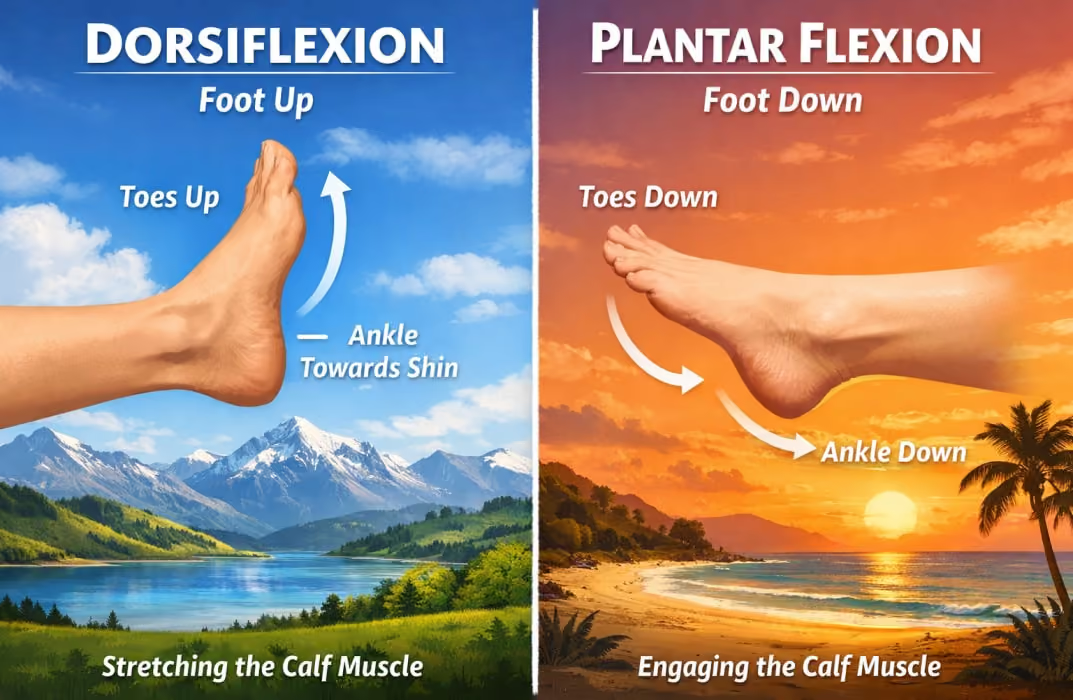
Dorsiflexion lifts the foot toward the shin with a normal range of 15-20°. Plantar flexion of foot points it away at 40-50°. Restricted dorsiflexion causes squat compensation; weak plantar flexion kills push-off power.
Coaches use the weight-bearing lunge test and a 9-10 cm threshold to flag restrictions. Programming targets dorsiflexion and plantar flexion separately because each limits a different movement pattern.
The ankle is the foundation for all athletic movement. It controls balance, impact, and force generation. Mastering ankle action is key to client stability. This starts by understanding two core motions.
The primary actions are pointing up and pointing down. Coaches must know how this joint action affects the entire chain. This knowledge improves both performance and safety.
We will define dorsiflexion and plantar flexion clearly. We compare these critical motions directly. This shows the importance of dorsiflexion vs plantar flexion today.
Dorsiflexion and plantar flexion are opposing movements at the ankle joint. Dorsiflexion lifts the top of the foot toward the shin. Plantar flexion of foot points the sole away.
Understanding dorsiflexion vs plantar flexion matters because each limits a different pattern when restricted. Both happen at the ankle joint and together account for most of the ankle's contribution to squatting, running, and jumping. The more useful coaching question is what happens when one of them is short.
What is Dorsiflexion?
Dorsiflexion lifts the front of the foot, so the top of the foot moves toward the shin. The dorsum is the top surface of the foot, which is where the name comes from.
The tibialis anterior is the primary dorsiflexor, running down the front of the shin. It is assisted by the extensor hallucis longus, extensor digitorum longus, and fibularis tertius, all supplied by the deep fibular nerve.
The normal range is 15 to 20 degrees. Dorsiflexion prevents the toes from dragging during the swing phase of walking and allows the shin to travel forward over the foot once the heel is down, which is exactly what a squat depends on.
What is Plantar Flexion?
Plantar flexion of the foot points it downward, moving the sole away from the shin. The plantar surface is the sole of the foot.
The gastrocnemius and soleus are the primary plantar flexors, joining at the Achilles tendon. The normal range for plantar flexion of foot is 40 to 50 degrees.
Standing on your toes is plantar flexion. So is pressing a car pedal and the final push in a vertical jump. That is what is plantar flexion in practice: a load-bearing movement driven by the largest muscles in the lower leg.
Dorsiflexion vs plantar flexion at a glance
Dorsiflexion vs. Plantar Flexion Work During Gait
Dorsiflexion and plantar flexion divide the gait cycle between them.
At heel strike, the ankle dorsiflexes and the foot absorbs impact. As the cycle moves toward push-off, plantar flexion takes over and the foot has to become rigid to transmit force.
That is how plantar flexion and dorsiflexion serve different masters within the same stride. The ankle switches between dorsi and plantar flexion roughly a thousand times per kilometer of running, and coaching both sides of that switch is what separates ankle training from ankle guessing.
That conversion runs through the windlass mechanism. As the toes extend at push-off, the plantar fascia tightens, the arch rises, and the foot stiffens into a lever. A soft foot absorbs; a rigid foot propels. Knowing dorsiflexion vs plantar flexion as distinct roles in that cycle tells you which side to assess first.
Dorsiflexion, Squat Depth and Knee Tracking
In the dorsiflexion vs plantar flexion divide, squat depth is almost entirely a dorsiflexion problem.
A squat requires the shin to travel forward over the foot. The available range for that travel is dorsiflexion. When a client does not have enough, the body compensates in one of three ways. Understanding plantar flexion and dorsiflexion as a pair helps here: the client is not failing the squat; their ankle is running out of range.
- Pitch the torso forward
The most common. The hips shift back, and the chest drops to keep the center of mass over the feet. It reads as a mobility problem at the hip or a weak trunk, and it is neither.
- Lift the heels
The ankle bends range from leaving the floor.
- Turn the feet out
Rotating the foot outward allows the knee to travel along a diagonal, requiring less true dorsiflexion. Watch for a client whose feet drift wider apart across a set. That is the ankle looking for an easier path, not a cue that has been forgotten.
If you cue harder against any of these without addressing the ankle, you are asking a client to hold a position their joint range does not permit. The cue fails, and it appears to be non-compliant.
Plantar Flexion, Propulsion, and Compensation
Plantar flexion of foot drives push-off. It is the last joint action in a vertical jump, the final contributor in a sprint stride, and the reason calf strength shows up in jump testing.
Where plantar flexion vs dorsiflexion splits most clearly for programming:
- Dorsiflexion is the range issue in squatting
- Plantar flexion is the power issue in propulsion
A client can have adequate dorsiflexion and still produce a flat push-off. That is a plantar flexion problem, not a dorsiflexion one. The plantar flexion vs dorsiflexion split matters because the fixes are different: one requires mobility work, the other requires strength and control work.
When plantar flexors are weak, the foot tends to roll excessively inward or outward at push-off. The fault is not pronation itself; it is excessive pronation, rolling further and longer than the task requires. That drives the knee inward and shifts load to the knee and hip.
How to assess dorsiflexion
Use the weight-bearing lunge test, sometimes called the knee-to-wall test. It measures dorsiflexion under load, which is the condition that actually matters, rather than with the client lying on a bench.
- Have the client stand facing a wall, front foot pointing straight ahead.
- Ask them to drive the knee forward to touch the wall, keeping the heel flat on the floor.
- If the knee touches, move the foot back and repeat until the heel starts to lift.
- Measure from the tip of the big toe to the wall at the furthest point where the heel stayed down.
- Test both sides. The side-to-side difference is often more informative than either number alone.
A 9-10 cm threshold is used in clinical and coaching contexts. Less than that, and restricted dorsiflexion is a reasonable explanation for a squat that will not deepen without the torso pitching forward.
The heel staying down is the whole test. If it lifts, the measurement is meaningless.
Programming for Ankle Range and Control
Range without control does not transfer. Program both.
Restore Dorsiflexion Range:
- Banded ankle mobilization
Loop a band around the ankle just above the joint line, anchor it low and behind, step out to create tension, and repeatedly drive the knee forward over the foot. The band draws the talus backward, which is the direction the joint needs to glide.
- Half-kneeling wall mobilization
Half-kneeling, front foot a few inches from a wall, drive the knee forward to touch the wall without letting the heel lift. Same movement as the assessment, used as the drill.
Build Control at the New Range:
- End-range tibialis anterior work
Hold the top of a dorsiflexion contraction against resistance. The range you cannot actively hold tends not to stick.
- Loaded eccentric calf raises
Slow lowering through the full range, working the plantar flexors at length.
Reassess with the same knee-to-wall test after three to four weeks. If the measurement has not moved, the limitation may not be soft tissue, and that changes who should be looking at it.
When to refer?
Coaches work on mobility. Some presentations are not mobility-related and do not require a clinician.
Foot drop is the one to recognize. If a client cannot lift the front of the foot at all, drags the toes when walking, or has developed a high-stepping gait to compensate, that is a dorsiflexion failure with a possible neurological cause rather than a tight calf.
It is associated with deep fibular nerve injury, and with conditions including stroke, multiple sclerosis, and peripheral neuropathy. It does not respond to mobility work and requires a medical assessment.
Refer, rather than program around, when a client presents with:
- Loss of dorsiflexion that appeared suddenly rather than gradually
- Numbness, tingling, or altered sensation in the foot or lower leg
- Visible wasting of the muscle on the front of the shin
- A restriction that does not change at all across several weeks of consistent work
- Pain, as opposed to stiffness or tightness, at the end range
None of these is a reason to stop coaching the client. There are reasons for someone qualified to look at the ankle first.
Putting it to work
The plantar flexion vs dorsiflexion split is not just an anatomy distinction. It is a programming framework: two tests, two drill categories, two referral criteria. Knowing both sides of dorsi and plantar flexion as distinct coaching targets is what turns ankle work from guesswork into a measurable protocol.
FitBudd lets coaches log assessment results against a client profile and track them over time, so a knee-to-wall measurement taken in January is still there to compare against in March.
Book a demo to see how it fits into your programming workflow.
%20to%20Become%20a%20Certified%20Personal%20Trainer-min.avif)