

10 min read
TL;DR
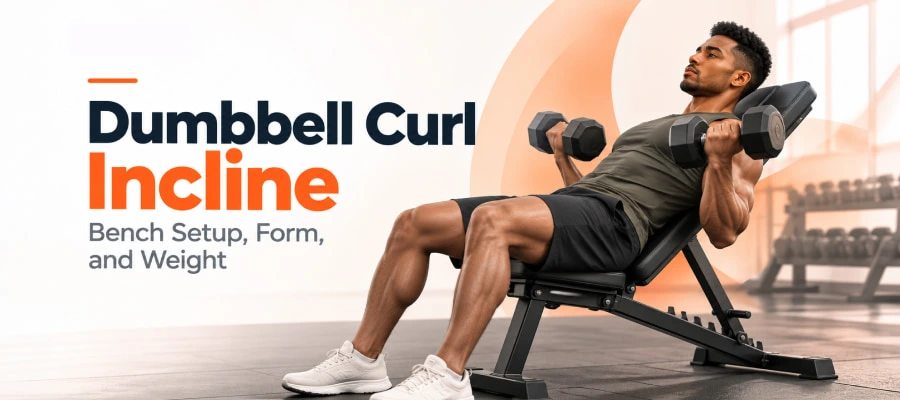
Set an incline bench around 45° to 60° and sit back with a light dumbbell in each hand. Keep your back against the pad and your palms facing forward. Bend your elbows to lift the weights to roughly shoulder level, then lower them steadily. Start with about half the weight you use for standing curls and aim for 8 to 12 controlled reps.
You finish standing curls, lean back on the bench, and pick up the same dumbbells. A few reps later, your neck feels tense, and your shoulders are helping, but you’re unsure whether your biceps are getting the work. Getting the dumbbell curl incline setup right can make a familiar movement feel surprisingly different. Before you decide the weight is too heavy, check the bench position and how you’re lifting.
How Do You Do an Incline Dumbbell Curl?
Sit back on an incline bench with a dumbbell in each hand. Face your palms forward, lift the weights toward your shoulders by bending your elbows, then lower them with control. Keep your back against the bench throughout.
- Settle against the bench
Rest the dumbbells on your thighs as you sit back, then let your arms hang beside you. Keep your shoulders comfortably back. Your neck should feel relaxed, whether your head rests on the pad or sits slightly forward of it. Don’t crane your neck to watch the weights.
- Set your grip
Turn your palms forward, with your fingers pointing away from the bench. Keep your wrists straight throughout the curl. If your palms face each other, that’s a hammer curl.
- Lift
Breathe out and bend your elbows to bring the dumbbells toward the front of your shoulders. Think about moving the weights with your biceps, not pushing your elbows forward to get them higher. Stop when your hands reach roughly shoulder level, while your back is still against the bench.
- Lower and repeat
Breathe in as you lower the dumbbells all the way back to where you started, slowly enough that they never drop. Once your arms are down, start the next rep. You don’t need to wait between reps. If you have to stop for several breaths to finish the set, use a lighter weight next time.
What Bench Angle Should You Use for Incline Dumbbell Curls?
Try a bench angle of about 45° to 60°. If your bench has no angle markings, start with the backrest about halfway between flat and fully upright. Let your arms hang naturally toward the floor. If you feel strain at the front of your shoulders, raise the backrest one notch and try again with a lighter weight.
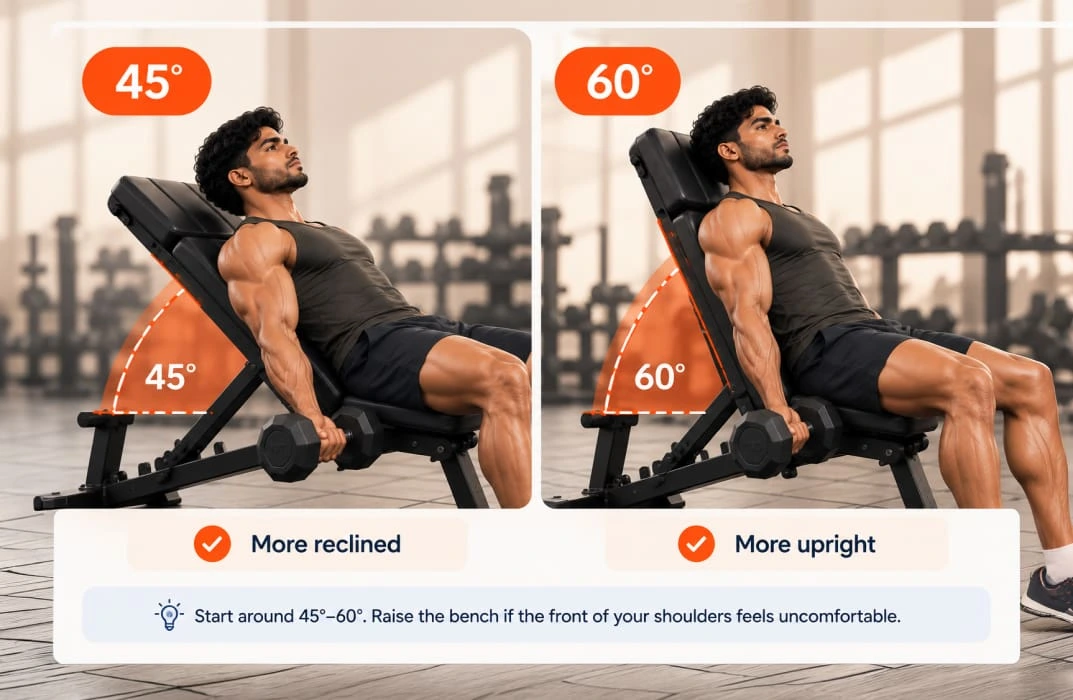
Men’s Health fitness director Ebenezer Samuel, C.S.C.S., recommends a more upright bench when the curl bothers the shoulders: “If you do feel it in your shoulders, it’s more than likely you still have the bench too far back.”
What Weight Should You Use for Incline Dumbbell Curls?
If you normally curl 20 lb in each hand while standing, begin with 10 lb in each hand on the incline bench. This follows Dr. Merrick Lincoln’s suggestion to start with about half your usual weight.
Aim for 8 to 12 reps with the 10 lb pair. If you cannot reach eight controlled reps, use 7.5 lb for your next set. If you reach 12 and could comfortably do more, try 12.5 lb at your next workout. If 8 to 12 reps feel challenging but controlled, stay with 10 lb.
What Muscles Do Incline Dumbbell Curls Work?
Your biceps, on the front of your upper arms, do most of the work. The brachialis beneath them helps bend your elbows, and your forearms help hold the weights. You may feel a gentle biceps stretch at the bottom, followed by effort in the same area as you lift.
A 2009 study of 22 men found that the biceps worked during both the lifting and lowering parts of an incline curl, with higher activity during the lift.
.jpg)
What Are the Benefits of Incline Dumbbell Curls?
- Stronger arms for pulling and lifting. Your biceps help when you pull a dumbbell toward you during a row or hold a heavy bag with your elbow bent. Training them can make those movements feel stronger.
- More shape in your upper arms. Incline curls can help build biceps muscle. In a 2025 study, 33 young women trained incline curls twice a week for eight weeks and gained muscle thickness near the upper part of their arms.
What Incline Dumbbell Curl Mistakes Should You Avoid?
.webp)
ulders dislike the bench angle, one arm tires sooner, or the next pair of dumbbells is too heavy.
If you feel sharp pain in a shoulder, elbow, or wrist, stop the set. Do not use another rep to test whether you can push through it
How Many Sets and Reps Should You Do?
If you’re new to the gym, start with 2 sets of 8 to 12 incline curls, resting about 60 to 90 seconds between sets. Once both sets feel controlled, you can work up to 3.
Put incline curls after your main pulling exercise, such as rows or pulldowns, on an upper-body day or in a push-pull routine. If you also do standing curls that day, you can do those first and use the incline curl afterward. Train it once or twice a week, leaving at least a day between hard biceps sessions.
For example, a pull workout could go: rows → pulldowns → standing curls → incline curls.
If that is more arm work than you need, skip the standing curls. You do not have to do every curl variation in one session.
How Do You Progress With Incline Dumbbell Curls?
Say you did 3 sets of 10 reps with 5 lb dumbbells on Monday’s pull day, and all three sets felt comfortable. At your next pull workout, keep the same dumbbells and aim for 3 sets of 11. When you can do that cleanly, aim for 3 sets of 12.
Once 3 sets of 12 feel controlled, try the smallest heavier pair available, such as 7.5 lb dumbbells. Your reps may drop back to 8–10. Build them up again before increasing the weight. This reps-first approach is a form of double progression.
A lifter on Reddit’s r/workout asked whether to increase the weight when their third set stalled at 10 reps instead of 12. If that happens to you, keep the same dumbbells until you can complete all three sets with control.
If your gym jumps straight from 5 lb to 10 lb, don’t double the weight just because you reached 12 reps. Keep the 5 lb dumbbells and work toward 15 controlled reps, or use adjustable dumbbells or a cable setup that lets you increase the load in smaller steps.
Incline Dumbbell Curl Variations: 10 Ways to Change the Exercise
You don’t need ten curls in one workout. Pick a variation that solves what you’ve noticed: your shoulders dislike the bench angle, one arm tires sooner, or the next pair of dumbbells is too heavy.
Change Your Position on the Bench
1. Paused Incline Dumbbell Curl
Curl the dumbbells halfway up and hold them still for a second. Finish the lift, then lower as usual.
Why try it? The pause quickly reveals whether you’re swinging your elbows forward to get the weights moving. If you can’t hold them still, go lighter.
2. High-Incline Dumbbell Curl
Raise the backrest above your usual setting, to around 60°–75°. Keep your back on the pad and use the same palms-forward grip.
Why try it? Your arms begin less far behind your body. This may feel more comfortable if the standard bench angle bothers the front of your shoulders.
3. Prone Incline Bench Curl, or Spider Curl
Turn around so your chest rests against the inclined backrest. Let the dumbbells hang below your shoulders and curl them without lifting your chest from the pad.
Why try it? Your arms now hang in front of your torso, so the curl feels different from the usual incline version. The chest support also makes it harder to rock your body to lift the weights.
Change Your Grip
4. Supinating Incline Dumbbell Curl
At the bottom, let your arms hang with your palms facing your legs. As you curl, turn your forearms gradually. At the top, your palms face you. Turn them back as you lower. Keep your wrists straight throughout.
Why try it? Your biceps help turn your palms upward as well as bend your elbows. It’s also an option if starting with palms forward feels awkward.
5. Incline Hammer Curl
Hold the dumbbells as though they’re two hammers, with your palms facing each other. Keep that grip for the whole rep. You can see the hand position in this hammer curl technique guide.
Why try it? Along with your biceps, you’ll work the brachialis (beneath the biceps) and brachioradialis (on the thumb side of the forearm) more than you would with a palms-forward grip.
6. Reverse-Grip Incline Curl
Turn your palms toward the floor and keep them there as you curl. Start with a lighter pair than you use for standard incline biceps curls.
Why try it? This grip puts more demand on the muscles along your forearms, particularly the brachioradialis. It’s a forearm-focused change, so don’t judge it against the weight you use for your regular curl.
Change How Your Arms Work
7. Alternating Incline Dumbbell Curl
Curl one dumbbell, lower it fully, then lift the other. Keep both shoulders against the backrest while you switch.
Why try it? Alternating curls let each arm work on its own, a simple form of unilateral training. You’ll notice sooner if one arm tires or starts swinging. Give both arms the same number of clean reps.
8. Slow-Lowering Incline Curl
Lift with your usual grip, then count about three seconds as you lower. If you can do that for the first rep but not the last, try a lighter pair.
Why try it? It gives you a clear way to work on the part of the exercise people often rush. You can make your current dumbbells challenging without moving up in weight yet.
Change the Equipment
9. Cable Incline Curl
Start with one arm. Put the incline bench a short distance in front of a low cable pulley, with its backrest facing the machine. Take the handle, sit down, and lean back. The cable should run beside your arm without rubbing the bench. Curl the handle toward your shoulder, lower it, then switch arms after the set.
Why try it? Your gym’s cable stack may have smaller weight increases than its dumbbell rack. If 10 lb dumbbells feel easy but the next available pair is 15 lb, a cable can give you a step in between.
10. Resistance-Band Incline Curl
Secure a band to a low, sturdy anchor behind the bench and check that it cannot slip. Hold the free end, sit facing away from the anchor, and lean against the backrest. With your arm beside you, curl toward your shoulder. Finish one side, then switch.
Why try it? You can train in the same incline-bench position at home without suitable dumbbells. Choose a band you can control at the top, where the stretch on the band makes it harder to pull.
If you’re picking just one, try alternating curls to focus on each arm or hammer curls to change which arm muscles get more work. Cable and band versions are useful when the equipment, rather than your form, is what’s limiting you.
Put Incline Dumbbell Curls Into Your Next Workout
Start with 2 sets of 8 to 12 reps, using a weight you can lift and lower with control. Record the weight and how many reps you finish in each set.
At your next workout, aim for one more controlled rep with the same dumbbells. You don’t need a heavier pair every session. Those small increases give you a clear way to build stronger biceps over time.
%20to%20Become%20a%20Certified%20Personal%20Trainer-min.avif)