-1.avif)

Starting an online personal training business costs far less than most trainers expect. According to PT Distinction (2025), most trainers launching fully online can do so for under $2,000 in their first month compared to $10,000–$50,000+ for a physical studio. The barrier to entry has never been lower, but the number of separate decisions to make has never been higher: coaching platform, payment processing, website, insurance, marketing, and email, each with its own cost and tradeoff. Obtaining a personal trainer certification is a foundational requirement, ensuring credibility and opening up more career opportunities.
Trainers who waste money at launch over-invest in branding before they have paying clients, then stitch together five tools that a single platform could replace. Understanding your target market and tailoring your services to their specific needs is crucial for effective marketing and business growth. This guide gives the full cost breakdown line by line, so you know what to spend, what to skip, and how to structure your personal trainer pricing to recover costs fast.
Also included: a head-to-head cost comparison of launching with FitBudd vs a DIY tool stack vs HevyCoach so you can see the true total cost before you commit. For more on how to structure your pricing once you’re live, see our guide to personal trainer pricing models. Group training and small group models can help trainers maximize revenue and offer affordable options to clients. Additionally, geographic location, such as Beverly Hills, can significantly impact personal training pricing, with affluent areas allowing for higher rates. However, trainers can still earn a decent income in less affluent areas by adjusting their pricing strategy and service offerings to fit the local market.
FitBudd Demo | Platform for Fitness Coaches: Build Your Fitness App With Ease | FitBudd
How Much Does It Cost to Start an Online Personal Training Business? Full 2026 Breakdown
1. Personal Training Certification: $400–$1,000 (one-time)
A nationally recognized certification is the foundation of a credible personal training business, as the expertise gained through personal trainer certification is essential for establishing credibility with clients. The most widely accepted certifications (NASM, ACE, ISSA, NSCA) cost $400–$1,000, including study materials and the exam. Some, like ISSA, bundle business and nutrition courses into higher-cost packages ($800–$1,200). Ongoing recertification typically costs $150–$400 every 2 years via continuing education credits.
Pursuing additional certifications and training specifically in areas such as working with special populations or medical conditions can further enhance your expertise and open up niche markets, allowing you to serve specialized client segments and justify higher pricing.
Lean launch tip: One nationally recognized cert is enough to start. Specializations can follow once you have revenue and a clearer niche.
2. Liability Insurance: $150–$400/year
Online-only trainers still need general liability insurance, which protects against client injury claims and legal fees. Specialist providers offer comprehensive policies for $150–$400/year. This coverage is non-negotiable and is often required for working with corporate clients or securing corporate wellness contracts.
3. Coaching Software: $0–$500+/month
Your online personal training software is the single most important monthly cost decision. It determines how you deliver workouts, communicate with clients, collect payments, and manage your business. When budgeting for coaching software, remember to factor in equipment and other costs, such as office supplies, technology, and marketing, as these are essential for running your business effectively. The cost range is wide because the tools are very different:
For new online trainers, using resources like Google Sheets can be a simple and effective way to track expenses, plan pricing, or create templates before investing in more advanced software. As an online personal trainer or health coach, providing comprehensive support, including fitness and nutrition guidance, can help clients achieve their health goals. These accessible tools help streamline your business operations from the start.
If you’re unsure which platform is right for you, consider reaching out to the online trainers community for support and advice. Many professionals share their experiences and resources in groups and forums to help you make the best choice. Offering more value and showcasing testimonials can also help you stand out. To effectively increase your personal training prices, it's essential to demonstrate the value you provide to clients, such as through testimonials, success stories, and before-and-after photos.
4. Website and Domain: $100–$500 (one-time) + $10–$30/month hosting
A DIY website via Squarespace, Wix, or WordPress costs $15–$30/month plus a domain ($10–$20/year). Hiring a designer adds $500–$3,000. FitBudd’s Pro plan includes a branded coaching website if you use FitBudd, this cost is already covered. However, it's best to focus on building your client base first; investing in a website is most effective once you have an established group of clients and are ready to scale your business.
5. Payment Processing: 2–3% per transaction
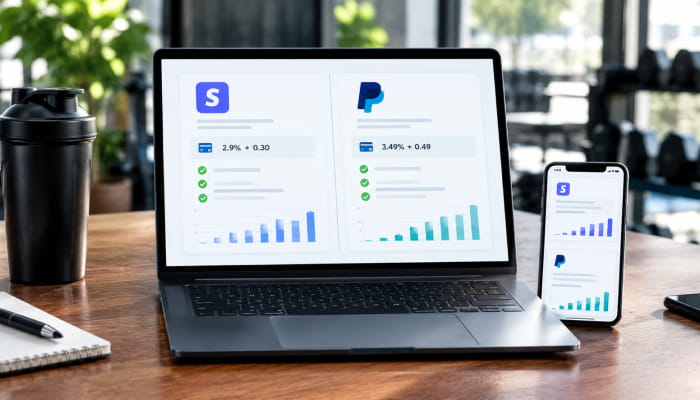
Stripe and PayPal charge 2.5–3.5% per transaction. Some platforms add an extra fee on top. When setting your personal training pricing, it’s important to understand that various factors influence the choice of payment methods, such as service type, payment frequency, and client preferences, as these factors shape the optimal payment solutions for your business and can impact your overall profitability and streamline your payment collection. FitBudd connects directly to Stripe and PayPal with zero platform commission; you pay the processor’s fee only.
6. Email Marketing: $0–$30/month to start
Free tiers of Mailchimp or MailerLite cover 500–1,000 subscribers, enough for the first 12–18 months. Budget $0 in month one; scale to $15–$30/month as your list grows.
7. Marketing and Content Creation: $0–$200/month
Paid ads before you have clients are usually a poor return. Organic first: social content, referrals, and local outreach cost only time. Sharing your own fitness journey can help you connect with your target market and define your ideal audience. Creating content tailored to your target market not only establishes you as an expert but also builds trust, both of which are essential for attracting clients. Utilizing social media and personal networks for marketing is often more effective than traditional advertising, especially for new trainers building their client base. Logo and design via Canva is free; professional design is $100–$500. Budget $0–$100/month in your first three months.
Small, personal gifts or gestures that cost little money can be a budget-friendly way to surprise and delight clients, helping to build rapport and boost client retention.
Additionally, offering more value, such as sharing client testimonials, showcasing visual transformations, or providing unique services, can justify higher rates and increase client willingness to pay, enhancing the perceived worth of your coaching service.
8. Continuing Education and Business Tools: $0–$200/month
Calendly (free tier), Google Meet (free), and Wave accounting (free) cover most early-stage needs. Budget $0–$50/month to start, scaling as the business grows. It's important to track all business expenses, including costs for continuing education and essential tools, to ensure your personal training pricing supports profitability and effective financial planning.
Total Cost to Start an Online Personal Training Business in 2026
*Lean = minimum viable setup to take first clients. Full = professional setup, including paid tools in each category.
Personal training pricing is often calculated per hour, with rates varying based on session length, trainer experience, and whether sessions are delivered as in-person training or online. The average cost of hiring a personal trainer ranges from $30 to $125 per hour, with most clients paying between $40 and $100 per hour, or about $300 to $600 per month. In-person sessions typically command higher rates due to the personalized attention and travel involved, while shorter session lengths (such as 30-minute sessions) may be priced lower than full-hour sessions.
Per-session pricing is a common starting point for personal trainers, but it can limit income growth as trainers become fully booked, leading to the 'time-for-money trap'.
Independent trainers retain 100% of their fees. However, when training at a commercial health club, facilities typically keep a 40% to 70% cut of the training fee.
What Are the Key Steps to Set Up a Successful Online Personal Training Business?
The platform you choose shapes your client experience, payment flow, and how many separate tools you manage. Building an online business enables you to offer online training as a distinct service, reaching more clients and providing flexible pricing options. Here’s the real month-one cost across three common approaches:
DIY and HevyCoach look cheaper on paper. The hidden cost is admin time, manual check-ins, spreadsheet tracking, and tool coordination. Past 10–15 clients, that admin becomes the business’s biggest constraint. FitBudd’s Pro plan at $79/month eliminates that friction from launch.
When creating your service packages, consider including nutrition coaching as a premium offering. This adds value to your online training packages and helps justify higher personal training pricing.
Explore FitBudd’s full pricing and our guide on starting an online personal training business.
Personal Trainer Pricing: How to Recover Startup Costs Fast
The fastest way to recover your online PT business startup cost is to sign your first clients before you’ve finished setting everything up, not after. Offering unique or standout services, such as specialized training sessions, nutrition coaching, or 24/7 support, can help justify higher pricing and attract new clients who are seeking more value from their personal training experience. Here’s a benchmark personal trainer pricing sheet to guide your starting rates:
Note: Personal training sessions and training sessions can be sold individually or as part of personal training packages. Packages help stabilize income by encouraging clients to commit to multiple sessions, while also providing better value for both the trainer and the client. For example, offering 10-session packages at a slight discount incentivizes longer-term commitment and helps avoid the ‘time-for-money trap’ of per-session pricing.
When structuring your pricing, consider models such as subscription-based pricing (monthly retainers with a set number of sessions and predictable recurring costs), pay-as-you-go (highest base rate, maximum flexibility), and tiered pricing packages (good/better/best options). Pay-As-You-Go sessions offer high flexibility but carry the highest base rate. Subscription and package models provide predictable recurring revenue and help build ongoing client relationships. Online coaching subscriptions typically range from $100 to $400 per month, providing customized digital workout plans.
Group training sessions, group classes, and small group training are effective ways to earn more money per hour by training multiple clients at once. These formats are cost-effective for clients and allow trainers to maximize revenue, especially in different economic areas. For instance, small group training sessions can be priced between $20 and $60 per person per hour, making them accessible while increasing your overall earnings.
Premium rates often include additional services such as custom macro/nutrition tracking, 24/7 text support, or exclusive access to resources. Understanding your target market’s willingness to pay and tailoring your pricing and packages to their fitness goals and health needs is crucial for success.
For example, in major metropolitan areas like New York or Los Angeles, personal trainers can charge $100–$150+ per session, while suburban or rural markets typically see rates of $40–$60 per session. Sessions in metropolitan hubs can even reach $150 to $225 per hour, while mid-level markets sit closer to $100 per hour. The average annual wage for personal trainers varies by location, with higher earnings in states like New Jersey, New York, and Connecticut.
Per-session pricing is a common starting point, but as your client base grows, consider shifting to packages or subscriptions to avoid income limitations. When working at a commercial health club, facilities may keep 40% to 70% of the training fee, whereas independent trainers retain 100% but must cover their own overhead.
It's worth noting that when demand remains strong, increasing your personal training rates can be a smart move to maximize your earning potential.
Implementing scarcity marketing, such as limited-time offers or exclusive packages, can create urgency and increase demand for your services, allowing you to command higher rates. Fitness professionals, online personal trainers, and health coaches who deliver more value, showcase testimonials, and help clients achieve their fitness goals are more likely to attract prospective clients and justify premium pricing. Many trainers prefer to use initial discovery calls for high-ticket or fully custom programs rather than listing fixed prices online.
Building a strong client base and offering services tailored to specific demographics or health needs can further support higher rates and long-term business growth. Remember, your fitness business can include in-person, online, and hybrid approaches, and personal training (one-on-one, hybrid, or in-person) impacts your pricing strategy and the value you deliver. Monthly rates for online personal training typically range between $100 and $500+, depending on the level of customization and direct access provided to clients. As an online personal trainer, setting appropriate rates ensures you are properly compensated for your expertise in the online fitness industry.
For more on structuring your pricing, see our guide on how to price your online fitness coaching services.
Launch Your Online PT Business Without Overspending
The online PT business startup cost in 2026 is genuinely low if you make the right software decision from day one. Most trainers recover their month-one investment within 30–60 days of signing their first clients. The platform you choose determines whether you spend those first weeks coaching or managing admin.
FitBudd's Pro plan at $79/month gives you workout delivery, nutrition, client check-ins, video calling, a branded website, and direct payments, everything you need to launch and run a professional online coaching business, without piecing together five separate tools.
Book a demo to see the full platform before you decide.