

Walking 10,000 steps takes between about 1 hour 17 minutes and 2 hours 5 minutes of continuous walking, depending on your cadence. At an average moderate cadence of 100 steps per minute, 10,000 steps takes exactly 1 hour 40 minutes. The table below divides 10,000 by each cadence, so the times are arithmetic and hold for anyone walking at that rate.
The intensity markers come from the CADENCE-Adults study (2019) in the International Journal of Behavioral Nutrition and Physical Activity, which tested adults aged 21 to 40. In that study, 100 steps per minute marked moderate intensity and about 130 steps per minute marked the start of vigorous walking. Across the studies in the 2018 review, walking speeds of 2 to 4 mph lined up with cadences of 96 to 134 steps per minute. So 10k steps takes a little under 1.5 hours for a brisk walker and close to 2 hours for a relaxed one.
Your height and stride change how far those steps carry you, though they change the clock less than cadence does. The distance side is worked out in our guide to miles in 10,000 steps, which breaks it down by height.
How Many Minutes Is 10K Steps for You?
Your personal time for 10,000 steps is 10,000 divided by your own cadence, which you can measure in one minute. Counting steps removes the guesswork of estimating pace in mph, and the steps below work outdoors or on a treadmill.
- Walk for 3 to 5 minutes at the pace you plan to use, so your rhythm settles.
- Start a 60-second timer on your watch or phone without slowing down.
- Count every footstep, left and right, until the timer ends. That number is your cadence.
- Divide 10,000 by your cadence to get your walking minutes. A count of 105 gives 95 minutes.
- Repeat the count on a second day, because cadence drops on hills, in crowds and when you are tired.
How many minutes it would take you to walk 10,000 steps also depends on stops. Traffic lights, a dog that sniffs every post and conversation breaks all add elapsed time without adding steps. A 95-minute walking estimate can easily become 110 minutes on the clock. Cadence also tends to fall with age and with lower fitness, according to the 2018 review, so recount every few months if your walking routine changes.
How Many Steps Is a 30-Minute Walk?
A 30-minute walk produces about 2,400 to 3,900 steps, depending on whether you stroll at 80 steps per minute or walk fast at 130. At the moderate threshold of 100 steps per minute, 30 minutes equals 3,000 steps. That figure became a public-health target after a San Diego State University team led by Simon Marshall proposed "3,000 steps in 30 minutes" as a simple pedometer goal. The study appeared in the American Journal of Preventive Medicine in 2009.
The same study suggested starting with 1,000 steps in 10 minutes, which gives you a quick check during any walk. If your tracker shows fewer than 1,000 steps for a 10-minute stretch, you are walking below moderate intensity and your 10,000-step walk will take longer than 100 minutes.
A 30-minute walk at 100 steps per minute covers 3,000 of your 10,000 daily steps. Three of those walks, plus the steps you take around the house and at work, put most people at or near the goal. For other step counts, the steps to miles chart converts anything from 1,000 to 30,000 steps into distance and time.
How Many Steps Is an Hour Walk?
An hour of walking produces about 4,800 to 7,800 steps at cadences of 80 to 130 steps per minute, and about 6,000 steps at a moderate 100. That means a single 60-minute walk rarely reaches 10,000 steps on its own. To hit 10,000 steps in one hour you would need to average about 167 steps per minute. That is well above the 130 steps per minute where vigorous walking begins, and most walkers reach it only by breaking into a jog.
A realistic plan pairs the hour with the steps your day already contains. If errands, stairs and office movement give you 4,000 steps, one hour at 100 steps per minute closes the gap.
How Long Does 10,000 Steps Take Real Walkers?
Walkers who share their numbers in public forums land close to the cadence table. In a Mumsnet thread titled "how many steps do you do a day?" (May 2025), one member described a pace between the 80 and 90 steps per minute rows:
"~4000 steps takes me around 45 minutes"
That works out to about 89 steps per minute, so 10,000 steps would take close to 1 hour 52 minutes. The same member put 10,000 steps at about 2 hours of walking. Another member of that thread wrote that a 50-minute walk is what they need to hit their target.
Other threads report faster walking. A Mumsnet thread titled "10,000 steps" (June 2022) includes the rule of thumb "10 minutes brisk walking per thousand steps", which is exactly the 100 steps per minute row. A different member of that thread said a regular three-mile walk of about an hour gives 6,000 steps, which matches the hour-walk figure above.
Height changes the answer too. A Mumsnet thread titled "10,000 steps a day seems impossible??" (February 2023) includes a member who is 5 ft 3 in (160 cm). They said 10,000 steps takes about an hour and a half. A second member suggested "3 X 30 minute walks will do it."
The limits of a single walk show up in a Mumsnet thread titled "How do you do 10,000 steps a day when working in desk job?" (August 2021). One member wrote that a "60-80 minute brisk walk isn't enough" to reach 10k.
The reported times run from about 90 minutes to 2 hours, inside the range of the table. Each post describes one person's pace, so treat these as examples rather than averages.
How Long Does It Take to Get 10,000 Steps in a Normal Day?
Getting to 10,000 steps in a normal day takes less dedicated walking than the 100-minute figure suggests, because your everyday movement already counts. Steps from commuting, shopping, chores and moving around the office build a baseline before you add any walk. Your dedicated walking time is the gap between that baseline and 10,000, divided by your cadence.
Use this formula: walking minutes needed = (10,000 minus your usual daily steps) divided by your cadence. Check your baseline by reading your phone or watch total on two or three days when you do not go for a walk. Your daily step total also feeds into your energy expenditure, which a TDEE calculator estimates from your activity level.
Here is a worked example for a hypothetical desk worker. If their usual day produces 4,000 steps and their measured cadence is 100 steps per minute, they need 6,000 more steps, which is 60 minutes of walking. If their baseline is 6,000 steps and their cadence is 110, they need 4,000 more steps, or about 36 minutes.
Time on the clock varies far more than walking time. According to the 2018 cadence review, US adults spend about 5 minutes a day at 100 to 119 steps per minute. They spend about 2 minutes a day at 120 or faster. That is why your baseline matters: the walk only has to cover the steps the rest of your day does not.
How Can You Split 10,000 Steps Across Your Day?
You can split the walking time for 10,000 steps into as many short walks as you like, because steps from short walks still count toward your health. The US Physical Activity Guidelines dropped the old rule that activity must happen in bouts of at least 10 minutes, as the American College of Sports Medicine explained in 2019. Your total minutes matter more than how you package them, and our guide to getting 10k steps a day covers practical ways to fit the walks in.
A 2025 study of 3,072 US adults in the Journal of Physical Activity and Health tracked sporadic steps and steps taken in walks of 10 minutes or longer. Each extra 1,000 sporadic steps was linked to about 10% lower all-cause mortality in that 2025 analysis by Wang and Ma. Each extra 1,000 steps in longer walks was linked to about 27% lower mortality in the 2025 data. The authors concluded that both patterns can count toward a daily goal.
The schedules below assume a cadence of 100 steps per minute and a baseline of 4,000 steps from daily life.
The three-meals schedule has an extra benefit for blood sugar. A 2022 meta-analysis in Sports Medicine found that light-intensity walking breaks during long sitting periods significantly lowered post-meal glucose and insulin compared with continued sitting.
Tying each walk to a routine you already have, such as lunch or the commute, makes a split schedule easier to repeat. The same idea underlies a habit-based lifestyle: a small action attached to a cue you already have each day.
How Can Personal Trainers Use the 10,000-Step Goal With Clients?
Personal trainers can turn the 10,000-step goal into a prescription a client can act on: a cadence, a number of walking minutes and a daily schedule. Asking a client to "walk more" rarely changes behavior, but "two 30-minute walks at 100 steps per minute" is specific and measurable. Start with each client's baseline, divide the gap to 10,000 by their cadence, and set the resulting minutes as the weekly target.
FitBudd, a white-label fitness coaching platform, lets coaches offer a client app under their own brand. On the Super Pro plan the app is fully white-labeled and published on iOS and Android. A step target can then sit inside your own custom fitness app next to workouts and check-ins.
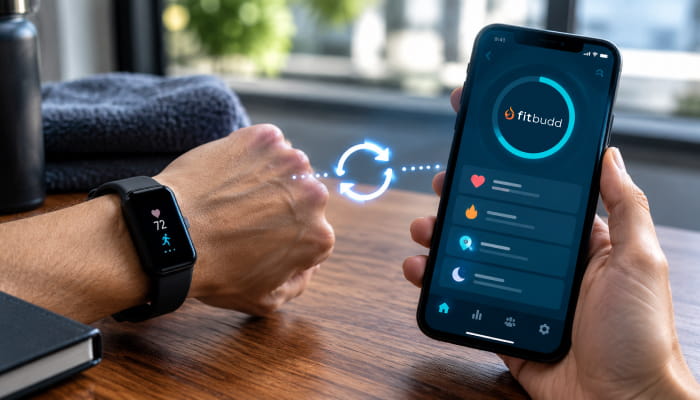
The steps themselves come from the wearable each client already owns, because the client app connects to Apple Health and Fitbit. Pick one step source for each client and keep it, so that week-to-week changes reflect walking rather than a change of device.
On iOS, clients can connect wearable devices from the Connect Apple Health / Fitbit tile. The client app home page then shows grids for Steps, Move Energy, Distance and Flights, according to FitBudd's help center (2025).
Start from the baseline, add 10 to 20 walking minutes a day, and raise the target only after the client hits it for a full week.
Clients who wear a Fitbit can keep using it, on iOS or Android. They connect Fitbit to the client app to synchronize supported activity data. FitBudd's help center (updated August 2026) says the connection is made from the client app, not from the coach's FitBudd dashboard.
Before offering the prescription to every client, pilot it with two or three clients for four weeks and compare their average daily steps with the target.
FitBudd's fitness client dropout report (2026) reviews the habit research behind early client dropout. It reports an average of 66 days for a habit to become automatic. It recommends predictable check-ins on a fixed schedule over the first 90 days, because consistency matters more than frequency. For a step goal, that supports one fixed weekly review of each client's average rather than daily messages about single days.
An average smooths out rest days, travel and bad weather. If a client misses the target two weeks running, lower it to the last number they hit.
The same report says visible progress supports a new client's sense of competence before they feel any improvement themselves. FitBudd's progress tools let you track client progress across check-ins, so each client's trend is visible at every review.
A group goal suits clients who respond to friendly competition. Set it in walking minutes rather than raw steps so slower walkers can compete fairly.
FitBudd's list of virtual fitness challenges includes a step count challenge you can adapt to that kind of group goal.
Start Your 10,000-Step Plan This Week
- Count your steps for 60 seconds at your usual walking pace to find your cadence.
- Read your phone or watch total on two or three non-walking days to find your baseline daily steps.
- Subtract the baseline from 10,000 and divide the result by your cadence to get your daily walking minutes.
- Choose one schedule from the split table and put those walks in your calendar this week, keeping the goal specific and time-bound as in SMART fitness goals.
- Add 10 to 20 minutes only after you hit the target for a full week.
Prescribing each client walking minutes instead of a vague step count takes a branded client app where those minutes sit next to workouts and check-ins. Start Free Trial with FitBudd, a white-label fitness coaching platform, and launch your own.