





10 min read
Walk into most gyms, and you will find athletes trying to build strength, power, conditioning, and technique all at the same time, week after week. The logic seems sound: train everything, improve everything. The problem is that the body does not adapt that way at advanced levels.
Mixed, simultaneous training stimuli produce shallow adaptations across many qualities rather than deep adaptations in any single one.
For beginners, who respond to almost any training stress, this does not matter. For intermediate and advanced athletes, it is the primary reason progress stalls.
Block periodization was developed as the structural answer to this problem. Instead of training all qualities in parallel, it trains them in sequence. Each block creates a concentrated physiological environment for a specific adaptation, and then the next block builds directly on what the previous one established.
The result is deeper adaptation, better fatigue management, and the ability to peak at a planned time rather than hoping fitness aligns with competition day.
What Is Block Periodization? Definition and Origins
Block periodization divides a macrocycle (the full training year or season) into sequential mesocycle blocks, each focused on just one or two physical qualities at a time. Instead of maintaining strength, power, endurance, and speed simultaneously, each block applies maximal stimulus to its primary target while holding secondary qualities at a reduced maintenance dose. This concentration is the entire point: a focused training signal drives deeper adaptation than the same volume scattered across every quality at once. It is why block periodization outperforms traditional models specifically for intermediate and advanced athletes, who no longer respond to general, distributed training.
The conceptual foundation was laid by Soviet sports scientist Yuri Verkhoshansky in the 1970s and 1980s, who demonstrated that concentrated loading of a single quality produced superior adaptation compared to mixed training approaches. His "block" or "conjugate sequence" system showed that high-level athletes needed concentrated rather than distributed training stress to continue progressing.
Vladimir Issurin, researcher at the Wingate Institute in Israel, formalized and refined this approach into the three-block model that most coaches use today.
His 2008 review in the Journal of Sports Medicine and Physical Fitness, along with his foundational texts on block periodization, provided the scientific framework, identifying the three core block types, the residual training effect principle that determines block sequencing, and the biological mechanisms underlying each phase. His 2019 Sports Medicine review paper added the specific physiological underpinnings of each block at the cellular level.
The central contribution of both researchers was the same: for advanced athletes, the concentration of training stimulus is more important than its breadth.
Residual Training Effects: The Core Principle Explained
The concept that makes block periodization structurally viable rather than just intuitively appealing is the residual training effect: the period during which the adaptations built in one training block are retained after that block ends and training focus shifts.
Different physical qualities have very different residual durations. Aerobic endurance adaptations (increased mitochondrial density, capillary networks, stroke volume) persist for approximately 25 to 35 days after aerobic training volume drops. Maximal strength adaptations last for 25 to 35 days. Anaerobic power remains for approximately 18 to 25 days. Maximum speed qualities are the most volatile, retaining for only 4 to 8 days.
This variation is not arbitrary. It is the structural logic for sequencing blocks. The aerobic base built in an accumulation block will still be present when the transmutation block begins, allowing the athlete to push anaerobic and speed qualities on top of that aerobic foundation.
The strength built in transmutation is retained long enough to support the realization block's power expression. Each block is sequenced to exploit the residual effect of the previous one rather than starting from zero.
Residual training effect duration by quality:
This table determines block sequencing. Qualities with long residuals are developed early. Qualities with short residuals are developed closest to the competition.
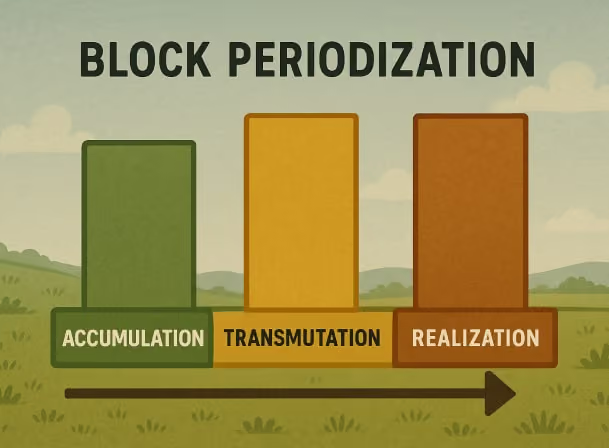
The 3 Block Types: Accumulation, Transmutation, Realization
Block 1: Accumulation (Base-Building Phase)
The accumulation block establishes the foundational physiological base that all subsequent blocks build upon. It is the highest-volume, lowest-average-intensity block in the sequence.
Primary targets: Aerobic capacity, muscular endurance, work capacity, foundational strength, and basic technical skills. The goal is to raise the ceiling of what the athlete can tolerate and adapt to, not to express peak performance.
Loading parameters: High volume (typically the highest in the macrocycle), moderate intensity (60 to 75% of 1RM for strength work, zone 2 to zone 3 for aerobic work), multiple sessions per day or per week targeting the same qualities.
Duration: 3 to 6 weeks, with 4 weeks being the most common.
Biological mechanisms: Issurin's 2019 Sports Medicine review established that voluminous accumulation training primarily stimulates mitochondrial biogenesis and protein synthesis in slow-twitch (Type I) muscle fibers. The aerobic metabolic machinery of the muscle is expanded: more mitochondria per fiber, greater oxidative enzyme activity, and increased capillary density. This is the block where the engine is enlarged, not where it is redlined.
For strength-focused athletes, accumulation typically features higher rep ranges (8 to 15 per set), more sets, shorter rest periods, and a broader exercise selection targeting general movement patterns and structural weak points rather than competition-specific exercises.
What accumulation is not: It is not an easy block. High volume at moderate intensity is genuinely demanding. Athletes often experience significant fatigue during accumulation weeks, and performance on maximal efforts typically declines temporarily as accumulated fatigue suppresses expression. This is expected and does not indicate poor programming.
Block 2: Transmutation
The transmutation block converts the base built during accumulation into sport-specific and competition-relevant physical qualities. Volume decreases while intensity increases. The athlete's improved work capacity, aerobic base, and foundational strength from accumulation create the physiological environment in which higher-intensity transmutation training produces superior results.
Primary targets: Sport-specific strength, anaerobic power, speed endurance, maximal strength expression, and specialized technical skills. The qualities trained here are those that directly predict performance in the athlete's event or sport.
Loading parameters: Moderate volume (significantly lower than accumulation), high intensity (80 to 90%+ of 1RM for strength work, zone 4 to zone 5 for interval-based work), greater emphasis on competition-specific movement patterns.
Duration: 3 to 5 weeks. Transmutation is typically shorter than accumulation because the high-intensity work it demands cannot be sustained without accumulating excessive fatigue.
Biological mechanisms: Issurin's research demonstrates that transmutation's lower-volume, high-intensity workloads evoke adaptive modifications specifically in fast-twitch glycolytic (Type IIx) and oxidative-glycolytic (Type IIa) muscle fibers. The fast-twitch machinery built on top of the slow-twitch aerobic base created in accumulation is what produces sport-specific power. Myonuclear content in muscle fibers increases markedly during this phase, providing the cellular machinery for subsequent rapid adaptation.
For strength-focused athletes, transmutation typically features lower rep ranges (3 to 6 per set), heavier loads, longer rest periods, and an increasing proportion of competition-specific movements.
Block 3: Realization (Peaking and Taper Phase)
The realization block prepares the athlete for peak competitive performance. Volume drops to its lowest point in the macrocycle, intensity is either maintained or also reduced, and the primary goal is to remove accumulated fatigue to allow full expression of the fitness built during the previous two blocks.
Primary targets: Maximum speed, competition-specific power expression, tactical preparation, and full recovery from accumulated fatigue. The athlete is not building new fitness during realization; they are allowing the fitness already built to surface.
Loading parameters: Low volume (30-50% of peak accumulation volume), maintained or slightly reduced intensity, and high specificity to competition demands.
Duration: 1 to 3 weeks. Realization is the shortest block because it is essentially a structured peaking-and-taper phase.
Biological mechanisms: Issurin's research shows that the realization block produces accentuated expression of stress-related and myogenic genes that affect protein synthesis, increase muscle glycogen content, and enlarge the size, force production, and power output of fast-twitch fibers. The performance gains that appear during realization are not the result of new training stimulus; they are the result of previously built adaptations fully expressing themselves once fatigue is removed.
This is why athletes who have trained correctly throughout accumulation and transmutation frequently set personal records or peak competition performances during the realization block even though training intensity and volume have decreased. The fitness was built weeks earlier. The taper makes it visible.
The Three-Block Sequence: How They Work Together
The power of block periodization is not in any individual block but in the sequence. Each block is designed to produce adaptations that the next block will leverage.
Accumulation creates the aerobic engine and structural base. Transmutation sits on that base and adds sport-specific horsepower. Realization removes the fatigue accumulated across both previous blocks and allows full performance expression. Then the cycle repeats.
Standard three-block sequence for a strength and power athlete:
A full sequence of accumulation, transmutation, and realization constitutes one training stage, typically lasting approximately 8 to 12 weeks.
Multiple training stages can be arranged within a macrocycle, allowing multiple performance peaks across a competitive season.
Does Block Periodization Work? The Research Evidence
Research on block periodization is strongest in endurance sports, where training stress is most quantifiable, but the findings are relevant across contexts.
A frequently cited study from Lillehammer University College in Norway divided 19 trained cyclists into two groups. One group followed a block periodization model, concentrating five high-intensity sessions within a single week, followed by three weeks of lower-intensity training.
The traditional periodization group spread two high-intensity sessions evenly across all four weeks. Total interval volume was identical between groups.
After four weeks, the block periodization group increased their VO2max by an average of 4.6% and their submaximal power output by 10%. The traditional group showed no significant change in either measure.
The mechanism the researchers proposed was consistent with Issurin's framework: concentrated loading produces a stronger initial adaptive signal than distributed loading of the same total volume. The body responds more forcefully to a concentrated stimulus than to the same stimulus spread across time.
A systematic review and meta-analysis published in the Open Access Journal of Sports Medicine found that block periodization approaches generally show advantages over traditional training for well-trained athletes, consistent with the theoretical rationale that advanced athletes need greater concentration of training stimulus to continue progressing.
The review noted that recreational athletes and beginners, who are far from their genetic ceiling, often respond equally well to both approaches.
Block Periodization vs Other Periodization Models
Understanding where block periodization fits in the landscape of training organization helps coaches choose the right model for each client.
Linear periodization gradually increases intensity while decreasing volume over a single training phase, resulting in a single peak. It is simple, predictable, and highly effective for beginners and athletes preparing for a single annual competition. Its limitation is that it produces only one peak per macrocycle and cannot efficiently develop multiple qualities for athletes with complex competitive calendars. The FitBudd guide to linear periodization covers its structure, uses, and who benefits most.
Daily undulating periodization (DUP) varies training intensity and volume daily or weekly, training multiple qualities within every week. It is more flexible than linear periodization and is well-suited to intermediate athletes who need variety and cannot afford to neglect any quality for weeks at a time. It lacks the concentrated loading depth of block periodization. The FitBudd guide to daily undulating periodization covers its programming structures and applications.
The conjugate method trains all qualities simultaneously each week through a rotating schedule of max-effort, dynamic-effort, and repeated-effort sessions. It excels at preventing detraining and developing concurrent multi-quality fitness, but does not produce the same depth of adaptation in any single quality that concentrated block loading achieves.
Block periodization produces the deepest single-quality adaptations of any periodization model, making it the superior choice for advanced athletes who have already developed all foundational qualities and need further concentrated improvement. Its cost is that de-emphasized qualities will partially detrain during each block, which is why the residual effect concept is so central to the model's design.
Periodization model comparison for coaches:
Who Should Use Block Periodization
Well-Suited Populations
Intermediate and advanced athletes with 2 or more years of training are the primary audience for block periodization. These athletes have already developed all foundational physical qualities through simpler programs, and their adaptation rate to mixed, distributed training has slowed. Concentrated loading is required to continue driving meaningful progress.
Athletes with multiple competitive peaks during a season benefit from block periodization's ability to cycle through multiple training stages within a macrocycle. A track athlete competing in both indoor and outdoor seasons, a powerlifter planning two or three meets per year, or a team sport athlete with pre-season and in-season performance requirements can structure multiple accumulation-transmutation-realization cycles to peak at planned times.
Athletes who have stalled on linear or DUP programs often respond well to block periodization because the concentrated stimulus provides a qualitatively different adaptive signal compared to the distributed training they have been doing. The novel stimulus concentration, rather than just a change in specific exercises, drives renewed adaptation.
Coaches managing athletes with identified specific weaknesses can use block periodization to temporarily concentrate training emphasis on the limiting quality. An endurance athlete who lacks power can run an accumulation block targeting strength and work capacity, a transmutation block developing speed and power, and a short realization block before their target race. The blocks are tailored to the athlete's specific gap.
Less Well-Suited Populations
Beginners do not need block periodization. They respond to almost any form of progressive overload and benefit most from frequent exposure to all movement patterns throughout a training week. Concentrating loading into blocks before foundational motor patterns and basic strength are established wastes the novelty response that makes beginner programming so productive.
Athletes with unpredictable competitive calendars struggle with block periodization because the realization block must align precisely with competition. If competition dates shift, the taper will not coincide with peak fitness.
General fitness clients without performance goals typically benefit more from DUP or modified linear approaches that maintain all qualities simultaneously. If there is no competition to peak for and no specific quality gap to address, concentrated block loading does not offer clear advantages over simpler programs.
Practical Block Periodization Examples
Example 1: Powerlifter Preparing for Competition (12 Weeks)
This structure applies to a powerlifter with a meet scheduled at week 12.
Accumulation (Weeks 1 to 4) Primary focus: Hypertrophy and work capacity. All three competition lifts were trained 3 to 4 times per week in varied forms (pause squats, Romanian deadlifts, close-grip bench). Volume is highest here. Intensity stays at 65 to 78% of 1RM. Sets of 4 to 6 at 6 to 8 reps dominate the programming. Accessory work is extensive.
Transmutation (Weeks 5 to 9) Primary focus: Maximal strength. Competition-specific lift variations increase in proportion. Intensity climbs to 80 to 92% of 1RM. Rep ranges drop to 2 to 5. Volume decreases by 30 to 40% from the accumulation peak. Rest periods lengthen. Accessory work reduces to only the highest-priority movements.
Realization (Weeks 10 to 12) Primary focus: Peaking and competition preparation. Volume drops to 40-50% of peak accumulation volume. Competition lifts at competition-specific loads and conditions. Weeks 10 and 11 include final heavy singles or doubles at 90 to 95%. Week 12 is meet week with a full taper.
Example 2: Endurance Athlete Preparing for a Target Race (10 Weeks)
Accumulation (Weeks 1 to 4) High-volume aerobic base training at zone 2. Strength training 2 days per week with compound movements at moderate loads. Long runs or rides at low intensity. Total aerobic volume is at its weekly peak.
Transmutation (Weeks 5 to 8) Aerobic volume is maintained, but intensity increases significantly. High-intensity interval sessions (zones 4-5) were introduced 2 times per week. Race-pace work begins. Strength training is maintained at reduced volume to preserve adaptations. Total volume decreases slightly from accumulation.
Realization (Weeks 9 to 10) Volume drops sharply. Race-pace and faster-than-race-pace sessions are maintained but shortened. Final long run or ride at moderate intensity. Race week is the final 7 days with progressive reduction in all training stressors.
Example 3: Simplified Block Structure for a General Fitness Client (9 Weeks)
For a client with no competition but a specific fitness goal (e.g., a body composition transformation or functional fitness improvement), blocks can be simplified while preserving the concentrated-loading principle.
Foundation Block (Weeks 1 to 3): Higher reps (10 to 15), moderate loads, full-body sessions 3 times per week. Goal: movement quality, work capacity, and baseline fitness.
Strength Block (Weeks 4 to 6): Lower reps (5 to 8), heavier loads, progressive overload session to session. Goal: maximal strength improvement across all primary patterns.
Performance Block (Weeks 7 to 9): Moderate reps (6 to 10), maintained loads, higher training density with shorter rest periods. Goal: convert strength gains into functional capacity and body composition improvements.
For coaches building these structures across a client roster, the FitBudd guide to mesocycle training covers block design, duration selection, and progression across mesocycles in detail.
How to Implement Block Periodization: A Coach's Guide
Assess Before Sequencing
Block periodization requires knowing the athlete's current level for each relevant quality before designing the block sequence. An athlete with a weak aerobic base needs a longer accumulation block. An athlete whose limiting factor is maximal strength may need an extended transmutation phase. The block sequence should be built around the athlete's actual gap, not a generic template.
The assessment protocols covered in the FitBudd periodization templates guide provide a practical framework for establishing baseline measures before designing block sequences.
Build Deloads Into Block Transitions
The transition between blocks is not simply a change in training focus. It is an opportunity for planned recovery that sets up the next block for success. A 3 to 5-day reduced-volume period between blocks, sometimes called a "mini-deload," allows accumulated fatigue from the preceding block to dissipate before new concentrated loading begins.
The FitBudd guide to deload weeks covers the structure, timing, and volume-reduction protocols that apply between block periods in block periodization.
Maintain Minimized Secondary Qualities
A critical misunderstanding about block periodization is that qualities not in focus should be completely eliminated. This is incorrect. De-emphasized qualities should be maintained with a reduced but present training stimulus, typically 20 to 30% of the volume used during their primary development block.
This prevents meaningful detraining while preserving the concentrated loading advantage. Issurin explicitly notes that the complete elimination of secondary qualities results in steeper detraining curves than the residual-effect model predicts.
Match Block Length to Training Age
Younger training-age athletes adapt more slowly and generally benefit from longer blocks (4 to 6 weeks) to allow full adaptation to the concentrated stimulus. Advanced athletes with faster adaptation rates can use shorter blocks (2 to 4 weeks) before the concentrated stimulus loses novelty.
The most common error in implementing block periodization is using blocks that are either too short (insufficient time for deep adaptation) or too long (exceeding the point of diminishing returns before moving forward).
Track Progress at Block Transitions
Each block transition is a natural assessment point. Testing primary qualities at the end of each block provides objective data on whether the block produced the intended adaptation, informs adjustments to the next block's loading, and motivates athletes by making progress visible. Strength athletes can test a relevant lift. Endurance athletes can test a time trial or VO2max proxy. The data gathered here, when tracked across multiple training stages, produces the longitudinal performance picture that makes coaching increasingly precise over time.
Advantages and Limitations of Block Periodization
Advantages
- Superior adaptation depth for advanced athletes: Concentrated loading at high volume or high intensity produces a stronger adaptive signal than the same training distributed over time. This is the primary reason block periodization outperforms traditional models for athletes who have already exhausted the simpler approaches.
- Planned multi-peak performance: The sequential three-block structure can be repeated across a macrocycle, allowing an athlete to peak two, three, or four times in a year, depending on their competitive calendar. Traditional linear periodization typically produces only one peak.
- Better fatigue management: By concentrating stress in blocks rather than maintaining all qualities simultaneously, block periodization creates natural fatigue accumulation and recovery cycles. The realization block removes fatigue precisely before competition rather than hoping accumulated mixed training stress resolves in time.
- Clear coaching framework: Each block has a specific primary objective, defined loading parameters, and measurable outcomes. This makes programming decisions easier for coaches because the goal of each session is clear within the current block.
Limitations
- Requires sufficient training age: Beginners and early intermediates do not respond sufficiently differently to concentrated versus distributed loading to justify the added complexity of block periodization. For these populations, simpler models produce equivalent or better results with less planning burden.
- Quality detraining between blocks: The qualities not in primary focus will partially train during each block. This is by design, but it means athletes may temporarily underperform on de-emphasized qualities mid-cycle. Coaches and athletes must understand that this is expected, not a programming failure.
- Reduced flexibility for unpredictable schedules: Block periodization's effectiveness depends on the realization block aligns with the competition. Athletes whose competition schedules shift unexpectedly may find themselves peaking at the wrong time.
- Requires athlete self-awareness: Athletes performing transmutation and realization blocks must be able to distinguish between productive fatigue (the body responding to training stress) and overreaching (training stress exceeding recovery capacity). This requires experience that newer athletes have not yet developed.
Conclusion
Block periodization is not a complicated idea dressed in technical language. It is a straightforward response to a real problem: that advanced athletes need concentrated training stress to continue adapting, and that training all qualities simultaneously at moderate levels stops producing results past a certain training age.
The accumulation, transmutation, and realization sequence works because it is built on how adaptation actually works at the physiological level. Aerobic machinery is built first because it takes the longest and provides the base for everything that follows. Sport-specific power is built second, on top of that base. Competition performance is expressed third, once fatigue has been removed and the adaptations from the previous two blocks can finally surface.
For coaches, block periodization provides a clear programming logic that makes every session's purpose explicit within the context of the current block, makes athlete progress measurable at each block transition, and makes competition peaking a plannable outcome rather than an optimistic estimate.
FitBudd gives coaches the infrastructure to design, deliver, and track block periodization programs across entire client rosters: phased programming blocks, session-by-session volume and intensity tracking, progress benchmarking at block transitions, and client communication built directly into the platform. Start your free 30-day trial at FitBudd and build the programs that produce peak performances when they actually matter.
%20to%20Become%20a%20Certified%20Personal%20Trainer-min.avif)