

If you're a personal trainer trying to manage clients across WhatsApp messages, a Google spreadsheet, a scheduling app, and a separate payment tool, you already know the problem. None of those things talk to each other, nothing is automated, and every hour you spend chasing admin is an hour you're not coaching.
That's the gap CRM software is supposed to fill. But here's the honest truth: most CRM tools were built for sales teams, not fitness coaches. They're designed for deal pipelines and contact databases, not for tracking workout compliance, sending check-in reminders, or delivering next week's training program to a client who just hit a PR.
This guide breaks down the 10 best personal trainers for 2026. It includes both traditional CRMs and coaching platforms that serve the same function more effectively for fitness professionals, as most trainers find that a purpose-built coaching platform entirely replaces the need for a standalone CRM.
What Is the Best CRM for Personal Trainers?
Before getting into the list, let's address the question directly. A traditional CRM (Customer Relationship Management tool) focuses on lead capture, pipeline management, and contact tracking. That's useful, but it's only part of what a personal trainer actually needs to run a client-facing business.
What trainers actually need from software:
- Client profiles that include health history, goals, injury notes, and progress metrics, not just a name and email address
- Scheduling and booking with automated reminders to reduce no-shows
- Program delivery so clients can access their workout plans without the trainer manually sending PDFs
- Check-in automation to track weekly compliance without manually messaging 40 clients
- Payment collection that doesn't require a separate tool and a manual invoice process
- Progress tracking is visible to both the coach and the client
- Nutrition tools, if your coaching model includes meal planning
With that framework in mind, here are the 10 tools worth considering in 2026.
Also read: Best CRM Software for Fitness Coaches
Head-to-Head Comparison: Best CRM for Personal Trainers 2026
Top 10 CRM and Client Management Tools for Personal Trainers (2026)
1. Mindbody, Best for Studio and Multi-Location Gym Businesses
Pricing: Starts at approximately $99/month (quote-based). Verified from user reports on Capterra and G2; Mindbody does not publish prices directly and requires a sales call for exact quotes.
Mindbody is the dominant platform in the boutique studio and wellness business space, and it's built for exactly that: multi-staff locations with class schedules, membership management, and a large client volume. It handles scheduling, payments, marketing automation, staff management, and reporting. The AI front desk feature and 700+ partner integrations are genuinely impressive for larger operations.
Where Mindbody falls short for individual personal trainers is price and complexity. The starting price is significantly higher than most solo-coach alternatives, onboarding can take weeks, and the interface is widely described as complex for smaller operations.
Who it's best for: Studio owners, boutique gym operators, or wellness businesses with multiple trainers, locations, and class schedules who need enterprise-level management tools and can justify the cost with volume.
2. PushPress, Best for CrossFit Boxes and Group Fitness Studios
Pricing: Free (Core plan) | Pro $159/month | Max $229/month.
Pricing verified from pushpress.com/pricing and PushPress blog (February 2026)
PushPress is specifically built for gym owners and is particularly popular with CrossFit boxes and functional fitness facilities. The Core plan is genuinely free with no monthly software fee (you pay higher processing rates), and the Pro plan at $159/month covers automated billing, class scheduling, member management, and reporting.
The CRM functionality lives in PushPress Grow ($329/month), which includes lead capture, automated follow-up sequences, email and SMS marketing, a website builder, and pipeline management. It's a solid CRM if you're running a membership-based gym with active lead generation needs. The challenge is that the full feature set requires stacking multiple modules: Core for operations, Train for workout programming, Grow for CRM, and a branded app on top.
Who it's best for: CrossFit boxes, martial arts studios, and boutique fitness facilities that run class-based programming and need a dedicated gym CRM with lead management and marketing automation.
3. Trainerize (ABC Trainerize), Best Workout Delivery Platform With CRM Gaps
Pricing: Free (1 client) | Grow $9/month | Pro 5: $23/month | Studio: $248/month.
Pricing verified from trainerize.com/pricing
Trainerize is the most widely used workout delivery platform in personal training, and its AI Workout Builder and program delivery tools are genuinely among the best available. Clients get a clean, functional app. The exercise library is large. Automated program delivery works reliably.
Where Trainerize struggles as a CRM replacement is its add-on pricing model; basic nutrition tracking is included, but the Smart Meal Planner (actual meal plan generation) is $20/month on lower plans and jumps to $45/month on Pro 30 and above. Payments are a separate $10/month add-on.
Trainerize is owned by ABC Fitness Solutions and sits in the same ecosystem as ABC Glofox. Its client relationship features are functional but not deep. There is no habit tracking built in, check-in automation requires the Business add-on, and the platform is fundamentally a program delivery tool first and a client management tool second.
Who it's best for: Trainers who prioritize workout programming above all else and are comfortable paying for features as separate add-ons. Less suitable for coaches who need nutrition, payments, and check-in automation bundled into one price.
4. Vagaro, Best for Service-Based Fitness Businesses Blending Training and Wellness
Pricing: Starts at $23.99/month (1 bookable calendar).
Pricing sourced from vagaro.com/pro/pricing
Vagaro is a solid business management platform built primarily for service-based businesses, including salons, spas, and fitness studios. For personal trainers, its strongest features are online booking, appointment scheduling, automated reminders, payment processing, and a marketplace listing that can help attract new clients in your local area.
The client management side of Vagaro covers contact profiles, appointment history, purchase history, and basic notes. It is functional but not designed around coaching relationships. There is no workout delivery, no program tracking, and no nutrition tools. Trainers using Vagaro typically still need a separate tool for actual coaching delivery.
Who it's best for: Personal trainers who blend fitness and wellness services (massage, recovery, nutrition consults) and want a clean booking and payment system. Not ideal as a standalone tool for online coaching businesses.
5. HubSpot CRM, Best Generic CRM Adapted for Fitness
Pricing: Free CRM (basic features) | Starter from $15/month/seat | Professional from $800/month | Enterprise from $3,600/month.
Pricing verified from hubspot.com/pricing
HubSpot is one of the most capable CRM platforms available, and its free tier is genuinely functional for basic contact management, email sequences, deal tracking, and pipeline visibility. For personal trainers who are actively selling high-ticket packages and managing a lead funnel, HubSpot's automation and reporting capabilities are hard to match.
The limitation is that HubSpot is built for sales and marketing teams, not fitness coaches. There are no client profile fields for injury history, no workout delivery, no progress tracking, and no nutrition tools. Using HubSpot as your primary trainer CRM means adding separate tools for everything coaching-specific, which recreates the exact fragmentation problem most trainers are trying to solve.
Who it's best for: Personal trainers who are scaling a coaching business, hiring staff, and running active lead generation campaigns,s who need a proper sales CRM alongside their coaching platform. Not suitable as a standalone coaching tool.
6. Zoho CRM, Most Customizable Generic CRM for Budget-Conscious Trainers
Pricing: Free (up to 3 users) | Standard $14/month/user | Professional $23/month/user | Enterprise $40/month/user.
Pricing verified from zoho.com/crm/zohocrm-pricing.html
Zoho CRM is highly customizable and genuinely affordable at the lower tiers. You can build custom fields, automate follow-up sequences, create lead pipelines, and set up email and SMS workflows. For trainers who want to run their client acquisition and retention follow-up through a dedicated CRM, Zoho offers a lot of capabilities at a reasonable price.
The fitness-specific problem applies here too: no workout delivery, no progress tracking, no nutrition tools, no branded client app. Zoho is a contact and pipeline management system that you would use alongside (not instead of) a coaching delivery platform.
Zoho's strength is its customization depth. With the right setup, you can build a client health dashboard, track renewal dates, and automate retention campaigns. But that setup requires meaningful time investment, and for most personal trainers, that time is better spent coaching.
Who it's best for: Trainers comfortable with CRM configuration who want maximum flexibility on a tight budget and plan to pair Zoho with a separate workout delivery platform.
7. HoneyBook, Best for Personal Trainers Running a Service Business Model
Pricing: Starter $29/month | Essentials $36.75/month | Premium $81.75/month (unlimited clients).
Pricing verified from honeybook.com/pricing
HoneyBook is built for independent service professionals: photographers, designers, coaches, and consultants. It handles proposals, contracts, invoices, scheduling, and client communication in one workflow. For personal trainers who sell packaged services (rather than ongoing memberships), HoneyBook's proposal and contract tools are genuinely useful.
The Premium plan at $79/month includes unlimited clients, automated workflows, and a branded client portal. That's a reasonable price point for the features offered. The limitation, as with other generic business tools, is no fitness-specific functionality. Client profiles in HoneyBook are project-based, not relationship-based. There is no workout delivery, no check-in system, and no progress tracking.
HoneyBook works well as a client onboarding and contract management tool paired with a separate coaching platform. As a standalone solution, it covers the business side but leaves the coaching side entirely unaddressed.
Who it's best for: Personal trainers who sell high-ticket packages, need professional proposals and contracts, and want clean invoice management. Best used alongside a dedicated coaching platform for program delivery.
8. Acuity Scheduling (Squarespace), Best Scheduling-First Tool for Trainers
Pricing: Emerging $20/month | Growing $34/month | Powerhouse $61/month.
Pricing verified from acuityscheduling.com/pricing
Acuity is one of the most reliable online booking and scheduling tools available. Clients book their own sessions, receive automated reminders, complete intake forms, and pay directly through Stripe, Square, or PayPal at the time of booking. The interface is clean, and the booking experience is smooth for clients.
For personal trainers, Acuity handles the scheduling and intake side of client management extremely well. The Growing plan ($34/month) supports multiple calendars, packages, subscriptions, and payment processing. Intake forms can be customized to capture health history, goals, and availability before the first session.
Who it's best for: Personal trainers who want a polished booking experience and are comfortable using a separate platform for coaching delivery. Strong for hybrid trainers who do in-person and online sessions.
9. FitBudd, Best All-in-One Coaching Platform for Personal Trainers
Pricing: Starter $15/month | Pro $79/month (up to 20 clients, +$2/client/month after) | Super Pro $149/month | Elite: custom
Pricing verified from fitbudd.com/pricing
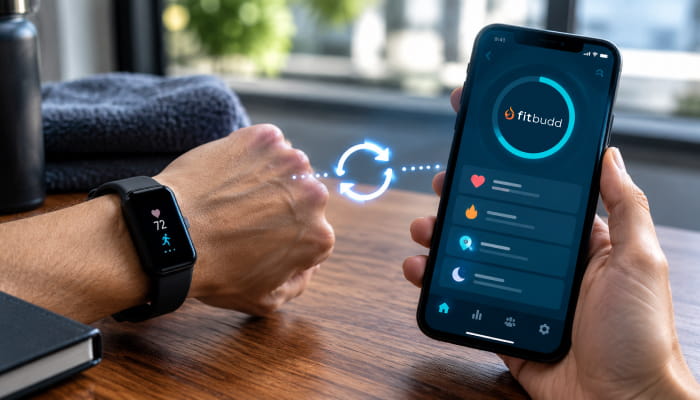
FitBudd is not a CRM. It is something more useful for most personal trainers: a complete coaching platform that handles everything a trainer needs to manage and grow a client base without stitching together five separate tools.
Where traditional CRMs give you contact management and follow-up sequences, FitBudd gives you client profiles that actually matter to a coach. Each client profile includes their health history, fitness goals, injury notes, progress photos, body metrics over time, workout compliance scores, habit tracking data, and nutrition logs. That's the kind of relationship data a trainer needs, not deal stages and lead scores.
What makes FitBudd stand out:
The Pro plan ($79/month for up to 20 clients) includes things that cost extra as add-ons on most other platforms: a custom-branded app with your logo and colors, nutrition tools with a recipe library, 1:1 video calling, automated check-ins, Smart Flow automation for program delivery, real-time messaging, and direct client payments. As your client roster grows, you add $2/client/month, which is one of the most cost-transparent pricing models in the market.
FitBudd's automation features handle the admin work that eats coaches' time. Automated onboarding questionnaires go out to every new client before the first session. Smart Flow sequences deliver programs, check-in prompts, and follow-up messages on a schedule you set once. Clients get nudge reminders for water intake, supplement tracking, and daily step targets without the coach manually messaging anyone.
The Super Pro plan ($149/month) adds a fully white-labeled iOS and Android app with your own App Store listing, Apple Pay and GPay integration, and direct in-app sign-ups. This is the plan for coaches who want their coaching business to look and feel like a premium branded product.
Who it's best for: Online personal trainers and fitness coaches at any stage of growth who want one platform to replace their current patchwork of scheduling tools, payment processors, WhatsApp groups, and spreadsheets.
Pro Tip: FitBudd's 30-day free trial (no credit card required) gives you full Pro plan access. Build out a complete client experience before committing so you can see exactly how it fits your workflow.
10. My PT Hub, Best Budget All-in-One for New Trainers
Pricing: Starter: 22.50 (3 clients) | Premium: $15.60/month |Ultimate: $195/month.
Pricing verified from mypthub.net/pricing
My PT Hub is one of the most affordable all-in-one platforms for personal trainers, with paid plans starting at $9.99/month. It covers workout programming, client management, nutrition tracking, progress photos, scheduling, and basic reporting in a single platform.
The feature set is solid for the price point. The Professional plan ($19.99/month) supports unlimited clients and includes basic automations, nutrition tools, and a branded portal for clients. The trade-off is depth: My PT Hub's tools are functional but not as polished or feature-rich as FitBudd or Trainerize in their respective specialties. The mobile app experience has been noted in reviews as less refined than newer platforms, and the automation tools are limited compared to what coaches need at scale.
Who it's best for: New personal trainers and fitness coaches on a tight budget who want a single platform covering the core coaching functions without a significant monthly commitment.
What Features Should a Personal Trainer CRM Have?
This is worth answering clearly because most generic CRM guides don't account for what fitness coaches actually do day to day.
- Client profiles that support coaching decisions. A useful trainer CRM stores health history, injury notes, movement limitations, fitness goals, and progress metrics alongside basic contact information. If your platform only stores names, emails, and appointment history, it is a scheduling tool, not a client management system.
- Automated check-ins. Manually messaging every client weekly to ask about compliance, energy, and progress is unsustainable past 20 clients. A good platform automates this delivery while letting you review and respond to the responses that need attention.
- Program delivery. Workout programming should live in the same system as your client profiles, not in a separate app your clients have to download and remember to check. When the workout, the check-in, and the messaging all happen in one place, client engagement goes up.
- Nutrition tools. If nutrition coaching is part of your service, your client management tool needs to handle it. Sending a separate PDF meal plan and hoping your client uses MyFitnessPal alongside your training app is a fragmented experience that reduces compliance.
- Payment collection. Chasing invoices manually is one of the biggest time drains in a personal training business. Your platform should handle recurring subscriptions, one-time package sales, and payment reminders without you lifting a finger.
- Progress visibility for clients. Clients who can see their own progress data (strength gains, body composition changes, habit compliance scores) stay engaged longer. If your clients have no visibility into their results, you're relying entirely on them feeling good subjectively, which isn't enough to retain clients through plateaus.
- A mobile-first client experience. Your clients live on their phones. The client-facing side of your platform needs to be a clean, easy mobile experience, not a web portal they have to remember to open on a laptop.
Personal Trainer Client Management Software: Why FitBudd Wins for Coaches
The tools on this list fall into three categories. Generic CRMs (HubSpot, Zoho, HoneyBook) handle contacts and pipelines well but require significant setup and additional tools to serve a coaching business. Gym management platforms (Mindbody, PushPress) are built for class-based studio operations and scale better for locations than for individual coaches. Coaching-specific platforms (Trainerize, My PT Hub, FitBudd) are purpose-built for the personal trainer use case.
Within that last category, FitBudd's advantage is its combination of coaching depth and pricing transparency. The Pro plan at $79/month includes the features that cost extra elsewhere: a custom-branded app, nutrition tools, automated check-ins, video calling, and built-in payments. As your roster grows, you pay $2/client/month, which is predictable and scales with your revenue.
The result is a single client-facing experience where your clients access their workouts, submit their check-in responses, track their nutrition, watch their progress, and message you, all inside your branded app. That unified experience is what keeps clients engaged long enough to see results, renew their subscription, and refer their friends.
CRM for Fitness Coaches: A Quick Decision Framework
Not every personal trainer needs the same tool. Here's how to decide quickly:
You primarily need scheduling and booking: Acuity or Vagaro handles this cleanly and affordably. Pair with a workout delivery tool.
You run a CrossFit box or class-based gym: PushPress Core plus Grow gives you the gym CRM and marketing tools purpose-built for that model.
You manage a large multi-location studio: Mindbody is built for your scale, and the higher price reflects that.
You want a sales-first lead pipeline alongside your coaching tools: HubSpot Starter paired with FitBudd is a strong combo for coaches running active lead generation.
You want one platform that handles coaching, check-ins, nutrition, payments, and a branded client app: FitBudd is the most complete option available in 2026 for online personal trainers and fitness coaches at any stage of growth.