-1.avif)

Structured onboarding is one of the most reliable retention levers in fitness. In a study of around 1,000 new members by retention researcher Dr. Paul Bedford, members who received structured onboarding (an orientation plus three short follow-up sessions) stayed active at 87% after six months, compared with 60% for those given a standard one-hour orientation alone. That gap isn't about coaching quality. It's about whether the follow-up touchpoints happen consistently, and at 30+ clients, consistency is a systems problem.
The coaches who scale to 50, 100, or 200 clients aren't necessarily better coaches. They've built better systems: onboarding sequences that fire automatically, re-engagement triggers that catch inactive clients, and payment retries that recover failed billing without manual chasing.
Fitness business automation falls into two categories: native (built into your coaching platform) and bolt-on (no-code tools like Zapier or Make that connect separate apps). Both have a place. The right balance depends on how much your platform already handles natively.
This guide covers both categories, with honest gaps for Trainerize, Mindbody, and Stripe as standalone solutions.
Fitness Business Automation Tools: What Should Be Automated?
The workflows in a fitness business that benefit most from automation, for solutions built for fitness businesses of any size:
- Client onboarding intake forms, digital waivers, welcome sequences, first workout, and check-in setup triggered at member sign-ups, with a member portal app that supports digital onboarding so clients can manage accounts after sign-ups
- Failed payment recovery automated retry logic, decline notifications, and dunning sequences to recover failed billing
- Re-engagement sequences triggered messages when a client hasn't logged in, completed a workout, or submitted a check-in for a defined period
- Check-in reminders, weekly check-in prompts with progress photo and measurement requests sent automatically
- Class and session reminders, members can use online booking to reserve classes through an app or website before automated 24-hour and 1-hour reminders reduce no-shows and last-minute cancellations
- Lead follow-up automated response to inquiries, nurture sequences, and trial offer delivery triggered by website form submissions
- Membership renewal reminders, automated notifications 7 days and 1 day before renewal, with upsell or upgrade offers
- Progress milestone messages, automated celebration messages when clients hit workout streaks, weight milestones, or program completion
3 Gym Management Software Automation: Native Automation Inside Your Coaching Platform
Native automation is the most efficient form of fitness business automation inside cloud-based gym management software, with no external tools, no API connections to maintain, no additional monthly cost, plus remote access and automatic updates. Here's how the major platforms compare within broader gym management, not just coaching-platform automation.
FitBudd Smart Flow Automations: Full Workflow Automation Native to the Platform
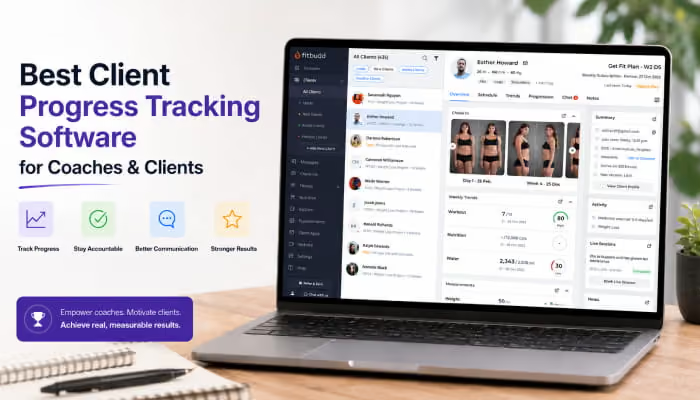
FitBudd's Smart Flow automations use a visual no-code builder, no Zapier required. Triggers include client sign-up, workout completion, missed check-in, inactivity threshold, and payment events. Each fires a sequence of messages, program assignments, habit updates, or check-in forms at defined intervals. It can also deliver custom workouts and other content through a member-facing app, where clients can book sessions and manage accounts.
Common Smart Flows: onboarding sequence (member sign-up → digital waiver → welcome → first workout), re-engagement sequence (7, 14, and 21-day inactivity triggers that escalate from push notifications to personal messages to win-back offers), and milestone sequences (streak badges, photo prompts, program completion). Push notifications via the branded app reach clients immediately, not buried in email. This supports a unified hybrid fitness delivery system for in-person and digital workouts.
- Strengths: Visual no-code builder, full trigger library, push notifications via branded app, onboarding + re-engagement + milestone flows all native
- Best for: Coaches, trainer-led gyms, and personal training or group fitness operators who want one system for in-person and digital delivery while eliminating Zapier and no-code tool costs by handling automation natively in their coaching platform
ABC Trainerize Automation on Higher Plans Only
Trainerize includes triggered automations and automated messaging (welcome sequences, re-engagement nudges, scheduled check-ins) in its Pro plan, not just the top tier.
What scales the real cost is the add-on stack: Stripe Payments ($10/month), Advanced Nutrition ($20–$45/month), Video Coaching ($10/month), and a Custom Branded App ($169 one-time plus Apple's $99/year).
A Pro plan that looks affordable on its sticker price climbs once those are switched on.
- Strengths: Triggered automations and auto-messaging from the Pro tier, gamification integrations, step-count and streak triggers, and deep wearable sync.
- Gap: The base price understates the real cost; nutrition, payments, video, and branding are all separate add-ons.
Mindbody Marketing Automation as a Paid Add-On
Mindbody's marketing automation (email campaigns, win-back sequences, referral tracking) is powerful for multi-location studios, but it sits in the upper tiers of a quote-based subscription rather than the entry plan. Its automation is built for the consumer studio experience (booking reminders, promotional emails) rather than the coaching-relationship workflows personal trainers need.
- Strengths: Enterprise marketing automation, referral programs, win-back campaigns, multi-location CRM
- Gap: Marketing add-on costs extra; automation designed for studio operations, not coaching workflows; overkill for solo coaches or small studios
4 Fitness Software Integrations and Lead Management: No-Code Tools for Connecting Your Tech Stack
When your coaching platform doesn't natively handle a workflow, no-code integration tools fill the gap by connecting payments, messaging, client onboarding, and class scheduling across systems. These are most valuable when you're running multiple specialized tools and need them to communicate with each other. Centralized scheduling helps prevent double bookings, while real-time availability helps maximize class capacity. That also gives you more control over how key operational workflows run.
Zapier: The Standard for Fitness Business Integrations
Zapier connects thousands of apps via trigger-action Zaps.
Common fitness automations: new client → Google Calendar event; new payment → Google Sheets row; website form → Mailchimp plus welcome email.
The free tier covers 100 tasks per month, enough to test a few basic automations. Paid plans start at around $20/month (billed annually) on the Professional tier, scaling with task volume.
The limitation is maintenance. Zaps break when a connected app updates its API, which means a workflow you set up months ago can fail silently until you notice a missed handoff and fix it manually.
- Best for: Coaches using multiple separate tools (Stripe, Google Sheets, Mailchimp, Calendly) who need to automate handoffs between them.
- Gap: Monthly costs add up, Zaps break when APIs change, and Zapier connects coaching tools rather than replacing the need for them.
Make (formerly Integromat) More Powerful, More Complex
Make offers stronger branching logic and a lower entry price than Zapier, with paid plans starting around $9/month (billed annually) on the Core plan. It is better for complex multi-step workflows, for example: new Stripe payment → Notion record + Typeform intake + Mailchimp subscriber + calendar link.
One thing to know before committing: in August 2025, Make switched from counting "operations" to a credit-based model. Every module that runs in a scenario, including triggers and filters, consumes a credit, so a workflow with several steps burns credits faster than the headline plan size suggests.
The free tier (1,000 credits per month, two active scenarios) is fine for testing but runs out quickly under real use. The complexity that makes Make powerful also makes its real monthly cost harder to predict than Zapier's task-based pricing.
- Best for: Tech-comfortable coaches or studio operators who need complex multi-step integration workflows between separate platforms and are willing to monitor credit usage.
- Gap: Higher learning curve than Zapier, credit consumption is harder to forecast, and it still does not replace a coaching platform.
Stripe: Payments and Billing Automation
Stripe is the payment-processing standard for online coaching, handling automated billing, recurring subscriptions, one-time sales, Smart Retries for failed payments, and dunning sequences at 2.9% + $0.30 per transaction. Most coaching platforms integrate with Stripe natively. Stripe charges no setup or monthly fees under standard pricing; recurring subscription billing incurs a small additional fee (about 0.7% of billing volume) on top of the base processing rate.
As a standalone tool, Stripe still requires a separate platform for workout delivery and client management. FitBudd integrates with Stripe at zero platform commission, so coaches pay only Stripe's standard processing fee, with nothing added on top.
Best for: An integration layer inside a coaching platform, not a standalone fitness business solution.
Gap: No coaching features; it needs a full coaching platform alongside it to run a fitness business.
How to Reduce Churn in a Gym With Automation: The Three Workflows That Matter Most
Three fitness business automation workflows are most directly connected to churn reduction and to better retention, since increasing customer retention by 5% can boost profits by 25% to 95%:
- Onboarding automation structured first-week sequences (intake → welcome → first workout → day-7 check-in) improves member engagement across the member lifecycle and increases 6-month retention from ~50% to 87% (Dr. Paul Bedford).
Coaches running manual onboarding at 30+ clients miss these touchpoints inconsistently, which makes member retention harder and limits stronger relationships with current members
- Inactivity re-engagement triggered at 7, 14, and 21 days of missed check-ins or workout completion. Tracking member attendance or activity helps identify at-risk individuals earlier, and automated messages at day 7 catch 40–60% of at-risk clients before they've mentally decided to cancel. Manual follow-up catches a fraction of these because coaches don't track inactivity systematically
- Failed payment recovery automated retry logic and dunning sequences recover an average of 70% of failed payments that would otherwise result in involuntary churn.
Platforms with native payment retry (FitBudd, Trainerize) handle this automatically; coaches using Stripe standalone must build this in Zapier or Make
FitBudd's Smart Flow automations handle all three workflows natively, no Zapier required.
Fitness Business Software Comparison: Automation Features at a Glance
Build Automation Into Your Coaching Platform, Not Around It
The most efficient fitness business automation is the kind you never maintain because it's native to your platform. Every Zap is a connection that can break, a monthly cost, and a workflow that needs your attention when it fails. Coaches scaling to 50-100+ clients haven't built more complex stacks; they've chosen platforms that handle onboarding, re-engagement, and payment recovery automatically.
FitBudd's Smart Flow automations eliminate the need for Zapier or external tools for most coaching business workflows. Onboarding sequences, re-engagement triggers, push notifications, and check-in workflows are all native, starting at $79/month for 20 clients, with no add-ons or platform commission.
Start your 30-day free trial, no credit card required, or book a demo to see FitBudd's automation features in a live walkthrough.










.avif)