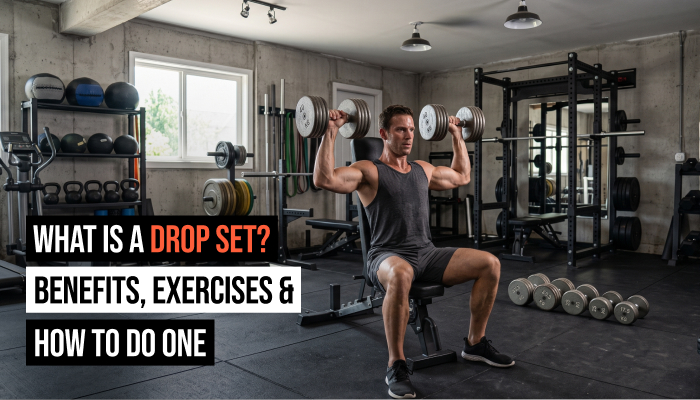

Perform a set to failure or within one to two reps in reserve, immediately reduce the weight by 20 to 25%, and continue repping without rest, repeating for one to three drops.
A dumbbell curl drop set looks like 25 lbs to failure, straight to 20 lbs, straight to 15 lbs, all inside one extended set. Some lifters write drop sets as one word; the method is identical.
What separates a drop set from three normal sets is the missing rest. Removing rest keeps the muscle under continuous tension as fatigue accumulates, recruiting fibers that fresh, rested sets leave in reserve.
What does the research actually say about drop sets?
Equal muscle in far less time, with two caveats worth knowing before you quote it at a client.
Sødal and colleagues (2023), in Sports Medicine Open, found no significant difference in hypertrophy between drop sets and traditional training when total training volume was equal, while some drop set modalities took half to one-third of the time. Coleman and colleagues (2022) reached the same conclusion in the International Journal of Strength and Conditioning, reporting trivial differences in hypertrophy alongside a 30 to 70% reduction in training time.
Caveat one: the evidence base is thin
Both of those meta-analyses included only five studies in their quantitative analysis, because relatively few trials have investigated drop sets directly. The direction of the finding is consistent, but it is not built on a deep literature.
Caveat two: the equivalence is volume-matched
Drop sets do not produce more growth. They produce the same growth in less time, which is a scheduling advantage rather than a hypertrophy one.
The better-powered evidence arrived in 2026. A meta-analysis of 12 studies and 274 participants examined acute responses alongside chronic adaptations and found significantly higher ratings of perceived exertion for drop sets, with a standardized mean difference of 1.62.
That is the trade. Drop sets buy time with discomfort, which is exactly why you dose them rather than sprinkling them everywhere.
How do you run a drop set?
Five steps.
- Pick a machine or dumbbell exercise where the load changes in two seconds.
- Take the final working set to one rep short of failure.
- Cut the load by 20 to 25% and continue immediately, stopping near failure again.
- Repeat for one or two more drops, then stop.
- Log every drop so next session's starting weight is a decision, not a guess.
Reserve the technique for the last set of an exercise. Drop-setting every set multiplies fatigue without multiplying growth, since the volume-matched research already shows where the ceiling sits.
Which drop set exercises work best?
The best candidates share one trait: the load changes in seconds. Pin-loaded machines lead, and barbell compounds sit at the bottom because stripping plates kills the no-rest window.
Lat pulldown and seated row
Move the pin two slots and keep pulling, with no setup between drops. Both allow a braced torso, so the only thing failing is the target muscle, not your position. Expect the second drop to feel like the bar is winning, and keep the elbow path the same rather than turning it into a body-english row.
Leg press and leg extension
Quads tolerate high fatigue, and neither lift asks anything of balance once the client is exhausted. Load changes are fast on both, and a partner can strip plates on the leg press while the feet stay on the platform. Cut range of motion before you cut effort, and you lose most of the stimulus, so hold depth on every drop.
Dumbbell curls and lateral raises
Running the rack is the classic format: 25 lbs to failure, then 20, then 15, with only the time it takes to set the bells down. Small muscles recover quickly between drops, so expect more reps on drop two than the load reduction suggests. Watch for swing creeping into curls and the traps taking over on raises once fatigue sets in.
Cable pushdowns and machine chest press
Both deliver pressing volume to failure without a spotter, which makes them the safest option for anyone training alone. A cable stack changes in one pin move, and the fixed path lets you reach true failure without the load ending up on someone's chest. Elbows take less punishment here than on skullcrushers at the same effort.
Skip barbell squats and deadlifts entirely. Form decays fastest on those lifts exactly when drop sets demand more reps, and technique breakdown under fatigue is why machines handle this method better than free weights.
Where do drop sets fit in a training program?
They are a finishing tool, dosed at one or two exercises per session inside hypertrophy blocks.
Place them on the final exercise for a muscle group, keep them out of strength-focused days where bar speed matters, and pull them entirely during deload weeks. Drop sets work best for intermediate lifters whose sessions have outgrown their schedules.
Time-crunched weeks are the method's real home. A client with 30 minutes can hit a full stimulus with drop sets on four machine exercises, which beats skipping the session. If a client is regularly losing sessions to time, that is a programming and adherence problem before it is an intensity one.
How should trainers prescribe drop sets?
With exact numbers, or clients turn them into random extra sets.
Write the trigger weight, the drop percentage, and the stop point into the program itself. "Drop set on the last set" is not a prescription. "Final set: 60 lbs to 1 RIR, drop to 45, drop to 35, stop at 1 RIR each" is.
Then review the logs. Delivery decides whether the drops get recorded at all, and per-set logging inside a branded coaching app captures each drop's load and reps, turning next week's prescription into data rather than memory.
Building the block once in an AI workout builder also means you set the protocol once and adjust it per client, instead of rewriting the same three drops every week.
How to use drop sets over the next eight weeks
Pick two exercises, not eight
One upper body, one lower, both machine or cable-based. Those are the only two that get drop sets for the whole block.
Write the numbers into the program
Trigger load, drop percentage, stop point, number of drops. If the client has to decide any of it mid-set, they will decide wrong under fatigue.
Progress the first set, not the drops
Add load or reps to the top set and let the drops follow. Progressing the drops themselves just adds fatigue.
Pull them in deload weeks
The 2026 data on perceived exertion is the reason. A deload with drop sets in it is not a deload.
Review the logs weekly
If you're not recording drop numbers, you're not following the protocol, and you are guessing at next week's prescription.
The lifter who drop-sets two exercises for eight weeks gets everything the method offers. The lifter who drop-sets everything gets sore and stalls.
If clients skip sessions they don't have time for, drop sets are the 30-minute answer, and prescribing them properly requires exact numbers and per-set logs. Book a demo to deliver drop set protocols with video demos and progress tracking in your own branded app.