
.avif)

Your clients have already heard about AI workout apps. FitnessAI. Fitbod. Dr. Muscle. Planfit. They've seen the ads, heard about the sub-$13 price tag, and at least one of them has downloaded one to see what the fuss is about.
That's the problem. And it's not going away.
Every month these apps get smarter, better funded, and more visible. Trainers who ignore the trend keep losing price-sensitive clients to technology that promises "personalized programming" for less than a single session fee.
But here's what those apps can't tell your clients: an algorithm has never spotted the hip shift that predicts a torn ACL, talked someone through the real reason they keep skipping leg day, or shown up on a Tuesday when everything felt impossible. That's where you live. This guide gives you the competitive intelligence to prove it.
Quick Answer: The best AI workout apps for general consumers include FitnessAI for strength progression, Fitbod for variety and recovery, Dr. Muscle for hypertrophy, and Planfit for beginners. None replace the form correction, psychological coaching, and adaptive programming that a skilled trainer delivers. For trainers looking to use AI to scale their own services, FitBudd's AI workout builder is built specifically for coaching businesses, not end consumers.
Why Personal Trainers Should Care About AI Workout Apps
Your clients already know about these tools. They see them on social media, hear about them from friends, and wonder if they're missing out on something cheaper. Smart trainers don't overlook this trend. They study it, the same way gym owners studied boutique fitness studios when they first appeared, and found ways to compete on what couldn't be replicated.
The Best AI Workout Apps: A Trainer's Competitive Analysis
Let's take a look at the major competitors within the AI fitness app world. This isn't just a list, but strategic knowledge of what your prospective customers may be considering as alternatives.
1. FitnessAI: The Data-Driven Strength Builder
What It Does Well
FitnessAI has built its reputation on algorithm-based progression for strength training, analyzing millions of workout logs to determine optimal sets, reps, and weight for each exercise.
It automatically adjusts based on performance, increasing weight when you complete all reps easily and scaling back when you struggle.
At around $12.99 per month, it's significantly cheaper than personal training and delivers solid value for straightforward strength programming.
The Limitations
FitnessAI can't watch form, identify compensation patterns, or recognize previous injuries that require modified movements.
It lacks comprehensive programming beyond basic strength work- minimal mobility integration, proper warm-ups, or advanced techniques like tempo training and periodization.
Your Competitive Edge
When clients mention FitnessAI, emphasize your ability to provide form coaching, injury prevention strategies, and truly personalized programming that accounts for their unique biomechanics and movement history.
Explain that while algorithms can suggest progression, they can't prevent the compensatory patterns that lead to injury down the road.
2. Fitbod: The Adaptive Workout Generator
What It Does Well
Fitbod excels at variety and adaptability, tailoring workouts to recovery status, equipment, and muscle fatigue to deliver fresh workouts every session.
With hundreds of exercises, detailed videos, and recovery tracking that adjusts volume based on logged soreness, it prevents workout boredom while providing strength analytics to identify muscle imbalances. At $12.99 monthly, it's ideal for those with varied equipment setups or frequent travelers.
The Limitations
While Fitbod optimizes for variety and recovery, it lacks strategic, long-term programming to achieve specific performance goals.
There's no periodization structure for peak performance phases, and it can't account for life stressors such as difficult work weeks, poor sleep, or relationship issues that experienced trainers instinctively recognize and adapt to.
Your Competitive Edge
Position yourself as the strategic architect of their fitness journey. While Fitbod generates workouts, you design comprehensive programs with clear progression models, peak phases for specific events, and intelligent deload periods.
You read between the lines when clients say they're 'fine,' but their movement quality suggests otherwise.
3. Dr. Muscle: The AI Strength Coach
What It Does Well
Dr. Muscle takes a coaching-oriented approach, providing rest-pause protocols, auto-regulation, and detailed progression tracking. It excels at volume management and fatigue monitoring, incorporating advanced techniques like cluster sets and myo-reps to prevent plateaus.
With a focus on hypertrophy optimization at $9.99 monthly, it positions itself as an affordable AI personal training alternative.
The Limitations
Despite sophisticated algorithms, Dr. Muscle can't identify movement dysfunction or technique issues.
It assumes perfect exercise execution and focuses narrowly on training variables while ignoring nutrition, sleep optimization, and stress management strategies that determine real-world results.
Your Competitive Edge
Emphasize your holistic approach to client transformation. You don't just program workouts; you coach movement quality, provide nutritional frameworks, manage recovery strategies, and address the psychological barriers that prevent progress. You see your clients as complete humans, not just training logs.
4. Planfit: The AI Personal Trainer for Beginners
What It Does Well
Planfit targets fitness beginners with detailed video demonstrations and progressive programming that builds confidence alongside strength.
It prioritizes simplicity over complexity, featuring muscle recovery visualization that helps prevent overtraining the same areas repeatedly. The free version offers substantial functionality, with a premium at $12.99 monthly.
The Limitations
Planfit's beginner focus limits clients ready for advanced programming. It lacks pathways toward powerlifting, Olympic lifting, or sport-specific conditioning.
More critically, it can't provide the encouragement and accountability beginners need most, nor can it offer a human connection to reignite motivation or navigate gym anxiety and social challenges.
Your Competitive Edge
For beginner clients, emphasize the irreplaceable value of human guidance, encouragement, and accountability. You provide the confidence-building that apps can't deliver, being physically present to spot them, correct form in real-time, and celebrate victories that matter beyond numbers on a screen.
5. FitBudd: AI Workout Builder for Trainers
What It Does Well
FitBudd takes a different approach; it's designed as a tool for personal trainers rather than a direct replacement. The AI workout builder helps trainers create customized programming through a branded app experience, combining AI-assisted generation with human oversight.
Trainers use AI to quickly generate workout templates based on client goals and equipment, then review and personalize before delivery. It includes client management features, progress tracking, and branded mobile apps, providing the infrastructure trainers need to scale or deliver remote programming efficiently.
The Limitations
While positioned as a trainer's tool, FitBudd still shifts toward technology-mediated coaching. The AI builder may encourage over-reliance on automated programming rather than developing program design expertise.
Some trainers report that clients perceive the service as 'just an app' rather than personalized coaching, especially when customization is limited to AI templates.
The platform requires a learning curve and subscription costs that cut into margins.
Your Strategic Consideration
FitBudd represents an interesting middle ground; it's both a tool you might use and a competitor if other trainers use it to scale services that undercut your pricing.
If you choose to use platforms like FitBudd, ensure you're adding substantial value beyond the AI-generated programming.
Your expertise should be clearly visible in workout customization, form feedback, and strategic program adjustments that demonstrate why clients need you, not just the software.
.avif)
What AI Workout Apps Can't Do (Your Unfair Advantages)
Understanding the best AI workout app landscape reveals patterns in what technology does well and where it fundamentally falls short. These gaps represent your competitive moat, areas where human expertise remains irreplaceable.
Real-Time Form Correction and Injury Prevention
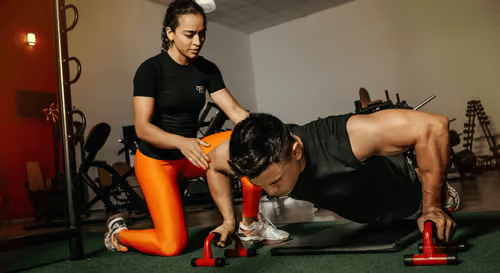
AI can suggest exercises and track metrics, but it cannot watch someone deadlift and notice the hip shift indicating glute weakness, the shoulder elevation during rows signaling poor scapular retraction, or the knee valgus during squats predicting ACL issues.
These observational skills require years of experience and anatomical knowledge. When you correct form, you're preventing compensatory patterns that compound into injuries months later.
The American College of Sports Medicine's 2026 Worldwide Fitness Trends report reinforces this distinction. ACSM notes that certified fitness professionals provide "evidence-based programming, personalized support, and reduced risk of injury" and that in an industry increasingly shaped by social media and technology, they serve as a critical safeguard against misinformation. No app carries that credential or that accountability.
Position this advantage clearly: 'While AI fitness apps can tell you what to do, I ensure you're doing it safely and effectively. The difference is whether you're building sustainable strength or building toward your first injury.'
Psychological Coaching and Behavior Change
Fitness transformation is fundamentally psychological. AI workout apps deliver programming, but they don't navigate the emotional complexity of behavior change.
Research from Stanford University supports this. Matthew Jörke, a Computer Science PhD candidate studying health behavior change, found that most AI fitness apps treat coaching as an optimization problem — prescribing plans and expecting users to comply. His conclusion: "That's not how human behavior works." His 2026 Best Paper-awarded study found that the approach most effective for lasting behavior change is facilitative and nonprescriptive precisely what a skilled trainer delivers, and what no algorithm currently replicates.
You recognize when enthusiasm masks fear, when perfectionism prevents celebrating progress, and help clients explore the deeper 'why' behind their goals.
Apps can't have conversations about fitness goals that are really about regaining confidence after divorce or reclaiming your body after pregnancy- the psychological dimension where lasting transformations happen.
Adaptive Intelligence for Life Context
The best AI fitness app operates on data inputs, but life doesn't fit into data fields.
You read body language indicating stress, adjust programming for work deadlines or family health scares, and know which clients need aggressive coaching versus gentle encouragement on any given day.
This contextual intelligence, which considers the full picture of someone's life, distinguishes adequate training from transformational coaching.
Accountability and Relationship-Based Motivation
Most fitness apps are downloaded enthusiastically and abandoned within weeks. The technology works, but there's no human connection sustaining engagement.
The data backs this up. A 2024 scoping review published via PubMed Central found that 69% of fitness apps are abandoned within the first 90 days and 81% within a year. The technology works. The human connection to sustain it does not exist inside an app. That sustained engagement is what you provide.
You provide relational accountability where clients show up because they committed to you, push harder in your presence, and share victories knowing you genuinely care.
This relationship is powerful precisely because you can't automate caring or algorithm trust.
Positioning Your Services in an AI-Aware Market
The existence of AI workout apps doesn't threaten skilled trainers, but it clarifies the value proposition. Here's how to position yourself effectively when clients are weighing their options.
Tier Your Services Strategically
Consider creating tiered services that acknowledge different budgets. Premium offers comprehensive transformation with psychological coaching and adaptive programming.
A middle tier combines app-based programming with periodic check-ins for form review. Position each tier clearly, and premium isn't just 'more'; it's a complete transformation.
Hybrid isn't a discount service; it's structured guidance for independent executors.
Emphasize Outcomes Over Methods
When clients compare you to apps, redirect from methods to outcomes. AI provides workouts; you deliver transformations. Talk about the client who avoided shoulder surgery, the person who reclaimed confidence after failed diets, and clients who achieved impossible goals.
These conversations shift perspective from price to value when they understand you're selling lasting change; cost objections dissolve.
Use Technology as Your Ally
Don't position yourself as anti-technology. Demonstrate how you leverage it more intelligently, apps for tracking, video analysis for movement assessment, and heart rate monitoring for intensity management.
You're using technology to enhance human coaching, not replace it, positioning yourself as modern while maintaining irreplaceable strategic value.
Develop Specialized Expertise
AI workout apps excel at serving the broad middle market. Your advantage grows through specialized expertise such as post-injury rehabilitation, training people over 50, and prenatal and postnatal fitness.
Specialized knowledge creates distance from AI alternatives, making generic solutions obviously inadequate.
Addressing the Cost Objection Directly
AI workout apps cost $10-13 monthly, while training runs $50-150+ per session. Handle this directly by reframing the comparison: you're not an expensive app development service; you're a different service category.
Discuss investment per outcome: $120-150 annually on apps with modest results, versus three months with you achieving significant transformation, which delivers superior ROI. Your expertise prevents costly injuries and dramatically compresses timelines.
The Hybrid Model: Working Alongside AI Tools
The case for hybrid coaching goes beyond intuition. A 65,000-user study found that hybrid AI-human coaching delivers 74% better results than AI-only approaches — not marginally better, dramatically better. Meanwhile, an ISSA 2025 industry survey found that over 70% of fitness professionals who use AI tools report improved efficiency. Trainers who use AI as a force multiplier not a replacement — outperform both pure AI and trainers who ignore the technology entirely.
Some trainers embrace collaboration with AI tools rather than viewing them as pure competition.
You might program primary training through direct coaching while clients use apps for supplementary work, or conduct monthly assessments while apps guide daily execution.
This works well for frequent trainers who can't afford daily hands-on coaching; you remain the strategic intelligence while technology handles implementation.
.avif)
Marketing Messages That Resonate
Your marketing should acknowledge that AI fitness apps exist while clearly differentiating your value. Here are messaging frameworks that resonate with clients evaluating their options:
The Technology Limitation Frame
AI workout apps are impressive technology. They can generate workouts, track progress, and adjust variables based on performance data.
What they can't do is watch you move, identify the subtle compensation patterns that lead to injury, or understand the psychological barriers holding you back. That's where experienced human coaching becomes irreplaceable.'
The Investment Comparison Frame
'You can buy a cookbook for $20 or hire a personal chef. Both provide food, but they're fundamentally different services. AI fitness apps are cookbooks that are useful tools for people who know what they're doing.
Personal training is the chef's expert guidance that transforms your relationship with fitness and delivers results you couldn't achieve alone.'
The Outcome Focus Frame
'My clients don't hire me for workouts; they hire me for transformations they've tried and failed to achieve on their own.
Whether that's finally deadlifting their bodyweight, running their first 5K without pain, or reclaiming confidence in their body, I help people accomplish goals that matter to them. Apps provide structure. I provide results.'
The Experience-Based Frame
I've had dozens of clients who started with AI apps before coming to me. They initially loved the convenience and low cost.
But after weeks of minimal progress, nagging joint pain from poor form, or just feeling lost without real guidance, they realized that professional coaching delivers value far beyond the price difference.
I welcome comparisons because I know what happens when people experience both.'
Educating Clients About the Human Advantage
Many prospective clients don't fully understand what they're getting or missing with AI workout apps. Your educational content can help them make informed decisions while naturally highlighting your advantages.
Create content that compares typical user experiences. Blog posts like 'What I Learned from 30 Days with an AI Fitness App' or 'Why My Clients Tried AI Apps Before Hiring Me' provide honest assessments without being dismissive. Share genuine insights about what these tools do well and where they struggle.
Video content showing side-by-side comparisons is particularly powerful. Film yourself identifying form issues that an app would miss, or demonstrate how you'd modify a workout based on a client's feedback about knee discomfort.
These real-world scenarios illustrate the difference between algorithmic programming and adaptive coaching.
Social proof matters tremendously. Feature testimonials from clients who switched from apps to your services, letting them explain in their own words what changed.
Their authentic stories about injury prevention, faster progress, or finally breaking through plateaus carry more weight than any marketing message you could craft.
Consider offering free movement assessments where you evaluate someone's squat, hinge, and press patterns. Many AI app users have developed compensatory patterns they're completely unaware of.
When you identify these issues and explain their long-term consequences, the value of expert observation becomes immediately tangible.
Future-Proofing Your Training Business
AI will continue advancing. Rather than hoping this reverses, successful trainers are adapting their business models. Focus on skills AI can't replicate: movement assessment, pain science, coaching psychology, and behavior change.
Think of your role evolving from workout provider to transformation architect. Trainers who thrive will embrace technology as a tool while doubling down on irreplaceable human expertise.
Final Thoughts: Competing on Value, Not Price
The best AI workout app represents legitimate competition only if you position yourself as a commodity competing on price. When you compete on value like outcomes, expertise, irreplaceable human benefits, the comparison becomes irrelevant.
Clients choosing apps often don't understand what they're buying. Your job is to educate the market through confident articulation of your unique value.
Know your competition. Understand their strengths and limitations. Then position yourself not as the expensive alternative, but as the superior solution for people who are serious about transformation. Because fitness apps are tools.
Skilled trainers using tools strategically? That's where lasting change happens.











.jpg)

.jpg)
.jpg)