

The personal fitness training industry was valued at $13.9 billion in 2025 and is projected to reach $43.3 billion by 2036, growing at a 10.9% compound annual rate, according to Future Market Insights.
A meaningful part of that growth is subscription and digital-product revenue trainers building recurring income through memberships, workout bundles, and challenge programs instead of relying solely on per-session fees.
This guide compares the apps coaches actually use in 2026 on the metrics that affect revenue: transaction fees, billing flexibility, supported product types, and total cost at scale.

Why the Billing Model Matters as Much as the Platform Price
Your subscription fee is not your only cost. For coaches collecting payments through their platform, the per-transaction fee is often the larger number and one that most coaches don't calculate until they're already committed.
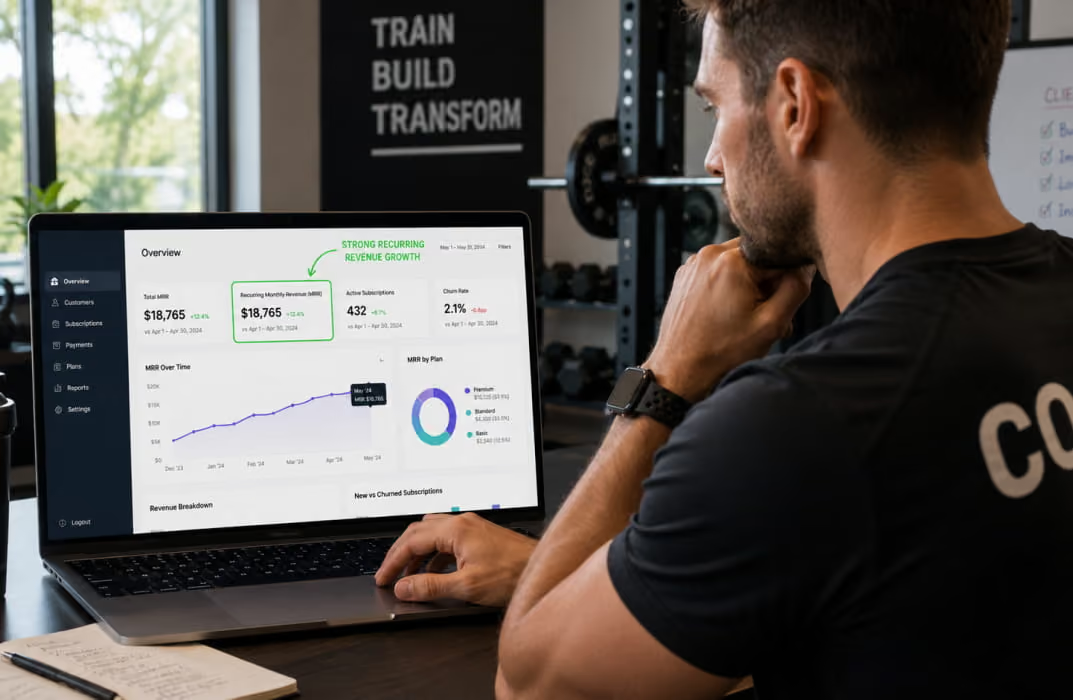
Here's how it compounds. A coach with 40 clients paying $150/month generates $6,000 in coaching revenue. On a platform that charges a 5% transaction fee, that's $300/month in fees alone, $3,600/year on top of the software subscription. Routing the same volume directly through Stripe at standard rates (2.9% + $0.30 per transaction) costs roughly $186/month. The $114/month difference, about $1,368/year, covers the annual subscription on most mid-tier plans.
This is not hypothetical. TrueCoach's own help documentation confirms that TrueCoach Payments applies a flat 5% fee on every transaction, calculated on the full invoice total. That's notably higher than what a coach would pay if they went through Stripe directly.
The right question before choosing any platform isn't just "what does the subscription cost?" It's: "What does every payment to a client cost me, at my current revenue volume?"
What to Evaluate Before Choosing a Fitness Membership App
Beyond the headline fee, here are five billing-side questions every coach should ask before committing:
- Can you sell more than one-on-one subscriptions?
Memberships, one-time bundles, on-demand packs, challenge registrations, and group enrollments are all different product types. Confirm the platform supports the specific structure you need, not just "payments."
- Is billing automated or manual?
Automated recurring billing (monthly, quarterly, annual) is the baseline. Some platforms still require manual invoicing for renewals or restrict automated billing to higher tiers.
- Who processes the payment?
Platforms that route payments through their own processor often charge above-Stripe-rate fees. Platforms that connect directly to your Stripe or PayPal account typically pass the full payment to you, minus only the standard card-network fee.
- What happens if a payment fails?
Automated retries and dunning sequences (reminder emails and retry attempts before access is cut) protect recurring revenue. Platforms without them add admin work every time a card declines.
- Can you set your own pricing?
This sounds obvious, but it isn't universal. Some platforms restrict pricing structures, minimums, or payment-plan options. Confirm you can build the exact offer you want to sell.
The Platforms: Compared on Billing and Revenue Flexibility
FitBudd
Best for: Coaches who want to sell memberships, bundles, on-demand content, and challenges under their own brand without losing revenue to platform commissions.
Billing model: Zero platform commission. Payments are processed through Stripe or PayPal directly to the coach's account; FitBudd takes no transaction fee. Standard Stripe fees (2.9% + $0.30) apply, as with any Stripe integration.
FitBudd supports subscription plans with automated recurring billing, one-time purchases, and on-demand content monetization. Coaches set their own pricing, and plans can be monthly, quarterly, or annual. Because billing runs on Stripe, clients can be charged in a wide range of currencies, making international coaching viable without workarounds.
What you can sell:
- Monthly, quarterly, and annual coaching subscriptions
- One-time workout bundles or program purchases
- On-demand video libraries (add-on on Pro/Super Pro; included in Elite tiers)
- Group challenges with flat enrollment fees or bundled access (Studio Elite)
- Session packs and multi-program bundles
Apple Pay and Google Pay support on Super Pro and Elite reduces checkout friction, which directly affects conversion when selling to new clients.
Honest limitations: On-demand content monetization (the Explore add-on) is $50/month on Pro and Super Pro, not included by default, and it's bundled into Creator Elite. The Super Pro-branded app also includes a one-time $75 setup fee, plus Apple Developer ($99/year) and Google Developer ($25) account fees. Plans cover up to 20 clients, with $ 2 per client per month for clients beyond that. Full billing flexibility applies from the Pro tier up; the entry Starter plan is more limited.
Pricing reference: FitBudd pricing plans start at $15/month, pro starts at $79/month, Super Pro at $149/month; Studio Elite and Creator Elite are custom-priced.
How the billing setup connects to your broader workflow: FitBudd Personal Trainer Software.
Kajabi
Best for: Creator-coaches who want an integrated marketing stack alongside course and membership delivery and who generate enough revenue to absorb higher platform costs.
Billing model: No platform commission when using Kajabi Payments, which processes at standard rates by tier (2.9% + $0.30 on Starter and Basic, 2.8% + $0.30 on Growth, 2.7% + $0.30 on Pro). If you use your own third-party processor instead, Kajabi adds a surcharge on top of that processor's fees: 5% on Starter, 2% on Basic, 1% on Growth, 0.5% on Pro (PayPal and Kajabi Payments are excluded from the surcharge).
Kajabi is not a coaching platform in the same sense as FitBudd or TrueCoach. It is a digital business platform built for course creators, membership sites, and digital product sellers, with coaching added as a product type.
Honest limitations: The Starter plan ($71/month annual, $89/month) caps you at 1 product and 250 contacts. Basic ($143/month annual) raises this to 5 products and 2,500 contacts. There is no fitness-specific client management, no workout delivery, progress tracking, or check-ins. Coaches using Kajabi for sales typically still need a separate coaching platform for delivery, which roughly doubles the software cost.
Pricing range (2026): Starter $71/month to Pro $399/month (annual billing). The branded mobile app and API are included on the Pro plan.
ABC Trainerize
Best for: Coaches building an e-commerce storefront for programs alongside 1:1 client management.
Billing model: Integrated with Stripe for payment processing. Trainerize does not publish a platform-level transaction fee; its "Storefront" feature (for selling programs to new clients) is tied to higher plan tiers.
The Storefront is Trainerize's designated revenue-generation feature: coaches can list programs, bundles, and challenges publicly, with Stripe handling checkout. The platform handles automated recurring billing for subscriptions, but the Storefront and advanced billing features are available only on higher-tier plans, not on entry-level plans.
What you can sell:
- 1:1 coaching subscriptions via automated billing
- Programs sold to external buyers via the Storefront
- Bundled packages (workout + nutrition + coaching)
- Challenge registrations with group billing
A broad ecosystem of wearable integrations (Apple Health, Fitbit, Garmin, and more) makes Trainerize a common choice for performance-focused coaches, as its tracking data is built into the product.
Honest limitations: Payment availability is limited outside the US, Canada, UK, and Australia. The Storefront is a real differentiator, but it is a higher-tier feature, so verify which plan includes it. Some users on Capterra and G2 find the billing setup less intuitive to configure than on payment-first platforms.
Pricing range: A free tier exists for a single client; paid plans scale by active client count from roughly $10/month up to studio-tier pricing, with the branded app as a separate add-on.
TrueCoach
Best for: Programming-first coaches who don't primarily sell through their coaching platform.
Billing model: Stripe-integrated processing. TrueCoach applies a flat 5% fee on every transaction processed through TrueCoach Payments, per TrueCoach's help center, calculated on the full invoice total, including tax. That is materially higher than the 2.9% + $0.30 a coach would pay routing payments directly through their own Stripe account, and it is the highest rate of any platform in this comparison.
TrueCoach built its reputation on workout delivery and client management, with billing layered on through TrueCoach Payments. That origin shows in how the billing is structured.
What you can sell:
- Coaching subscriptions with automated recurring billing
- One-time program purchases
- Basic package billing
TrueCoach covers the essentials but lacks a public storefront for selling to non-clients, challenge-based group billing, and on-demand content monetization. For coaches whose model is primarily 1:1 subscription coaching, that may be enough.
Honest limitations: The 5% fee is a material cost at any real billing volume. At $5,000/month in platform revenue, the fee alone is $250/month, $3,000/year, more than the annual subscription on several competing platforms. Refunds carry a 5% fee, and chargebacks incur a $15 fee. TrueCoach Payments is available only to coaches with bank accounts in the US, UK, Canada, and Australia.
Pricing range (annual billing): Starter $26.34/month (5 clients), Standard $57.99/month (20 clients), Pro $136.99/month (50 clients), plus the 5% transaction fee on payments processed through TrueCoach Payments.
Everfit
Best for: Coaches who want modular billing features at a low base cost, accepting that add-ons raise the real monthly price.
Billing model: Integrated billing for packages, subscriptions, and session packs. Processing fees vary by country and are charged by Everfit's processor. Billing is an add-on ($8–$9/month on most plans) and not included in the base tier; factor it into your real cost.
What you can sell:
- Package-based coaching (session packs)
- Subscription billing for recurring coaching
- Group program enrollments
- Community-based challenge access
- DIY "packed courses" for lower-touch clients (Autoflow)
The Autoflow feature, which automates program assignment and client communication on a timeline, is especially relevant for low-touch digital programs or challenge-based offerings.
Honest limitations: Multiple reviews on GetApp and Capterra flag payment processing fees as a source of frustration, especially for international transactions. Reviewers describe the white-label version as "pricey" and unavailable below the enterprise tier, making it relevant for coaches who want to sell under their own brand.
Pricing at full feature stack (35 clients, annual billing): based on $63/month, plus payments ($8), plus nutrition ($33) and automation ($24), if used, roughly $128–$134/month before processing fees.
Exercise.com
Best for: Large fitness businesses and multi-trainer operations with complex product catalogs and enterprise billing needs.
Billing model: White-label e-commerce with Stripe integration and zero platform commission on standard plans. It's built to support complex product structures, group challenges, on-demand libraries, membership tiers, appointment packages, and digital products sold through a coach-branded storefront.
Exercise.com's strength is breadth: it handles the widest range of product types, including gym memberships and coaching subscriptions. For businesses selling in-person memberships, online programs, and digital products from one system, it's the most comprehensive option.
Honest limitations: Pricing is not published; every plan requires a sales conversation. User reports consistently place entry-level costs starting at $239+/month, putting them out of reach for independent coaches and small studios. It's designed for businesses with multiple revenue streams, not solo coaches.
Challenge-Based Programs: A Growing Revenue Model Billing Has to Support
Quarterly fitness challenges have become a significant revenue driver. Coaches commonly report that a single well-run challenge can add several thousand dollars per event. The billing model differs from a standard subscription: a flat enrollment fee paid once grants access to a time-limited program.
Not every platform handles this cleanly. What challenge billing needs:
- A flat-fee enrollment product (not a recurring subscription)
- The ability to close enrollment at a deadline
- Group-based access that expires when the challenge ends
- An optional upsell path from challenge to ongoing subscription
FitBudd supports challenge creation with leaderboards, community announcements, and one-time group enrollment (Studio Elite). Trainerize's Storefront covers challenge listings with flat enrollment fees. Kajabi handles challenge access as a one-time product with an access expiry.
Everfit supports community-based challenges. TrueCoach's billing is less well-suited to challenge-style enrollment, as it is built primarily for 1:1 subscription management.
If challenges are a meaningful part of your revenue, verify how the platform handles enrollment deadlines, group access, and post-challenge upselling before deciding.
For a practical guide on structuring challenges as revenue events: How to Sell Online Fitness Programs.
Selling On-Demand Fitness Content: What the Platforms Actually Support
On-demand content, pre-recorded workouts, program libraries, and tutorial series are a different revenue model from live coaching. The client pays once (or via subscription) for content they consume independently, and it scales without adding coach time per client.
The billing infrastructure for on-demand content needs:
- A product listing with a purchase or subscription access gate
- Content delivery inside the same app clients use for coaching
- The ability to monetize buyers who aren't existing coaching clients
That last point is where most coaching platforms fall short; they're built for managing existing clients, not for selling to new buyers who find you via social media or search.
Kajabi handles new-buyer acquisition better than any coaching-native platform, but at the cost of requiring a separate delivery tool. FitBudd's Explore add-on supports content delivery and monetization for existing clients in the coaching app, but it isn't a standalone storefront for cold buyers like Kajabi is.
Exercise.com comes closest to handling both a fully branded storefront for new buyers alongside the coaching platform, but only at pricing that makes sense for established businesses.
The practical conclusion: for coaches primarily monetizing existing clients, a coaching-native platform with on-demand support (FitBudd, Trainerize) is the cleaner choice. For coaches building a large digital product business with substantial cold-buyer acquisition, Kajabi's marketing stack justifies the premium, given that a separate coaching tool is also needed.
A step-by-step look at launching an app that handles both: How to Launch a Fitness App Without Coding.
The Zero-Commission Case: When It Actually Changes the Math
The Zero-Commission Case: When It Actually Changes the Math
Zero platform commission matters most at specific billing volumes. To calculate whether it is material for you, take your monthly coaching revenue, multiply it by the platform's rate above standard Stripe fees, and that is your annual platform cost.
Figures assume an average transaction of $200. "Direct Stripe" reflects FitBudd's and Exercise.com's zero-commission model at the standard 2.9% + $0.30 rate; TrueCoach reflects its flat 5% per-transaction fee on TrueCoach Payments.
At $2,000/month, the gap is meaningful but not decisive. At $10,000/month and above, the annual fee difference exceeds most annual software subscriptions. Coaches growing toward those levels should factor this in before they reach them, not after.
Watch: Why Every Fitness Trainer Needs a Branded App
Platform-by-Product Quick Reference
"Coaching Platform" vs. "Creator Platform": What It Means for Revenue
This distinction shapes how billing works.
A coaching platform is built around the client relationship, delivering workouts, tracking progress, checking in, and communicating. Revenue features support the coaching business: billing a client for a subscription and collecting payment for a new program.
A creator platform is built around the product, selling courses, memberships, and downloads to an audience, with marketing tools to grow that audience. That's the Kajabi model: revenue infrastructure is central, and actual coaching delivery is secondary.
Most fitness coaches need a coaching platform, not a creator platform. The exceptions are coaches who've built a large digital audience and monetize mainly through scalable products rather than active client relationships. Kajabi's marketing stack justifies the cost.
For the majority, a coaching-native platform with solid billing is the right fit, and overpaying for creator-platform features you won't use is a common, avoidable mistake.
Related Reading: Best White Label Fitness Apps for Personal Trainers.
Final Thoughts
The app you use to collect coaching revenue isn't a neutral decision. Transaction fees, billing-model restrictions, and product-type limits all affect how much you keep and how many things you can sell.
The coaches generating the most predictable revenue in 2026 run multiple product types in parallel: monthly subscriptions for active clients, on-demand libraries for lower-touch buyers, and quarterly challenges that bring in new revenue without proportional coach time. The right platform supports all of these with clean billing and no commission eating into margins.
Before choosing, calculate your current monthly billing volume. Run the fee math at that number, and again at your 12-month target. The platform that looks cheapest at sign-up often looks different at 40 clients than it did at 10.
For coaches building a fitness subscription app around their brand, with their name in the App Store and billing straight to their own Stripe account, read more here: White Label Fitness Apps: The Full Guide.
For coaches evaluating tools to grow their audience, buying those subscriptions: Best Gym Lead-Generation Software Tools.