
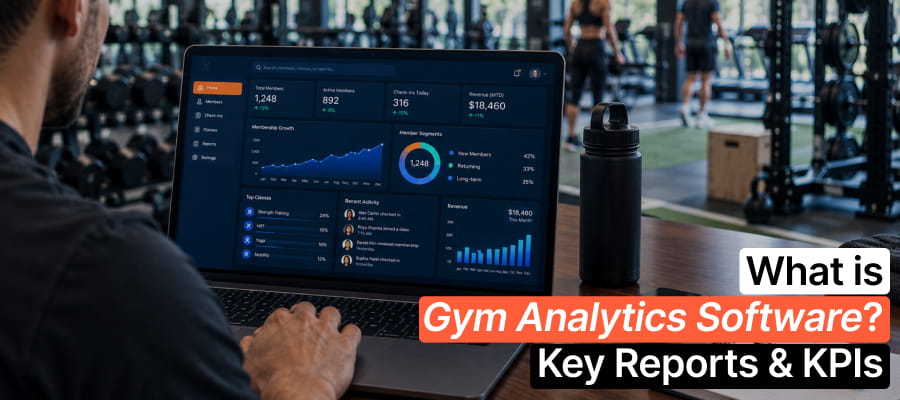

Gym analytics software is the reporting layer that answers business questions from your member data: which revenue stream is growing, which members are about to cancel, and which lead source is worth more budget. Every gym platform ships a dashboard.
The difference is whether it answers the questions an owner asks each week or just displays numbers nobody acts on. This guide covers the five reports worth building, the KPIs with current benchmarks attached, and how to spot the difference between an analytics tool and a wall of charts.
What is gym analytics software?
Gym analytics software sits on top of the booking and billing records you already keep, reading member, payment, and attendance data rather than asking you to enter anything new. That is why most gyms use the reporting module inside their gym management app instead of buying a separate product.
The useful distinction is between reporting and analytics. Reporting shows what happened last month, while analytics connects events: which acquisition channel produced the members who are still here at 12 months. The second question changes where you spend money.
How is gym analytics software different from profit tracking?
Profit tracking and gym analytics software overlap, but they answer different questions. Profit tracking isolates margin: what a class, trainer, or service actually nets after costs. Gym analytics software is broader. It explains member behavior, attendance, and lead conversion alongside revenue, so an owner can see why the numbers moved.
If margin is the question you're stuck on, start with this roundup of profit tracking tools built for that job. If the question is closer to “why are members leaving” or “which lead source is worth the budget,” gym analytics software is the layer to add on top.
Which reports matter most in a gym?
Five reports cover almost every weekly decision:
- Revenue by stream
Memberships, personal training, retail, and class packs separated, so you know which line is growing.
- Retention by cohort
Members grouped by join month, tracked forward. Blended churn hides the fact that your January intake leaves at twice the rate of your September intake. This is the exact window FitBudd's 90-day fitness client dropout report maps in detail.
- Attendance frequency
Visits per member per week, flagged when a member drops below their own baseline.
- Lead-to-member conversion
Inquiries, trials booked, trials attended, and members signed, with the drop-off visible at each step.
- Staff and class performance
Revenue and retention by trainer and by class slot, which tells you what to schedule more of.
Cohort retention is the report most gyms lack and the one that changes decisions fastest. Platforms compared in this roundup of profit tracking tools differ mostly on whether they build it for you or leave it to excels.
What KPIs should gym analytics software track?
Seven KPIs cover a gym's health, each with a benchmark to judge it against:
- Annual retention: 66.4% is the current industry average, per the Health & Fitness Association's 2025 Fitness Industry Benchmarking Report, with boutique studios targeting 75 to 80%, mid-range clubs at 58 to 65%, and budget gyms at 55 to 60%.
- Monthly churn: 3 to 5% across most gym types, with the best boutique operators under 3%. The two numbers should always reconcile, since 3% monthly compounds to roughly 31% annual churn.
- Average revenue per member: $50 to $150 per month in the US, with budget chains at the bottom of that range and boutique studios at the top.
- Member lifetime value: $1,800 to $4,500 for boutique members, calculated as monthly revenue divided by monthly churn.
- Cost per lead: roughly $14 to $52 on Meta depending on gym type, and higher on Google Ads. Track it per channel, since a blended CPL hides which source is actually working.
- Lead-to-member conversion: 20 to 35% within 30 days for boutique gyms, with above 35% counted as excellent.
- Visit frequency: 1.5 to 3 visits per week, the leading indicator that predicts churn months early. FitBudd's 2026-27 fitness burnout report covers this drop-off pattern in more depth.
Benchmark against your own category, not the blended average. A budget gym comparing itself to boutique retention numbers will conclude it has a crisis when it has a business model.
How do you tell good gym analytics software from a dashboard?
Good analytics answers a question you would otherwise ask a spreadsheet. Test any fitness management app against four questions before buying: Which lead source produced members who lasted a year? Which class slots lose money? Which members are likely to cancel next month? What is revenue per square foot by service?
A tool that cannot answer those without an export is a reporting module. Disconnected sources are the usual reason a gym's numbers stop agreeing with each other, so check whether the platform holds billing, check-ins, and bookings in one database before judging its charts. Most gym CRM software already holds this data, so the analytics layer just needs it wired together instead of duplicated. Gym owners raise this often enough that it's become its own r/SaaS thread on gym management split across too many tools.
How does a gym membership app feed the analytics?
The member-facing app supplies the behavioral data that makes analytics predictive. Check-ins, class bookings, workout completions, and in-app purchases are all timestamped automatically, removing the manual entry that corrupts most gym datasets.
Coverage matters more than sophistication here. A gym membership app used by 80% of your members produces reliable trend data, while one used by 20% produces a biased sample that will mislead every report built from it.
What should fitness industry software cost for analytics?
Analytics rarely prices separately. Entry-level fitness industry software runs $50 to $100 per month with basic reports, mid-market platforms reach $200 to $500 with cohort and forecasting tools, and enterprise platforms go past $500, where advanced reporting or CRM is often billed as a separate module on top of the base subscription.
Judge the cost against one decision it improves. A platform that identifies a class slot losing $800 a month pays for itself in the first quarter, which is the only analytics ROI calculation worth running. It's also the live debate in gym-owner communities right now, from r/gymowner's thread on best value for money gym management software to r/fitbiz's running list of the best software for gyms.
Final Thoughts
Pick three KPIs, review them weekly for a quarter, and add nothing until those three drive a decision you actually made. Dashboards fail from excess rather than scarcity, and the gyms getting value from analytics are usually watching fewer numbers than the gyms that abandoned theirs. Cohort retention, lead-to-member conversion, and revenue per member answer most of a gym owner's questions. Gym analytics software just turns those three numbers into a weekly decision.
Reporting your gym's numbers from excel? Exports age the moment you build them. Book a demo to see live revenue, retention, and attendance reporting alongside a branded member app that feeds it automatically.