

NASM-certified personal trainers earn approximately 22% more than the overall industry average, according to NASM's 2026 State of the Personal Trainer Survey. NASM-certified trainers often start around $45-$50 per hour and move toward $55-$60 per hour as they gain experience, while uncertified peers take several years to reach comparable rates.
NASM's own 2026 survey data identifies what the organization calls a "Decade Gap" in the market. The study found that NASM trainers achieve a professional hourly rate of $48.29 within their first year of practice pay scales that non-NASM peers frequently require nearly ten years of experience to reach. Mehul Patel, CEO of NASM, commented: "This data confirms that the market recognizes the high standard of NASM's evidence-based content and our proprietary Optimum Performance Training (OPT™) model. Our goal is to ensure every trainer has the knowledge and the business foundation to translate their passion into a sustainable, professional career." That timeline compression — earning premium rates in year one instead of year ten — is the practical case for investing in accredited certification.
But the salary story does not end at the hourly rate. Where you work, the specializations you hold, whether you train clients in person or online, and how well you build a client base all determine whether your NASM CPT becomes a $ 42,000-per-year job or a $ 100,000-per-year business.
This guide covers verified salary data for NASM-certified personal trainers in 2026, how NASM compares to ISSA, ACE, and NSCA across different employment settings, which specializations move the salary needle most, and what certified trainers are doing to build income well beyond what a gym floor offers.
NASM certification does increase personal trainer salary relative to having no certification and relative to some competing credentials. According to ZipRecruiter, the average NASM personal trainer salary is $61,014 per year as of January 2026, with top earners reaching $100,000 annually. Independent NASM-certified trainers who add online coaching clients to their existing in-person business frequently report income between $80,000 and $150,000 per year.
Personal Trainer Salaries and Certifications

Personal Trainer Salaries and Certifications are more closely linked than most people entering the industry expect. The Bureau of Labor Statistics reports a 2024 median annual salary of $46,180 for fitness trainers and instructors, translating to roughly $22 to $23 per hour. But that number is a median across all fitness workers, including group exercise instructors, part-time gym staff, and uncertified trainers at budget facilities.
When you isolate NASM-certified personal trainers, the salary picture shifts meaningfully.
The April 2026 NASM study that produced the 22% premium figure is worth understanding in full. Surveying 1,133 active personal trainers 842 NASM-certified and 291 non-NASM — NASM found that its certified professionals earn an average of 22% more than their counterparts, a gap that holds steady across in-person, virtual, and small-group formats. For self-employed trainers, the study noted, the NASM credential "acts as a shield against market commoditization, establishing a significantly higher price floor." The study carries a margin of error of ±2.9% at 95% confidence, making it the most statistically robust salary comparison NASM has published to date.
ZipRecruiter reports the average annual pay for a NASM personal trainer at $61,014 as of January 2026, equivalent to $29.33 per hour on an annualized basis. The 25th percentile is $40,500 per year, and the 75th percentile is $65,500. Top earners at the 90th percentile reach $100,000 annually.
NASM's own salary data shows a more specific breakdown by setting:
Gym and fitness center: $20-$35 per hour for general trainers. NASM-certified trainers at these facilities average $61 per hour, according to NASM's published salary data.
Corporate wellness programs: $50 to $150 per hour. Experienced NASM-certified trainers in corporate roles exceed $100,000 annually.
Independent personal training: $50 to $100 or more per hour. This is where the income ceiling is highest and most directly tied to niche, referrals, and business infrastructure.
The 22% premium NASM reports over non-certified trainers reflects a real market dynamic. Employers at premium facilities, corporate wellness programs, and clinical fitness settings specifically require or prefer NASM certification. That preference creates a structural salary advantage that starts before the first session and compounds over time.
For a detailed breakdown of what personal trainers charge at different experience levels and settings, the personal trainer cost and pricing breakdown covers the full picture from entry-level to independent premium rates.
Are There Significant Salary Differences for Personal Trainers With NASM Certification Versus Other Certifications?
"Are there significant salary differences for personal trainers with NASM certification versus other certifications?" is the question that most certification-comparison articles answer vaguely. Here is what the data actually shows.
NASM CPT Salary
- Average annual salary: $61,014 (ZipRecruiter, January 2026)
- New trainer starting rate: $48 per hour (NASM, 2026 State of the Personal Trainer Survey)
- Experienced 1-on-1 rate: $61 per hour average (NASM salary data)
- Market share: 28% of US personal trainers hold NASM certification (Insurance Canopy, 2024)
- Employer recognition: Required or preferred at LA Fitness, Gold's Gym, Equinox, and the majority of premium US gym chains. Used by 100% of NBA, NFL, and MLB teams for coaching staff.
ISSA CPT Salary
- Average annual salary: $63,032 according to ZipRecruiter (slightly above NASM average, reflecting a different distribution of roles rather than inherently higher pay)
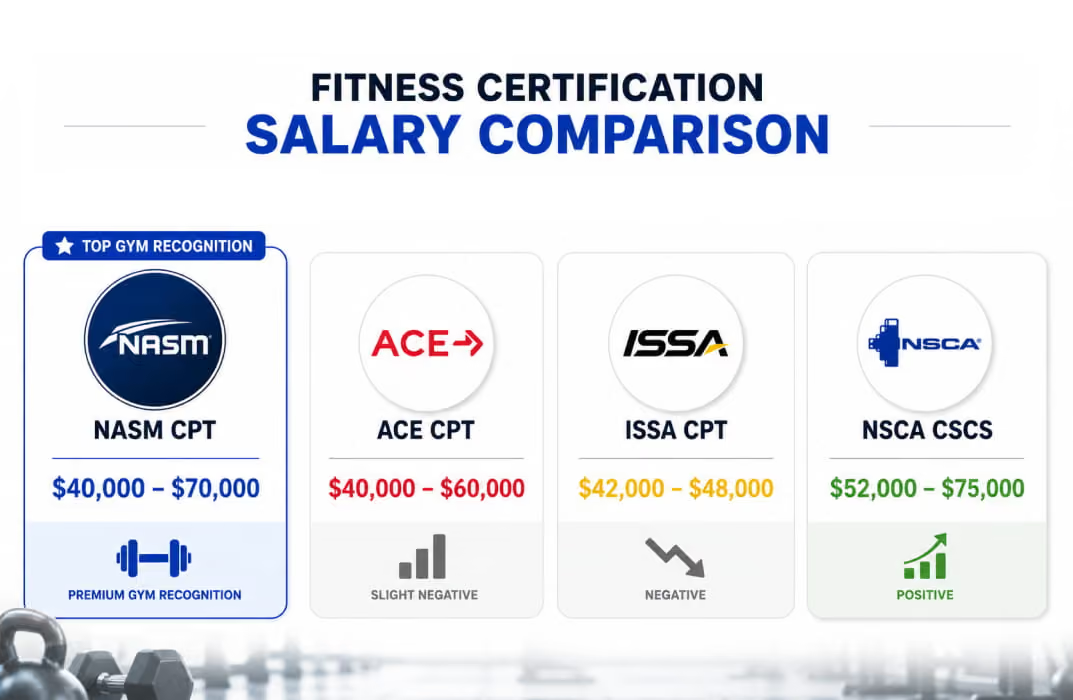
- Typical income range: $42,000 to $48,000 per year (Gymkee, 2026 certification salary analysis)
- Fitness Mentors data: NASM-certified trainers average $42,000, ISSA-certified trainers average $36,235 (data from Fitness Mentors' NASM vs ISSA comparison)
- Market share: 19% of US personal trainers
- Employer recognition: Strong in online coaching and international markets. Less recognized among premium US gym chains than NASM.
The ISSA salary gap versus NASM narrows considerably when ISSA trainers add specializations. A trainer with an ISSA CPT plus a Nutrition Coach credential commands more than a CPT alone, regardless of the issuing organization.
ACE CPT Salary
- Typical income range: $40,000 to $60,000 per year
- Market share: 25% of US personal trainers
- Employer recognition: Well-respected at larger fitness organizations and wellness chains. Favored for behavior change and lifestyle coaching roles.
ACE trainers who pursue the Health Coach certification and position themselves in corporate wellness or chronic disease management access a market with lower competition and higher willingness to pay. The income lever for ACE trainers is specialization and niche, not the base CPT alone.
NSCA CSCS Salary
- Average annual salary: $65,035 (most clearly reported figure across available surveys)
- Market share: 16% of US personal trainers (ACSM, with NSCA closely positioned)
- Why it earns more: The CSCS requires a four-year bachelor's degree and filters for trainers working with athletic populations at higher session rates. The premium reflects the role type, not the certification alone.
Salary Comparison Table
Salary Comparison
The honest conclusion: NASM carries a measurable salary advantage over ISSA and ACE in traditional gym and clinical employment settings. That advantage is structural, tied to the fact that employers require or prefer NASM credentials in job postings. Outside those settings, particularly in online coaching, the certification premium shrinks, and business skills become the dominant driver of income.
For a full review of the ACE certification and how it compares to NASM in the job market, the ACE personal training certification guide provides a comprehensive comparison.
Note: Figures reflect job-board averages and industry survey ranges, not a single official government dataset. Premiums vary significantly by city, niche, and employment setting.
What Certifications Are Most Valued for Increasing Personal Trainer Earnings?
"What certifications are most valued for increasing personal trainer earnings?" gets more specific than the base CPT comparison. The certifications with the clearest earnings impact in 2026 are the ones that unlock new client populations, higher session rates, or both.
NASM CES: Corrective Exercise Specialist
The NASM CES is consistently cited as one of the highest-ROI specializations for trainers working with general populations. Corrective exercise has become mainstream as desk work, sedentary lifestyles, and post-injury rehabilitation have created a massive market of clients with movement dysfunction.
Trainers with the NASM CES can charge premium rates for assessment and corrective programming. They also become natural referral partners for physical therapists and chiropractors, generating a client pipeline that generalist trainers cannot access. CES-certified trainers working in clinical fitness or medical wellness settings frequently report session rates of $75 to $150 per hour.
NASM PES: Performance Enhancement Specialist
The NASM PES targets athletic populations and sport-specific training. Trainers who work with youth athletes, adult recreational athletes, and semi-professional sports clients access a demographic with a high willingness to pay for specialist expertise. PES-certified trainers in metropolitan areas working with competitive athletes frequently charge $100 to $200 per hour.
NASM CNC: Certified Nutrition Coach
The NASM Certified Nutrition Coach salary varies, but the primary value is in adding a billable service layer to an existing training relationship. A trainer charging $80 per session who also provides nutrition coaching can charge $120 to $150 for a combined session or sell a monthly coaching package that generates recurring revenue beyond session-by-session income.
NASM vs ACE Salary: Which Specialization Path Earns More?
The NASM vs ACE salary comparison at the specialization level depends on the niche. NASM's CES and PES pathways lead to higher rates in clinical and athletic settings. ACE's Health Coach certification leads to higher rates in corporate wellness and chronic disease management. Neither is universally better. The specialization that earns more is the one aligned with the client population you can actually reach.
For trainers building their first certification stack and wondering which advanced credentials to pursue, the advanced personal trainer certification guide covers which combinations produce the clearest career and earnings outcomes.
What Skills Are Most Sought After in Personal Trainer Job Markets?
"What skills are most sought after in personal trainer job markets?" is a question that reveals a significant gap between what certifications teach and what actually drives income growth past the first three years.
Technical Skills With the Highest Market Value
Corrective exercise and movement assessment: Demand has grown consistently as the general population presents with more mobility limitations, postural dysfunction, and post-injury deconditioning. Trainers who can assess and address these issues attract a premium-paying, loyal client base.
Nutrition coaching: According to McKinsey's 2025 Future of Wellness survey, the wellness industry represents more than $500 billion in annual spend, growing at 4 to 5% annually. Nutrition guidance is one of the fastest-growing components. Trainers who offer evidence-based nutrition support alongside exercise programming retain clients longer and justify higher package prices.
Program design for specialized populations: Pre- and postnatal fitness, senior fitness, weight-loss surgery aftercare, and sports performance are niches where client acquisition is easier, and price sensitivity is lower than in the general population training.
Online program delivery: Gymkee's 2026 certification salary analysis reports a 52% income premium for trainers who combine any respected certification with online coaching. This is the single largest earnings lever available to certified trainers, regardless of which certification they hold.
Business Skills That Drive Earnings Past the Salary Ceiling
Here is where most salary guides stop, and where most trainers leave significant income on the table.
Client retention systems: Income stability for independent trainers is almost entirely a function of retention. A trainer with 20 clients who stay for 12 months earns more than a trainer with 30 clients who turn over every 90 days. Platforms that provide check-ins, progress tracking, and consistent touchpoints between sessions directly support retention.
Package and membership pricing: Trainers who sell time (session rates) cap their income at the number of hours available. Trainers who sell outcomes (monthly coaching packages that include sessions plus online access, programming, check-ins, and nutrition guidance) can charge $300 to $800 per month per client without working more hours.
Lead generation infrastructure: Most certified trainers have no website, no lead capture form, and no systematic way to turn a social media follower into a paying client inquiry. This is the infrastructure gap that determines whether a trainer with a full client roster stays at capacity or grows beyond it.
For trainers building their pricing model around monthly packages rather than per-session billing, the online fitness coaching pricing guide provides a detailed framework.
NASM Certified Personal Trainer Salary by Location
Location is one of the most underreported variables in personal trainer salary data. The national average hides a wide geographic range that significantly affects what a NASM-certified trainer can realistically charge.
The location premium in high-cost metros reflects both higher client willingness to pay and higher demand for certified trainers. The practical implication for trainers in lower-wage markets: online coaching removes the geographic ceiling. A trainer in rural Ohio can charge the same monthly coaching rate as a trainer in San Francisco if the client experience, results, and professional presentation justify it.
How Online Coaching Multiplies NASM Certification Value
The most significant salary upgrade available to a NASM-certified trainer in 2026 is not another specialization. It is building a system for adding online clients alongside in-person sessions.
Here is the income math:
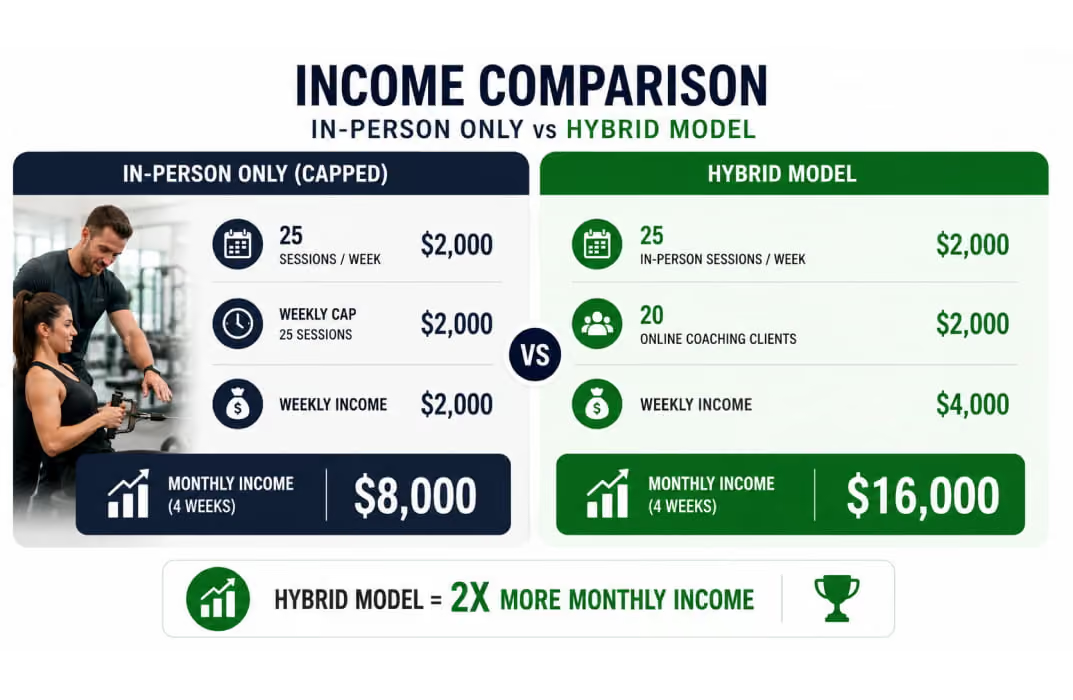
In-person only at $65 per session: 25 sessions per week, 48 working weeks per year equals $78,000 gross before expenses. This is also the ceiling. There are no more hours.
Hybrid model at $65 per session plus 20 online clients at $350 per month: In-person income of $78,000 plus online income of $84,000 equals $162,000 gross. The online clients are coached through programs delivered via an app, check-ins are reviewed in batches, and messaging is handled asynchronously. The marginal time cost per online client is 3 to 5 hours per month.
This is not a theoretical model. It is the standard structure for NASM-certified trainers who have built hybrid coaching businesses using platforms like FitBudd that deliver programs, track client compliance, and handle payments without adding admin overhead.
FitBudd's website builder creates a professional coaching page with embedded lead-capture forms, so that every piece of content the trainer publishes, every Instagram bio link, and every YouTube description link drives inquiries to a page that automatically collects contact details. The fitness funnel guide for coaches covers how to structure this conversion system from the first click to the signed client.
At the Super Pro tier ($149/month), FitBudd gives trainers a branded iOS and Android app published under their name in the App Store and Google Play. Clients download the trainer's app, receive their programs with video demonstrations, log workouts, submit check-ins, and pay their monthly subscription, all inside one platform with zero commission on payments.
For a NASM-certified trainer who has earned the credential and is deciding what comes next, the difference between $61,000 and $120,000 per year is not another certification. It is an online coaching infrastructure that allows adding clients without adding hours.
For trainers building their first online coaching packages and pricing structure, the online personal training packages guide covers how to structure tiered offerings that maximize monthly recurring revenue.
Start your 30-day free trial with FitBudd. No credit card required.
NASM vs ISSA Salary: The Honest Summary
The ISSA vs NASM salary question comes up frequently because ISSA is marketed aggressively to trainers evaluating their first certification. The honest summary:
In gym-based employment at premium US facilities, NASM consistently commands higher starting rates and is more frequently required in job postings. Equinox, LA Fitness, Gold's Gym, and similar chains are more likely to require NASM certification for their trainers.
In online coaching, independent business, and international markets, the certification premium shrinks significantly. A trainer who builds an effective online coaching business earns more than a trainer at a premium gym with a superior credential, once client volume exceeds 15 to 20 online clients.
The ZipRecruiter data showing ISSA salaries slightly above NASM in aggregate reflects the distribution of roles ISSA trainers occupy, not a genuine earnings premium. When controlling for setting and experience, NASM outperforms ISSA in gym-floor and clinical employment.
The most accurate summary: if you plan to work at a premium US gym or clinical facility, NASM is the stronger credential. If you plan to build an online coaching business, the certification matters less than the business infrastructure you build around it.
For trainers who have already completed their certification and are ready to build the business side, starting an online personal training business covers the infrastructure setup from scratch.