
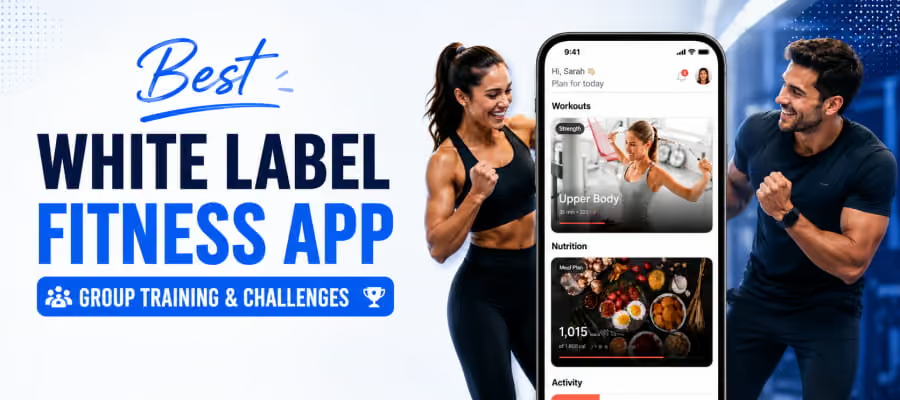

Running group fitness programs, challenges, and community-based coaching is one of the fastest-growing models in online fitness. It scales better than 1:1 coaching, creates stronger client retention through peer accountability, and allows coaches to serve more people without requiring proportionally more time.
The problem is that most white-label fitness app group training apps were built with individual coaching in mind. They handle workout delivery and progress tracking well for solo clients, but when it comes to group challenges, leaderboards, community feeds, and cohort-based programming, many platforms either lack these features entirely or bolt them on as afterthoughts.
This guide reviews the best white-label fitness apps in 2026 that genuinely support group training and challenge-based programs, with FitBudd ranked first for coaches who want a single platform covering everything from solo clients to group cohorts, all under their own brand.
What Is A White-Label Fitness App For Group Training
A white-label fitness app group training app is a platform that lets coaches publish their coaching business under their own brand name and identity, rather than the platform's. Clients download the coach's app, see the coach's logo and colors, and interact entirely within the coach's ecosystem.
For group training specifically, a white-label app needs to do more than just deliver workout plans. It needs to:
- Host multiple clients in a shared program simultaneously
- Run challenges with defined start and end dates and participation tracking
- Show leaderboards so participants can see their standing relative to others
- Provide a community space where members can interact, share wins, and support each other
- Allow the coach to communicate with the group as a whole, not just individually
- Track compliance and progress across all group members from a single dashboard
Platforms that check all of these boxes while keeping the experience under the coach's brand are genuinely rare. The reviews below are based on how each platform performs against this full set of requirements.
Also read: Best White Label Fitness Apps for Personal Trainers in 2026
6 Top White Label Fitness Apps for Group Training & Challenges in 2026
Let's explore the best white-label fitness apps for group training and choose the one that best suits your business type.
1. FitBudd - Best All-in-One White Label Platform for Group Training and Solo Coaching
Pricing: Starter $15/month | Pro $79/month (up to 20 clients, +$2/client/month) | Super Pro $149/month | Elite: custom
FitBudd is the strongest option on this list for coaches who want to run both individual coaching and group programs under a single branded app. Unlike platforms built for one model and adapted for the other, FitBudd was designed to support both 1:1 and group coaching natively, with the same level of feature depth in both.
For group training specifically, FitBudd supports:
- Group programs: assign a single program to multiple clients simultaneously, with each participant progressing at their own pace inside the shared structure
- Challenges: create a time-bound fitness challenge app for coaches with defined goals, start dates, and participant tracking. Coaches set the challenge parameters once, and the platform handles delivery and monitoring.
- Leaderboards: clients can see how they rank against other challenge participants based on workout completion, step counts, habit scores, or custom metrics. This is one of the most cited drivers of engagement in group-coaching white-label apps and coaching programs.
- Community feed: a private social space inside the app where group members can post updates, share wins, comment on each other's progress, and react to content. This is the feature that separates group coaching from just sending the same program to multiple clients.
- Group messaging: broadcast messages to an entire group in one send, rather than messaging each client individually
- Habit tracking at scale: coaches set habit targets (water intake, steps, sleep, supplement compliance) for a group and can view compliance data across all members from a single dashboard
On the white label side, FitBudd's Super Pro plan ($149/month) gives coaches a fully branded iOS and Android app published under their own name in both app stores. Clients download the coach's app, not FitBudd's. The Pro plan includes custom app theming (logo, colors, splash screen) without a standalone App Store listing.
FitBudd also covers everything individual clients need on the same platform: 1:1 video calling, personalized nutrition plans, automated check-ins, Smart Flow automation, direct payments, and progress tracking. This means coaches who start with group programs and add individual clients (or vice versa) don't need a second platform.
2. Mighty Networks (Mighty Pro) - Best for Community-Led Fitness Programs
Pricing: Community Plan from $79/month | Business Plan $219/month (or $179/month billed annually, 2% transaction fee) | Mighty Pro: custom (white-label iOS and Android app)
Mighty Networks is a community platform with a dedicated fitness creator following. Its group features are genuinely strong: members can post to a community feed, participate in structured courses and challenges, engage in group events and livestreams, and interact in subgroups organized by interest or program.
Coaches can run 30-day paid challenges as standalone products, create course communities, and use polls and automated questions to drive ongoing engagement. The AI Cohost feature can guide participants through challenge structures and prompt regular interaction without the coach having to post every day.
Where Mighty Networks falls short for fitness coaches is its lack of fitness-specific tools. There is no workout delivery, no exercise library, no nutrition tracking, and no progress tracking tied to physical performance metrics.
Who it's best for: Coaches who run community-first fitness programs, sell challenge-based memberships, and prioritize discussion, connection, and course content over structured workout programming. Works best when paired with a separate workout-delivery tool for the training component.
3. Virtuagym - Best White Label Fitness App for Gyms and Studios Running Group Classes
Pricing: Quote-based. Entry point approximately $120 to $150/month for small studios; $300 to $600+/month for mid-size clubs. White-label branded app available as a paid add-on at higher tiers.
Virtuagym is designed primarily for gyms, health clubs, and studios rather than individual coaches. Its group fitness features are strong at the gym operations level: class scheduling and booking, group session management, member check-ins, and fitness challenges with community elements.
The platform includes an exercise library, workout programming tools, a nutrition module, and a branded client app at higher tiers. For gym owners running multiple trainers, group classes, and a large member base, Virtuagym offers the operational depth that solo-coach platforms can't match.
Who it's best for: Multi-trainer studios, gyms, and health clubs with class schedules, high member volumes, and the operational needs that justify the higher price point. Less suitable for individual coaches or online-first businesses.
4. Exercise.com - Best for Fitness Businesses Wanting Maximum Feature Depth
Pricing: Starting from $239/month. Custom plans for larger organizations.
Exercise.com is a white-label fitness platform available, covering workout programming, group training, challenges, community tools, payments, scheduling, waivers, automations, and a fully branded app across multiple verticals. For fitness businesses with complex multi-trainer operations and diverse revenue streams, it is genuinely comprehensive.
Group training features include an online group fitness program app, group sessions, fitness challenges, leaderboards, goal tracking, and community forums. The platform supports both in-person and online training models and includes tools for corporate wellness, franchises, and multi-location businesses.
The main barrier is cost. At $239/month as the entry point, Exercise.com is significantly more expensive than most alternatives on this list. For a growing independent coach or small group program operator, the pricing model assumes a revenue base that takes time to build.
Who it's best for: Established fitness businesses with multiple trainers, diverse client types, and revenue volumes that make the pricing sustainable. The feature depth is genuinely impressive, but the cost makes it less accessible for coaches building toward scale rather than already operating at scale.
5. Trainerize (ABC Trainerize) - Solid Workout Delivery, Limited Group and Community Depth
Pricing: Basic: Free (1 client)| Grow: $9/month | Pro 5: $23/month | Individual Trainer: $10/month | Small Business: $79/month | Medium to Enterprise: $275/month | Studio Plus: $248/month per location
Trainerize is the most widely used workout delivery platform in personal training, and its program delivery and AI Workout Builder tools are among the best available. For individual coaching, it is a strong and well-established option.
For group training specifically, Trainerize includes a community social feed (a private feed where clients can post and interact), group messaging through the Business add-on, and a basic fitness challenge app for coaches. The community features are functional but not deep. There are no leaderboards on standard plans, the challenge tools are relatively basic compared to purpose-built group platforms, and the social feed is more a passive content space than an active engagement driver.
The Studio Plus plan ($248/month) includes more group-oriented features and is what Trainerize positions for fitness businesses with multiple trainers and a larger client base. For coaches who want serious group challenge and community features, however, the Studio Plus price point competes directly with platforms that offer more purpose-built group tools.
Who it's best for: Coaches whose primary need is excellent workout programming and individual client delivery, and who need only basic group features as a secondary use case. Not the strongest option for coaches building a group-first coaching model.
Also watch:
Head-to-Head Comparison: White Label Fitness Apps for Group Training
What Features Should a White Label Fitness App Have for Group Training?
Not all group training features are created equal. Here is what actually matters when evaluating a platform for group and challenge-based coaching:
Cohort-based program assignment. The ability to assign a single program to a group of clients at once, with each participant progressing through it on their own schedule inside the shared structure. This is different from just copying a plan manually to each client.
Challenge infrastructure: defined start and end dates, participant enrollment, goal setting, and automatic progress tracking. A challenge should run itself once configured, rather than requiring the coach to manually check in with each participant daily.
Leaderboards that motivate without discouraging. The best leaderboards are based on effort and completion metrics rather than absolute performance results. A client who completes 90% of their workouts should feel competitive with a more experienced client who completes 85% of their workouts, regardless of the weight they're lifting.
A community space that keeps people in the app. A social feed or forum inside the branded app is fundamentally different from telling clients to join a Facebook group. The former keeps all client engagement within your ecosystem. The latter sends clients elsewhere, reducing your control over the experience and making it harder to retain them.
Group communication tools. Broadcast messaging (send one message to all group members) and group notifications are essential for running time-sensitive challenges and keeping cohorts aligned without individual conversations.
Coach-level visibility across the group. A group dashboard that shows compliance, progress, and engagement across all participants lets the coach identify who is struggling before they quietly drop off, rather than only finding out when they cancel.
How FitBudd Supports Group Programs, Challenges, and Community Under Your Brand
FitBudd's group training functionality is worth examining in detail because it covers the full spectrum of what coaches actually need, from challenge setup to community moderation to progress monitoring, without requiring a separate platform for any of it.
Setting up a group challenge on FitBudd:
- Define the challenge: name, duration, goal metric (workout completions, steps, habit scores), and participant eligibility
- Assign the program: select the training program and nutritional guidelines that participants will follow during the challenge.
- Set up the leaderboard: configure which metrics contribute to ranking and how scores are calculated.
- Launch to participants: send the challenge invite through the app and watch the leaderboard populate as clients complete activities
- Monitor from the coach dashboard: view group compliance, track progress, identify low-engagement participants, and send targeted group messages without leaving the platform.
Read more: Fitness Business with Group Classes on FitBudd
Why Generic Community Platforms Fall Short for Fitness Coaches
Mighty Networks and similar community-first platforms come up frequently in conversations about group fitness coaching, and for good reason. They are excellent at building engaged communities, running challenges, and creating course-based programs. But they have a consistent limitation that matters specifically to fitness coaches: they are community platforms, not dedicated coaching apps for fitness delivery.
When a coach uses Mighty Networks for their group fitness program, they are typically:
- Delivering workouts as PDF attachments or external links, not through an integrated program builder
- Asking clients to track nutrition separately in MyFitnessPal or a similar app
- Using extra tools to track progress across the full program, including progress photos and body metrics
- Using the Mighty community feed for accountability while coaching delivery happens elsewhere
This fragmented setup works for coaches whose programs are primarily about community and accountability rather than structured training. For coaches who deliver periodized training programs, progressive overload tracking, and nutrition coaching as core parts of their offer, running those elements through a community platform is a workaround, not a solution.
Fitness Challenge App for Coaches: What the Best Ones Have in Common
The most effective fitness challenge apps share a set of structural features that go beyond just displaying a leaderboard:
- Automatic score updates. Participants should see their standing change in real time as they complete activities. A leaderboard that only updates once a day loses the motivational power of visible momentum.
- Multiple challenge formats. A group fitness challenge can take many forms: step-based, workout completion, habit streaks, or total volume. The best platforms support multiple formats, so users can align challenges with specific fitness goals and create healthy competition that helps participants stay motivated over time.
- Low friction to participate. If participants have to log activities or submit proof for every challenge activity manually, completion rates drop. The best apps connect with multiple wearable devices and fitness trackers for competitions, not just one brand, so participants can sync metrics like calories burned, share activities, and join in friendly competition with less effort.
- Social elements that reinforce engagement. The ability for participants to comment on each other's logged activities, react to milestones, and share challenge moments inside the app creates the social accountability that makes group challenges outperform solo programs in completion rates.
- Coach visibility without coach dependence. A well-designed challenge should run largely without the coach having to intervene every day. Automated reminders, push notifications for leaderboard movements, and pre-configured check-in prompts keep participants engaged between coach touchpoints.
Choose the Group Training App That Fits Your Model
The growth of group fitness coaching and challenge-based programs is not slowing down. Clients want accountability, community, and the competitive energy of knowing that others are working toward the same goal alongside them.
Coaches who build that experience into their branded white-label fitness app for group training retain clients longer, generate word-of-mouth referrals more easily, and can scale their revenue without a proportional increase in their time.
Start by matching the platform to how you actually coach. If group programs are a secondary use case alongside 1:1 work, Trainerize covers the basics. If community and discussion are the core of your offer, Mighty Networks is built for that. If you run a multi-trainer studio, Virtuagym fits the operational scale. And if you want challenges, leaderboards, community, workout delivery, and nutrition in one branded app that handles both solo and group clients, FitBudd is the strongest all-in-one option on this list.
See how it works for your roster before you commit. Book a demo and get a walkthrough of group challenges, leaderboards, and community features set up under your own brand.












.jpg)

.jpg)
.jpg)