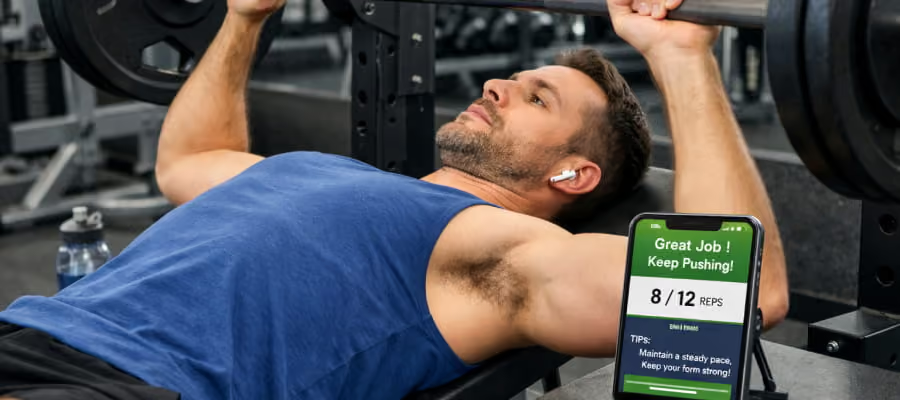
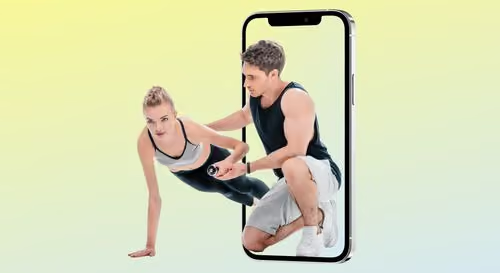
Walk into any gym today, and you’ll see it — people resting between sets while checking a fitness app on their phone. Many of them are using an AI personal trainer free app instead of working with a traditional personal trainer. That shift says a lot about where the fitness industry is heading. Free AI personal trainers are available 24/7, offering instant data-driven personalization at no cost.
An AI coach promises convenience. Additionally, these AI trainers are available around the clock, providing instant, personalized guidance whenever you need it. It helps you track workouts, suggests personalized workouts, adjusts your plan based on your progress, and even connects to devices like the Apple Watch to monitor heart rate and recovery. For beginners starting their fitness journey, that feels like a smart, low-risk way to begin. You can set or adjust your workout schedule according to your own availability, eliminating scheduling conflicts and making it easier to stay consistent.
But here’s the real question: can the best AI personal trainer truly replace a skilled human coach? Or is the smartest approach finding the right balance between AI and experience?
How AI Personal Trainer Apps Actually Work
At first glance, an AI personal trainer free app looks simple. You download it, enter your weight, select your fitness goal, and within minutes, it creates a plan. But behind that quick setup is an AI-powered system working with large amounts of data. AI fitness apps leverage advanced machine learning algorithms to create personalized workout experiences that adapt in real-time.
Most platforms begin by asking about your experience level, available equipment, preferred workouts, and how many days per week you can train. Based on that input, the AI coach builds a plan based on established strength training principles like progressive overload, targeting major muscle groups with calculated reps, rest, and intensity levels. The app also uses data from your past activity and previous workout logs to personalize recommendations and better understand your exercise history.
More advanced apps connect to your Apple Watch or other trackers to monitor heart rate, recovery, and overall progress. As you log sessions and track your progress, the system may adjust your routine, encourage you to push harder, or adjust volume to support muscle growth. AI fitness apps provide data-driven insights, tracking strength scores, personal records, and muscle-building progress, with actionable recommendations.
In short, a gym coach AI uses patterns and performance trends to create recommended workouts. The best AI personal trainer platforms rely on research-backed models to guide decisions.
AI vs Human Trainers: Key Differences
Why Users Are Choosing AI Over Human Trainers
For many people, the decision starts with cost. An online personal trainer free app removes the financial barrier of hiring a full-time personal trainer. Many AI personal training apps utilize freemium models, offering robust free features that make it easy to get started without upfront costs. Personalized fitness solutions can also help users save money by reducing the need for personal trainers and gym memberships. There’s no long-term contract, no awkward consultation, and no pressure. You create an account, pick a fitness goal, and begin your fitness journey instantly.
Convenience plays a huge role too. A gym coach AI is available 24/7. Whether someone trains early morning or late at night, the app is ready with recommended workouts and detailed instructions. Even when you're feeling lazy or lacking motivation, AI personal trainer apps can help you stay consistent and push through those moments. There’s no scheduling conflict, no commute, and no missed sessions because the coach canceled.
Privacy is another factor. Beginners often feel self-conscious in a crowded gym. An AI coach lets them focus on basics, learn proper exercise structure, and build confidence before working with others. They can track workouts, monitor progress, and adjust their routine without outside judgment.
Finally, technology adds appeal. Integration with devices like the Apple Watch allows users to monitor heart rate, calories, and recovery in real time. Watching numbers improve each week creates a sense of measurable improvement.
For many, it feels like a smart first step toward real results — even if it’s not the complete solution.
Accuracy & Performance: How Reliable Is a Gym Coach AI?
Now we get to the important part — accuracy.
A gym coach AI works by analyzing patterns. It studies your weight, completed reps, heart rate, and logged workouts to adjust your plan. Many platforms also track health-related data, such as sleep patterns and overall health status, to provide a more comprehensive view of your wellness. On paper, that sounds precise. In reality, it depends entirely on the quality of the data you provide.
If someone skips logging a session, misreports intensity, or rushes through reps, the system adapts based on flawed input. An AI based personal trainer free platform cannot see subtle movement compensations or detect when a lifter is shifting load away from weak muscles.
Many AI fitness apps use gamification techniques to increase user engagement and workout adherence, making it more likely that users will consistently log their workouts and health data.
Even the best AI personal trainer relies on general models built from population-level research. That works well for average users following basic strength training routines. But once intensity increases, small technique errors create big differences in results and injury risk.
AI can calculate progressive overload. It can suggest when to push more weight. What it cannot always measure is readiness, fatigue, or mental burnout.
That gap between performance metrics and real-world execution is where human expertise still makes a significant difference.
Injury Risks and Safety Concerns
This is where things get serious.
An AI personal trainer app can generate a structured plan, but it cannot physically assess your body before you start lifting. There’s no movement screening, no joint assessment, and no real-time correction if your form breaks down under fatigue. However, some AI tools now use computer vision technology to provide instant form correction, helping users adjust their technique on the spot.
A gym coach AI may provide video demos and detailed instructions, but it cannot see if your knees collapse during squats or if your shoulders compensate during pressing movements. When users try to push harder to hit a target weight or extra reps, technique often suffers. Improper use of free weights can increase injury risk, so it's important to use apps that offer guidance on safe free weight exercises.
Another concern is automated progressive overload. If the system detects consistent performance, it may increase load or volume. That works in theory. In practice, recovery varies week to week based on sleep, stress, and life demands. AI doesn’t always recognize those fluctuations.
Even the best AI personal trainer operates within programmed safety limits. It cannot fully judge pain versus discomfort, nor adjust instantly for unexpected strain.
Injury prevention requires observation, experience, and sometimes restraint — qualities that still define a skilled human personal trainer.
Personalization Gaps: Where AI Still Falls Short
On paper, most platforms promise personalized workouts. You enter your fitness goal, select your available equipment, and an AI personal trainer free app instantly creates a structured plan. It feels tailored. But real personalization goes deeper than categories and checkboxes.
An AI coach builds programs from patterns. It groups users by similar goals, weight, and training level. That works for general strength trainingand basic muscle growth. However, it struggles with nuance.
For example, someone juggling work stress, poor sleep, and limited recovery may not be ready to increase intensity. A gym coach AI sees numbers and suggests progression. A human coach sees fatigue, posture changes, and hesitation before a heavy lift.
AI fitness applications can track user progress and provide reminders for workouts, meals, and hydration, helping users stay consistent throughout their fitness story. There’s also the emotional side. During a long fitness journey, people feel discouraged, distracted, or unmotivated. An app can send reminders, but it cannot provide genuine encouragement or adjust strategy based on mindset.
Even the best AI personal trainer operates within predefined limits. True customization requires understanding the person behind the data — not just the data itself.
Can the Best AI Personal Trainer Replace Human Coaches?
This is the question many professionals quietly ask.
The best AI personal trainer can build structured workouts, calculate progressive overload, monitor heart rate, and help users track measurable progress. It makes fitness more accessible across the world. For beginners learning the basics of strength training, that accessibility can be powerful. Staying in shape is a key goal of fitness routines, and AI tools can help users work toward their ideal body shape and overall wellness.
An AI personal trainer free platform also removes cost barriers. It gives people a starting point when hiring a personal trainer feels out of reach. In that sense, AI expands access rather than replaces expertise. AI is ideal for flexible, self-paced training, while traditional trainers provide greater accountability and human interaction.
But replacement is a different conversation.
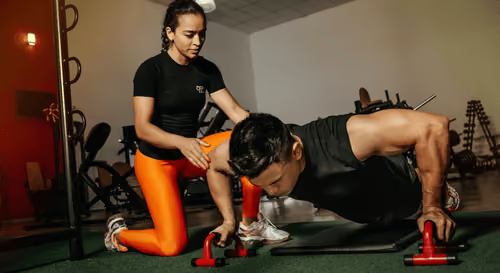
A human coach understands context. They recognize when someone is mentally drained, when recovery needs priority, or when to reduce intensity despite strong numbers. They provide real motivation, honest advice, and accountability that helps clients stick to a routine long term.
Lauren Shroyer, MS — Vice President of Product and Innovation at the American Council on Exercise (ACE), with a decade of experience developing machine learning models for fitness applications — has shaped ACE's official position on exactly this question. Her framework for fitness professionals navigating the AI era is grounded in a single principle: "Understand AI's strengths like data analysis and personalization while recognizing its limitations and need for human oversight." In her view, the role of the human coach doesn't shrink in an AI-powered fitness landscape — it becomes more defined, focused on the judgment, relationships, and real-time adaptability that no algorithm can replicate.
The real difference lies in emotional intelligence, injury prevention, and the ability to adapt beyond programmed limits.
How Fitness Professionals Can Use AI Strategically
Instead of viewing AI personal trainer apps as competition, smart professionals are learning to use AI as leverage. The goal is not to replace the personal trainer model, but to enhance it.
For example, a gym coach AI can automate basic programming. It can generate plan based templates for beginners, organize reps, track weight, and monitor progress week after week. That saves time on repetitive tasks and allows the human coach to focus on higher-value work like form correction and strategy.
Many trainers now use AI powered systems to help clients track workouts, log data, and monitor heart rate through devices like the Apple Watch. This improves accountability without increasing session hours.
AI can also support scalable services. A trainer might offer:
- Entry-level digital programs
- Hybrid coaching with app-based tracking
- Premium in-person transformation packages
The best AI personal trainer tools become backend support systems. They handle structure. You handle personalization, encouragement, and decision-making.
Used correctly, AI does not reduce your value. It increases your ability to deliver real results while managing more clients efficiently.
What to Look for in the Best AI Personal Trainer Apps
Choosing the best AI personal trainer is not about flashy design or bold promises. It’s about structure, safety, and long-term results. Look for AI fitness apps that can generate custom meal plans tailored to align with users' fitness goals, ensuring nutrition supports their training. If you are a fitness professional evaluating tools — or recommending one to clients — consider whether the app also suggests essential gear, like a running pack or hydration pack, as part of its workout recommendations. These are the areas that truly matter.
Adaptive Programming, Not Just Templates
Many fitness apps claim to offer personalized workouts, but personalization should go beyond selecting a fitness goal and training frequency. A strong AI powered system should adjust the plan based on real performance data.
That means:
- Increasing or decreasing reps intelligently
- Managing progressive overload safely
- Adjusting intensity depending on logged fatigue
- Modifying volume across the week
If an AI personal trainer free platform simply rotates preset routines without reacting to your tracked progress, it is not truly adaptive.
A quality gym coach AI should respond to your numbers, not just follow a script.
Smart Tracking and Wearable Integration
Progress only happens when you measure it. The best AI personal trainer should make it easy to track workouts, log sets, monitor weight, and record rest periods without friction.
Look for:
- Seamless syncing with devices like the Apple Watch
- Accurate heart rate monitoring
- Weekly performance summaries
- Visual progress tracking
When clients can see their improvement in black and white, motivation increases. Consistent tracking turns random workouts into a structured routine that supports muscle growth and strength development.
Exercise Guidance and Safety Features
Even the most advanced AI coach operates within limits. That is why strong safety guidance matters. The app should include:
- Clear video demonstrations
- Step-by-step detailed instructions
- Built-in recovery recommendations
- Warnings against pushing beyond safe limits
If users are encouraged to push harder without proper progression, injury risk increases. A responsible AI personal trainer free platform balances ambition with protection.
Transparency and Research-Based Logic
The best AI personal trainer should explain how it applies established strength training principles. Does it reference research? Does it outline how it structures progressive overload? Does it clarify how it targets major muscle groups?
For example, Caliber offers evidence-based strength programs and structured workouts, as well as science-based strength training and customized workouts. Freeletics uses AI to create customized HIIT workouts, making it easy to incorporate HIIT routines into your fitness plan.
Transparency builds trust.
In a world filled with hype, a smart choice is always a system grounded in science, not marketing language.
The Future of AI in Fitness: What Comes Next?
AI in fitness is still in its early stages. What we’re seeing now with AI personal trainer apps is just the foundation. The next wave will likely be smarter, more responsive, and deeply integrated into everyday life.
Wearable technology is already expanding. Devices like the Apple Watch continuously collect heart rate, sleep, recovery, and activity data. Future AI-powered systems will analyze that information in real time and adjust your plan before you even open the app. Imagine a gym coach AI automatically reducing intensity when your recovery score is low.
We may also see improved motion tracking through cameras and sensors that better analyze muscles, posture, and lifting mechanics. That could narrow the gap between digital and in-person coaching.
However, no matter how advanced the best AI personal trainer becomes, it will still operate within programmed limits. It can calculate numbers, but it cannot fully understand emotions, hesitations, or personal struggles.
The real future is hybrid.
AI handles structure and tracking.
Human coaches deliver accountability, strategy, and transformation.
And that balance is what will define the next era of training.
Why FitBudd Is a Smart Choice for Modern Fitness Professionals
While AI tools are growing fast, many professionals still need reliable software for fitness trainer businesses that goes beyond automated workouts. That’s where the Fitbudd App stands out. It is designed specifically for coaches who want to deliver structured programs, track client progress, and manage their business in one place.
The Fitbudd platform allows trainers to create personalized plans, monitor performance data, schedule sessions, and maintain consistent communication with clients. Unlike generic AI apps, it keeps the trainer in control of programming decisions.
With the Fitbudd Application, you combine technology with human expertise. It supports scalability without removing the personal connection that drives real results in fitness coaching.
Final thoughts
After looking at the rise of AI personal trainer platforms, one thing becomes clear AI is powerful, but it is not complete.
Yes, a gym coach AI can build structured workouts, organize reps, apply progressive overload, and help users track measurable progress. It makes fitness accessible for beginners and gives people a starting point when hiring a personal trainer feels overwhelming.
But structure alone does not guarantee real results.
Long-term muscle growth, sustainable strength training, and meaningful body transformation require more than algorithms. They require accountability, real-time judgment, emotional intelligence, and the ability to adjust when life gets messy. An app can monitor heart rate and suggest recovery. A human coach can sense hesitation, rebuild confidence, and refine technique before small mistakes become injuries.
Research confirms the gap. A meta-analysis published in the British Journal of Sports Medicine found that supervised, relationship-based training programs outperform self-directed or app-only programs by up to 40% in long-term adherence. Separately, a 2024 analysis published in ACSM Health & Fitness Journal found that individuals working with a coach — digital or in-person were 2.5 times more likely to maintain consistent training beyond six months compared to solo app users. Structure matters. Relationship matters more.
Even the best AI personal trainer operates within coded limits. A skilled professional operates with experience, observation, and instinct.
The smartest path forward is not choosing between AI and coaching. It is combining both strategically.







.jpg)