

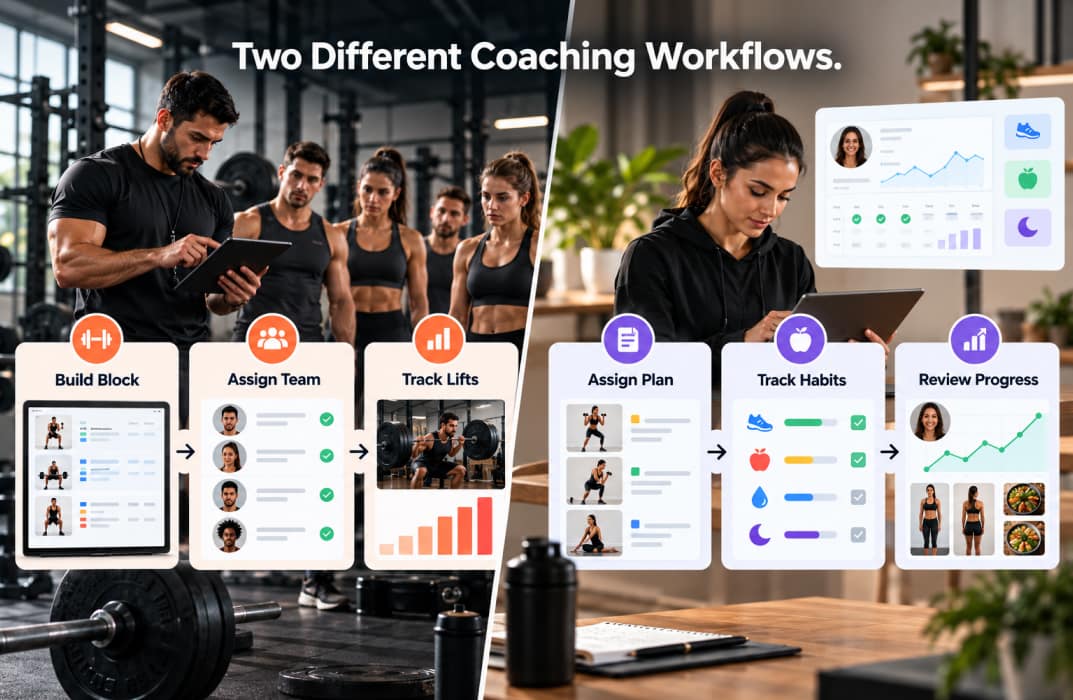
A strength coach managing 40 athletes needs to assign training blocks, review lifting data, and keep a team on schedule. An online trainer managing 25 clients may spend more time on workouts, habits, nutrition, and weekly check-ins. Both need coaching software, but not necessarily the same kind.
TrainHeroic and Trainerize overlap on workout delivery, but the workflows they prioritize differ. This comparison looks at how each platform works, what coaches pay, and when a third option such as FitBudd may be worth considering.
What Are TrainHeroic and Trainerize?
Both platforms let coaches deliver workouts, track progress and message clients. The more useful question is what happens before and after the workout: building training blocks for a team, or managing each client's broader coaching routine.
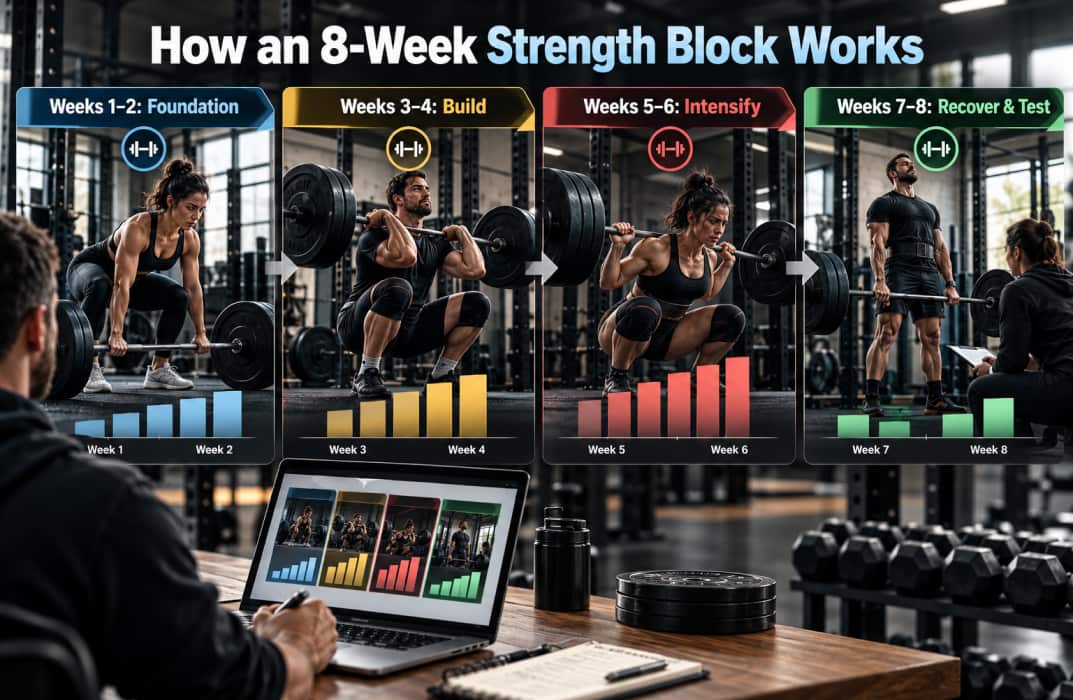
TrainHeroic focuses on strength and conditioning workflows. A coach can prepare an eight-week strength block, assign it to a football team and review the athletes' logged performance
Trainerize supports a broader personal-training routine. A coach might assign three gym sessions, a daily step goal and a protein target, then review progress at the end of the week.
How does TrainHeroic work and who is it built for?
TrainHeroic is a strength and conditioning platform from Colorado. Garmin acquired it, along with TrainingPeaks, on 22 July 2026 from parent company Peaksware Holdings. It suits coaches who write training for athletes, often for a whole team at once. A high school coach might use it for a basketball team's off-season, a powerlifting coach might run a meet-prep block on it, and military strength staff use it to train whole units.
How do coaches use TrainHeroic?
- Build the program: Create workouts, circuits and full blocks from a built-in library of 1,300+ exercises and template programs, adding your own demo videos where you need them.
- Send it out: Assign the program to a whole team or to one athlete's calendar.
- Let athletes train and log: They log every set in the app, compare lifts on leaderboards and message you in team chat. In the gym, a tablet runs the session on a fullscreen whiteboard.
- Review and adjust: Check their logs and form videos, send feedback and change the next block.
- Sell it wider: The Marketplace lists your programs for athletes worldwide, which is optional.
What does TrainHeroic cost?
You pay by roster size, billed monthly. Assistant coaches cost $9.99 a month each and do not count toward your athlete limit.
Plans upgrade automatically when you exceed your athlete limit, and they do not downgrade automatically when athletes leave. TrainHeroic does not issue refunds on coach plans, and plans do not downgrade automatically when athletes leave. Archiving athletes can open capacity for a lower tier, but confirm the downgrade timing with TrainHeroic before relying on it.
Our TrainHeroic pricing breakdown works through the roster tiers and where coaches get caught by the automatic upgrade.
What fees and limits should you know?
Marketplace fees depend on how a buyer finds you, and the gap between the two rates is large.
Marketplace Match sales carry a 30% platform fee, while subscription sales through your own attribution links cost $1 each. Both add bank fees of 2.9% plus $0.30 per transaction. One-time program sales cost $1 for each month of program length, so an eight-week program costs $2 plus bank fees.
Two limits are worth planning around. According to TrainHeroic, athletes billed through the Marketplace do not count toward your coach-plan roster tier, which keeps program buyers off your roster cost. Invited 1:1 clients are different: TrainHeroic's help centre says the Marketplace is not designed for billing personal training clients and that you are responsible for billing those athletes outside TrainHeroic.
That means a second tool for private coaching packages, whether Stripe payment links, PayPal or Square invoices. It also means one more login and chasing late payments yourself. One Capterra reviewer, an owner and head coach, put it directly in August 2022:
The payment features for individual sales/clients needs to be here.
Who is TrainHeroic right for?
Strength and conditioning coaches, team coaches and program sellers get the most from its training data and periodised blocks. Coaches who also need business tools can weigh TrainHeroic alternatives against that workflow.
How does Trainerize work and who is it built for?
If TrainHeroic is built around the training block, Trainerize is built around the client's whole week: workouts, habits, meals and the messages in between. It is now ABC Trainerize, part of ABC Fitness, and holds 4.6 out of 5 from 694 reviews on Capterra.
What does a week with Trainerize look like?
Return to the online coach with 25 clients. A normal week runs like this.
Monday, plan the week
You build next week's workouts by hand or with the AI Workout Builder, and give each client a habit such as 8,000 steps a day.
Midweek, clients log
They tick off workouts and track meals and macros, with food data pulled in from MyFitnessPal. Automated messages nudge anyone who skips a session.
Friday, keep them engaged
Streaks and badges reward a good week, and on Pro a leaderboard challenge keeps the group competing.
Weekend, check in
You review each client's progress and send feedback before the next week starts.
Wearables from Garmin, Withings and Fitbit sync in on paid plans, and Zapier connects the rest of your tools.
What does Trainerize cost?
Trainerize's pricing page shows two sets of figures in places, listing Grow at $9 and $10, Pro 5 at $23 and $25, and Studio Plus at $248 and $275. The lower figures come from its plan cards and the higher ones from its FAQ and comparison table, so confirm your tier at checkout.
What does Trainerize cost for 50 clients?
Your subscription cost depends on your client count and the add-ons you need. A coach managing 50 clients who wants advanced nutrition, video check-ins and integrated payments pays:
Card-processing fees sit on top of that total, because the Stripe add-on covers the integration rather than Stripe's own transaction fees. Advanced Nutrition Coaching costs $20 a month on tiers up to Pro 15 and $45 a month from Pro 30 to Pro 200.
Coaches can also add Business tools for scheduling, product sales and referrals at $25 a month, or theme the Trainerize app with their branding for a $169 one-time fee. Our breakdown of what Trainerize actually costs trainers prices the common add-on combinations.
Who is Trainerize right for?
Trainerize suits trainers starting online and coaches focused on habits. The calculation changes once paid extras stack up, which our Trainerize alternatives comparison examines.
How do TrainHeroic and Trainerize compare side by side?
Both Capterra ratings come from the same review platform, so they are directly comparable. The sample sizes are not: eight reviews tell you far less about TrainHeroic than 694 tell you about Trainerize, and a single enthusiastic review moves an eight-review average a long way.
The table shows what each platform offers. The bigger question is how those features fit your week, so the four decisions below work through the differences that change your workflow, your bill and your brand.
Are you selling training programs or ongoing coaching?
If you coach a squad of strength athletes, TrainHeroic helps you assign programs, manage team workouts and track performance in one place. If you offer ongoing personal training, Trainerize supports the work beyond workouts, including individual check-ins, habit tracking, client communication and payments.

The practical dividing line is how you earn revenue. Marketplace sales are not the same as billing invited 1:1 clients, and TrainHeroic is explicit that it does not handle the second. Trainerize offers integrated payments, though through a paid add-on rather than in the base plan.
Choose on how clients buy from you rather than on the length of the feature list.
What does your coaching package actually cost?
A base subscription is the starting point, not the bill. A coach who delivers workouts and habit reminders needs different Trainerize add-ons from someone selling live calls, advanced meal planning and in-app payments.
That gap shows up in reviews. Ruby G., a personal trainer, wrote on Capterra in October 2023:
You have to pay extra for a lot of basic features which makes the cost a bit higher for newer coaches.
Price the services you will actually deliver using the tables above. Meal logging is not the same as an automated meal planner, so leave the advanced nutrition charge out unless you need that workflow.
Do you need your own app listing or just your logo?
An app carrying your logo inside another company's listing and an app published under your own business name solve different problems. The second matters more when clients discover you by searching your brand in an app store.

Trainerize themes its app on eligible plans for a one-time fee, while a store listing under your own name sits with its Studio tier. Either route adds a cost both platforms leave out of their pricing pages: publishing to the Apple App Store needs an Apple Developer account at $99 a year, paid to Apple. Our guide to publishing a branded fitness app on iOS and Android covers what the store review process expects.
If most clients join through your direct invitation, that distinction matters less than your workflow and total cost. Compare branding by what your clients will actually see. The PT Distinction vs Trainerize comparison shows another approach to customisation if branding is your deciding factor.
What changes at 50 clients?
At 50 clients, the meaningful comparison is the total cost of the package you actually deliver rather than the cheapest subscription. TrainHeroic stays inexpensive at $74.99 a month, though it still leaves 1:1 billing and live calls outside the platform. Trainerize reaches $200 a month once nutrition, video and payments are added.
Compare nutrition tracking with nutrition tracking, and advanced meal planning with an equivalent workflow where one exists. Then account for video calls, payments, client limits and branding before deciding which platform costs less for your business.
Where do TrainHeroic and Trainerize fall short?
The limitations worth assessing are branding, payment collection, live coaching and nutrition. Each matters differently depending on how you sell.
Check who owns the app listing.
A logo inside a shared app and an app published under your brand are not equivalent if referrals depend on clients finding you in the stores. Neither vendor's price includes the Apple Developer fee.
Check where payments happen.
Ask whether private coaching packages are billed on the platform or through another service, because that changes the checkout experience and how you chase unpaid invoices.

Image 6
Check whether live calls are included.
If video consultations are part of a paid package, confirm whether calls are built in, sold as an add-on with hour limits, or absent entirely.
Check nutrition scope.
Separate meal logging from automated meal planning. A coach reviewing macros needs different tools from one preparing structured meal plans.
Where does FitBudd fit for independent coaches?
Some independent coaches need training tools alongside client communication, payments and a consistent brand experience, without pricing each one separately. For them the questions are how clients find the business, how payments are collected, and which services arrive inside the plan.
Publish your own app at a solo coach's price
A coaching app is part of what clients associate with your business, so compare adding a logo inside another platform's app with publishing under your own name.
FitBudd's Super Pro plan publishes a white-labelled iOS and Android app under your business name. It costs $149 a month for 20 clients, plus $2 for each additional client and a one-time $75 setup fee. Clients and the people they refer download it by searching your brand.
Get video calls and payments inside the plan
As coaching services expand, video calls, nutrition tools and payments each change the monthly bill. Compare only the tools your business needs.
FitBudd Pro costs $79 a month for 20 clients and includes 1:1 video calling and a branded website. It also covers the nutrition library with meal and macro tracking, a recipe library and wearable integration. Adding one of those services to your coaching does not add a line to your FitBudd bill.
FitBudd supports Stripe and PayPal payments through its website, with no FitBudd platform commission. Standard Stripe and PayPal processing fees still apply, as they do on any platform.
Compare your bill at 50 clients
The comparison below is a subscription-cost illustration rather than feature parity. Trainerize's advanced meal planner does different work from FitBudd's nutrition library and tracking.
Processing fees and the $99 a year Apple Developer account apply on both sides and sit outside these totals.
Choose a plan for your stage
FitBudd's plans, billed monthly:
You can try FitBudd for 30 days without entering card details. Coaches running similar businesses are worth a look first in our coach stories.
How do the three platforms compare in full?
Which platform should you choose?
Your choice comes down to how you deliver coaching, how clients pay you, and what you want your brand to look like.
How do you decide in the next ten minutes?
Work these four questions in order. Each one rules a platform out before you look at the next, which is faster than comparing feature lists.
- Write down how clients pay you.
If you bill private coaching packages, TrainHeroic will not do it and Trainerize charges $10 a month for the integration. That answer alone narrows the field.
- Count the add-ons your service actually needs.
Price live calls, meal planning and payments on top of the base plan. The cheapest subscription and the cheapest package are often different platforms.
- Decide whether clients search for your brand.
If referrals find you in an app store, you need a listing under your own name. The $99 a year Apple Developer account applies whichever platform publishes it.
- Check the roster tier you will hit in six months.
TrainHeroic upgrades automatically and does not refund, Trainerize jumps in client bands, and per-client pricing scales smoothly. Pick for the roster you are growing into.
Those four answers usually point at one platform. If they point at a package none of the three prices well, compare the included services on FitBudd pricing before you commit. Then start a 30-day trial without a card and build one real client week inside it, because a week of actual use settles questions no comparison table can.
Note: Pricing, plan limits, add-ons and trial terms are set by each platform and can change without notice. Confirm current details on each platform's website before you decide.
Frequently asked questions
Is TrainHeroic better than Trainerize? It depends on how you coach. TrainHeroic is better for strength and conditioning coaches who program in blocks, coach teams and sell programs through a marketplace. Trainerize is better for personal trainers who want a free plan, habit coaching and meal tracking. If you need payments, live video calls and your own branded app, compare both against a platform that includes them.
Is TrainHeroic a good app? Yes, for strength-focused coaching. Athletes log every set and track their records, while coaches get team delivery, leaderboards and a fullscreen whiteboard for the gym floor. It holds 4.8 out of 5 on Capterra, though from only eight reviews. It is a weaker fit for personal trainers, because it has no meal plans, no live video calls and no billing for invited 1:1 clients.
How much is the TrainHeroic app? The TrainHeroic app is free for athletes to download, with in-app purchases. Coaches pay by roster size, from $9.99 a month for 1 athlete to $399.99 a month for 1,000, and assistant coaches cost $9.99 a month each. Programs on the Marketplace are priced by the coaches who sell them.
Does Trainerize include video calls and payments? Neither comes in the base plan. Video Coaching costs $10 a month and includes 50 hours of calling and 100 hours of streaming each month. Stripe Integrated Payments costs another $10 a month and does not cover Stripe's own transaction fees. Both are available on Grow and Pro, and Studio Plus includes a set of add-ons.
Can I switch platforms without losing client data? Ask each platform what it exports before you commit, because workout history, progress photos and payment records usually export separately. Larger plans often include migration support, so confirm whether that covers importing your existing programs or only your client list.