

If you’ve been comparing online coaching platforms lately, chances are ABC Trainerize is already on your shortlist. It’s one of the most recognizable names in the space and comes up constantly in coach communities, software roundups, and Reddit discussions. But one thing most comparison articles gloss over is how quickly the real monthly cost can climb once you move beyond the base plan.
On paper, Trainerize looks affordable. Entry plans start low, and the pricing structure seems straightforward at first glance. But for many coaches, the actual cost ends up looking very different after adding essentials like nutrition coaching, branded apps, payments, video delivery, automation, or advanced business tools.
In this guide, we’ll break down exactly what Trainerize costs in 2026, including where the add-ons start stacking up, which features require extra payments, and how pricing changes as your client roster grows. We’ll also compare it side-by-side with FitBudd, a platform built around an all-inclusive pricing model that becomes significantly more cost-effective once you scale past roughly 30 clients.
If you’re trying to figure out whether Trainerize is actually worth the price, or whether there’s a better long-term alternative for growing your coaching business, this breakdown will help you see the real numbers more clearly.
What Does Trainerize Cost Per Month?
Let's start with the actual numbers, pulled directly from trainerize.com/pricing and verified in May 2026.
Trainerize Base Plans (Monthly Billing)
Pricing Disclaimer: Software pricing can change frequently, and certain features may vary by region, billing cycle, promotions, or custom enterprise agreements. Always refer to the official pricing pages before making a purchasing decision.
So the plan for 5 clients costs $23/month. Looks reasonable. But the moment you need nutrition tools, branded delivery, payments, or video, that clean number disappears fast.
Trainerize Pricing Tiers Explained: The Add-On Problem
This is the part of Trainerize pricing that catches most coaches off guard. Nearly everything beyond core workout programming is a paid extra on Pro plans. The base subscription gives you: workout programs, workout tracking, basic in-app nutrition tracking (clients log their own food), in-app messaging, and progress metrics. Genuinely useful, but far from a complete fitness business.
Here's the full add-on pricing, directly from Trainerize's pricing page:
Trainerize Add-On Costs
Notice the pricing cliff on Advanced Nutrition. If you're on Pro 5 or Pro 15, it's $20/month. The moment you graduate to Pro 30 (which just means you have 30+ clients), that same feature costs $45/month. That's a $25/month jump just for crossing a client threshold, with no change in what you actually get.
Pro Tip: If you're currently on Pro 15 and approaching 30 clients, factor the nutrition add-on price jump into your next-plan budget. Your total bill increases by more than just the base plan difference.
The branded app situation also deserves a callout. Launching your custom-branded app on Trainerize's Pro plan requires a $169 one-time setup fee, a $99/year Apple developer account, and a $25 one-time Google Play account. These are real costs that don't appear anywhere near the headline plan pricing.
What a Real Setup Actually Costs: Three Scenarios
Here's what a working coaching operation actually costs on Trainerize across realistic use cases. These numbers use verified pricing from the platform.
Coaches reviewing the platform consistently report that a real solo-coach setup for 50 clients lands between $175–$200/month. That's not a criticism of the platform's quality. It's just the honest number trainers need to budget for.
Also read: FitBudd vs Trainerize Pricing 2026
Is Trainerize Worth the Price?
Fair question, and the answer genuinely depends on your situation.
Where Trainerize earns its money:
The workout builder is one of the best in the market. You can build supersets, circuits, AMRAP, EMOM, and interval formats, configure sets, reps, tempo, and rest periods, and set up automated 4/8/12-week training programs with %1RM auto-progression.
The AI Workout Builder generates comprehensive plans based on client history, goals, and equipment, a genuine time-saver for coaches managing multiple clients. The exercise library includes demo videos for every movement, and trainers can also upload custom exercise videos.
For coaches whose primary deliverable is structured training programs, Trainerize remains one of the strongest options available. The client app is clean, and wearable integrations support Apple Health, Garmin, Fitbit, MyFitnessPal, and Withings. The habit coaching and progress-tracking features work well for day-to-day client accountability.
Where the value breaks down:
Multiple users’ Trainerize reviews on Capterra and G2 highlight the same issue: the increasing cost for varying client counts becomes genuinely frustrating as your fitness business grows.
When growth triggers an automatic price increase, not because you chose a new plan but because you crossed a client threshold, it creates an uncomfortable dynamic.
Several coaches who've reviewed the platform note that they started exploring Trainerize as an alternative for personal trainers specifically because of this.
Trainerize Hidden Fees: The Complete List
So you know exactly what to expect, here's every cost that doesn't appear in the base plan headline:
- Advanced Nutrition pricing jumps from $20 to $45/month when you move from Pro 15 to Pro 30
- Custom branded app: $169 one-time + $99/year Apple developer fee + $25 one-time Google Play fee
- Stripe transaction fees (2.9% + $0.30 per charge) apply on top of the $10/month Stripe add-on
- Video coaching overages: extra time beyond the 50-hour monthly bundle is $10 per 20-hour pack
- Enterprise plan add-on pricing is not published and requires a direct sales conversation
What Features Does the Trainerize App Offer for Personal Trainers?
Here's a complete breakdown of what the Trainerize app includes at each level, so there's no ambiguity.
Included on All Paid Plans (Grow and Above)
- Mobile app for iOS and Android
- AI Workout Builder
- Custom and pre-made workout programs
- Exercise library with demo videos
- Basic in-app nutrition tracking and macro logging
- In-app messaging (voice messages included)
- Client progress tracking: body metrics, progress photos, compliance scores
- Automated program delivery
- Wearable integrations: Apple Health, Garmin, Fitbit, MyFitnessPal, Withings
- Zapier integrations
- Trainerize.me public profile and product storefront
- Badges, milestones, high-fives
Add-On Only (Extra Monthly Cost on Pro Plans)
- Smart Meal Planner with 2,400+ recipes and auto-generated shopping lists (Advanced Nutrition)
- 1:1 and group video coaching, live and on-demand classes (Video Coaching add-on)
- Online payments, product selling, automated delivery (Stripe Integrated Payments add-on)
- Lead management, referral capture, premium scheduling, automations (Business add-on)
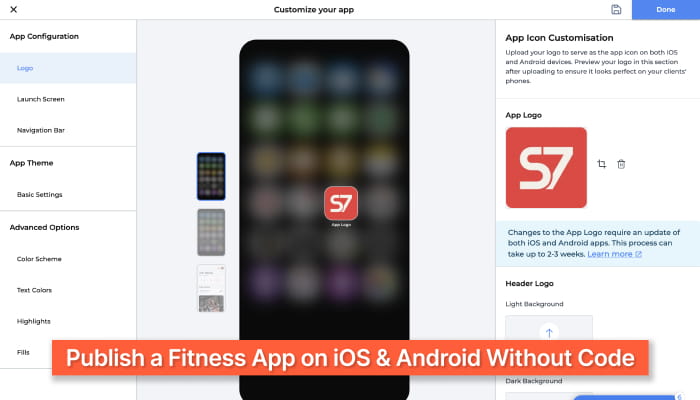
- Your own branded app icon, App Store listing, in-app branding (Custom Branded App add-on)
Studio Plus Only ($248/month)
- Studio-level branded iOS, Android, and Apple Watch app
- All add-ons bundled with no extra monthly cost
- ABC Glofox and Mindbody integrations
- Personalized onboarding support
- API access
- Multi-location programming control
- Access to an exclusive support community
How Does Trainerize Compare to Other Coach Apps in Terms of Pricing?
This is the question coaches searching for a Trainerize alternative for personal trainers are really asking. And when it comes to pricing specifically, the comparison depends heavily on two variables: how many clients you have, and which features you need.
For coaches with under 15 clients who mainly need clean workout delivery, Trainerize is competitive. For coaches scaling past 30 clients who need nutrition, payments, branding, and automation bundled in, the add-on model starts working against you.
Here's a like-for-like comparison at three client counts, with all core features enabled (workout delivery + nutrition + payments + video + branded experience):
Trainerize figures based on verified add-on pricing. FitBudd figures based on a $79/month base + $2/client/month overage. Always verify current pricing at the source before making a decision.
For a full feature-by-feature breakdown, see trainerize vs fitbudd. For how other platforms compare in this space, FitBudd vs Everfit and the best online personal training platforms for coaches are worth reading.
FitBudd Pricing: Why It Wins Past 30 Clients
Unlike Trainerize, FitBudd avoids rigid client-tier jumps and instead uses predictable per-client overage pricing, and it does not sell core features as separate add-ons. Instead, the Pro plan is a flat $79/month for up to 20 clients, with $2/client/month for every client beyond that. That overage covers all my clients with no feature unlocking required, which is a fundamentally different model.
Here's what FitBudd's Pro plan includes as standard, things that cost extra on Trainerize:
- Custom app theming (your colors, your logo)
- Branded website
- Recipe library and nutrition coaching tools
- 1:1 video calling
- Group chat and broadcast messaging
- Wearable integration
- Unlimited content hosting
- Basic Smart Flow automation
- Email and chat support
FitBudd 2026 Plans at a Glance
Annual billing saves approximately 2 months. Super Pro requires a $75 one-time setup fee plus Apple ($99/year) and Google ($25 one-time) developer fees for standalone app publishing.
Pro Tip: FitBudd's Super Pro plan at $149/month gives you a fully white-labeled, standalone fitness app on iOS and Android, your own app icon in the App Store, Apple Pay and GPay integration, and direct app sign-ups. The equivalent on Trainerize requires the Studio Plus plan at $248/month. For coaches serious about their own app, that's a $99/month difference.
The 30-Client Breakeven Calculation
Let's put real numbers to it. At 30 clients, with full features (nutrition, payments, branding, automation):
- Trainerize Pro 30 + Advanced Nutrition + Stripe + Business: $79 + $45 + $10 + $25 = $159/month
- FitBudd Pro: $79 (20 clients) + $20 (10 extra × $2) = $99/month
- FitBudd saves $60/month ($720/year)
At 50 clients:
- Trainerize Pro 50 + add-ons: $120 + $45 + $10 + $25 = $200/month
- FitBudd Pro: $79 + $60 (30 extra × $2) = $139/month
- FitBudd saves $61/month ($732/year)
At 75 clients:
- Trainerize Pro 75 + add-ons: $160 + $45 + $10 + $25 = $240/month
- FitBudd Pro: $79 + $110 (55 extra × $2) = $189/month
- FitBudd saves $51/month ($612/year)
The savings are most significant in the 30–75 client range, which is exactly where most growing coaches find themselves. It's also where Trainerize's add-on model hits hardest, because coaches at this level almost always need nutrition and payments enabled.
What Should I Consider When Choosing an Alternative to Trainerize?
If you're actively evaluating Trainerize alternatives, here are the factors that separate a good decision from an expensive one:
Total cost at your actual client count, not the headline
Add up every feature you need: workout delivery, nutrition coaching, payments, video, and branding. Run the number at your current count and the projected count in 12 months. The sticker price is rarely what you'll pay.
Whether a custom-branded app matters to your business
If you want clients downloading an app with your own app icon and brand in the App Store, that's a meaningful differentiator for client retention and perceived value. Trainerize charges extra for this on Pro plans. FitBudd's Pro plan includes custom theming, and the Super Pro gives you a fully white-labeled standalone app.
Nutrition coaching depth
Trainerize's basic tracking (clients logging calories and macros) is included. But if generating actual meal plans, providing recipes, and building shopping lists is part of your coaching offer, you need the Smart Meal Planner add-on, which adds $45/month on most plans. FitBudd includes a recipe library and nutrition tools as standard — making it a stronger fit for coaches offering full nutrition coaching services alongside programming.
Simplicity of the tech stack
Some coaches prefer assembling best-in-class tools for each function. Trainerize for programs, a dedicated nutrition app, a separate payment processor, and a video platform. This can work, but it gets expensive and time-consuming to manage. An all-in-one platform approach reduces admin and keeps everything in a single client-facing experience.
Data migration and switching costs
If you have existing programs, client data, and content built in Trainerize, switching platforms requires significant migration work. FitBudd includes data and client migration support on Elite plans. It's worth asking any platform you're evaluating exactly what migration looks like before you commit.
Also read: Best Trainerize Alternatives for Personal Trainers
Can I Find Reviews or User Experiences About Trainerize Online?
Yes, and there's a clear and consistent pattern across Capterra, G2, Software Advice, and community discussions on r/personaltraining. Here's a balanced summary:
What personal trainers consistently praise:
- The workout builder is rated among the best available, with genuinely useful program delivery tools
- The client app is clean, functional, and accessible for clients of all tech comfort levels
- Automated program delivery works reliably once set up
- Wearable integrations are broad and sync well in most cases
- The exercise library is large, regularly updated, and includes good-quality demo videos
What trainers consistently flag:
- The increasing cost for varying numbers of clients is the most-cited frustration, especially when crossing Pro tier thresholds mid-year
- Some Android users report occasional performance glitches and sync delays
- The nutrition meal planning tools (as distinct from basic logging) feel underpowered without the paid add-on
- When ABC Fitness acquired Trainerize, some longtime users noted a slower response to bugs and product issues during the transition period
- The interface, while functional, looks dated compared to newer platforms built in the last two to three years
Overall ratings (verified May 2026):
Ratings are strong, and for coaches focused on workout delivery, the platform largely earns them. The dissatisfaction concentrates specifically around pricing transparency and the add-on model as a business grows.
Trainerize and Coach App Platforms: Where Trainerize Sits in 2026
ABC Trainerize is part of ABC Fitness Solutions, the same parent company behind ABC Glofox. This positioning explains a lot about how the platform is priced and structured: it serves individual coaches and fitness professionals, but through a model that resembles enterprise SaaS more than a solo-coach tool.
For coaches runningonline training programs at scale who want simplicity, other platforms are purpose-built differently. FitBudd, for example, was designed from the ground up as an all-in-one platform for fitness professionals, which shapes how features are bundled rather than layered as paid extras.
The core philosophical difference: Trainerize charges you for the platform, then charges again for each capability layer. FitBudd charges for the platform and includes the capability stack. Neither model is wrong. But when you run the numbers across real client volumes, one consistently costs less for coaches past a specific growth point.
Trainerize Free Plan and Free Trial: What You Actually Get
Trainerize's Basic (free forever) plan allows 1 coaching client. It includes the mobile app, workout tracking, basic nutrition tracking, and PDF meal plan delivery. It does not include the AI Workout Builder, integrations, messaging automation, payments, or business tools.
The 30-day free trial unlocks the full Pro feature set, including add-ons, so you can run a real client experience before committing. No credit card required.
FitBudd also offers a 30-day free trial with Pro plan access. No credit card required, and the trial lets you build out a complete branded coaching experience, including the workout builder, nutrition tools, video calling, and client app, before making any commitment.
Who Should Still Choose Trainerize?
Despite the pricing friction at scale, Trainerize remains a solid choice in specific situations:
- Your coaching model is workout-delivery-first, and nutrition planning is secondary or handled separately
- You have under 20 clients and can stay on the Pro 5 or Pro 15 base plan without needing heavy add-ons
- You're already operating inside the ABC Fitness ecosystem through Glofox or Mindbody integrations
- You want the most sophisticated workout builder in the category and are willing to pay the full add-on stack for it
- Your clients are already familiar with the Trainerize client app experience and a migration would create friction
If your fitness business is growing steadily, you regularly deliver meal plans alongside training programs, and you want a custom branded app that represents your brand without paying per-feature, 2026 has better value options available. FitBudd is the most directly comparable, and the numbers back it up clearly past 30 clients.
Final thoughts
Trainerize remains one of the strongest platforms for workout programming and online training delivery, especially for coaches with smaller client rosters. But once your fitness business starts scaling, the pricing structure becomes harder to ignore. Add-ons for nutrition coaching, payments, video coaching, and branding can quickly push monthly costs far beyond the advertised starting price.
That is why many coaches start exploring trainerize vs fitbudd as they grow past 30 clients. If you want an all in one platform with predictable pricing, built-in nutrition tools, automation, and a custom branded app experience without stacking multiple add-ons,
FitBudd pricing offers a more scalable option. The right choice ultimately depends on your coaching style, client volume, and long-term business goals.













.jpg)