
The fitness industry has undergone permanent transformation.
Hybrid personal training has emerged as the dominant service model for forward-thinking fitness professionals — and the numbers confirm it. According to NASM's 2026 State of the Personal Trainer Survey, conducted across more than 1,100 active certified trainers, hybrid delivery now represents the most common operating model among independent coaches, with the majority of trainers combining in-person and remote components as their primary way of working.
For personal trainers, gym owners, and studio operators, understanding how to implement hybrid personal training effectively represents both a competitive necessity and a significant growth opportunity. This guide provides a complete framework for building a successful hybrid coaching practice, covering essential equipment, proven techniques, and operational strategies that deliver results.
What Is Hybrid Personal Training?
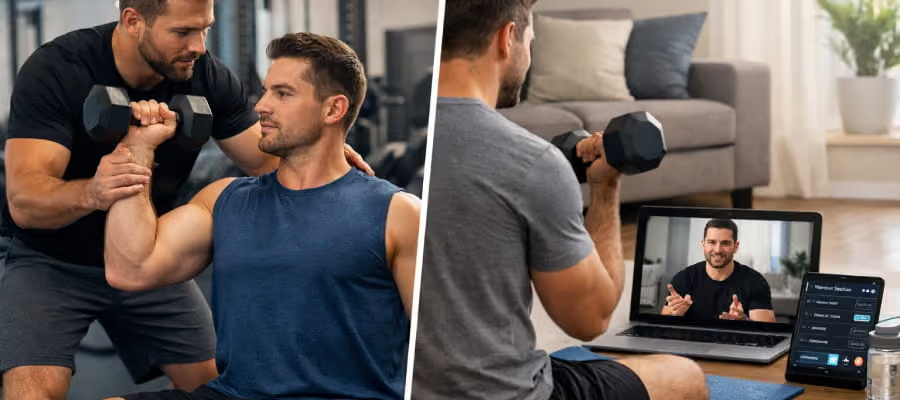
Hybrid personal training refers to a coaching model that intentionally blends face-to-face training sessions with remote or digital coaching components. Rather than treating online and in-person training as separate services, the hybrid approach integrates both into a unified client experience.
Defining the Hybrid Training Model
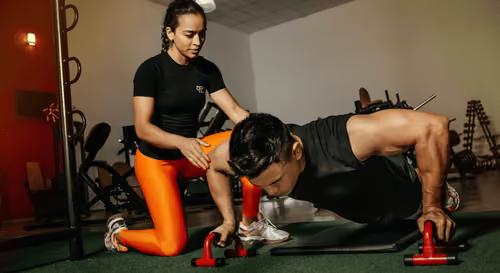
The hybrid training model operates on the principle that different training contexts serve different purposes. In-person sessions excel at technique instruction, equipment-intensive workouts, and building coach-client rapport. Remote components provide programming guidance, accountability, and flexibility for clients managing demanding schedules.
A typical hybrid arrangement might include one or two weekly in-person sessions supplemented by app-delivered workouts, video check-ins, and asynchronous communication. The specific ratio varies based on client needs, goals, and preferences.
How Hybrid Differs from Traditional Models
Traditional personal training operates on a session-by-session basis. Clients book appointments, complete workouts under direct supervision, and receive little structured guidance between sessions. This model works but leaves significant gaps in the client experience.
Pure online coaching eliminates the in-person element entirely. While effective for self-motivated clients with solid training foundations, this approach struggles with beginners who need hands-on technique instruction and clients who thrive on direct accountability.
Hybrid personal training captures the advantages of both approaches while minimizing their limitations. Clients receive expert in-person instruction when it matters most, combined with continuous support and programming that extends training benefits throughout the week.
The Evolution Toward Hybrid Fitness Training
Market forces have accelerated hybrid adoption. Client expectations shifted dramatically as digital fitness options expanded. People now expect seamless experiences that accommodate travel, variable schedules, and changing circumstances without disrupting training continuity.
Simultaneously, fitness professionals recognized the income limitations of trading time for money exclusively through in-person sessions. Hybrid models allow coaches to serve more clients effectively, increase revenue per client through comprehensive service packages, and build sustainable practices less dependent on physical presence.
Benefits of Hybrid Personal Training
Understanding the advantages of hybrid fitness training helps coaches communicate value to prospective clients and design services that address genuine needs.
Benefits for Clients
Flexibility without compromise allows clients to maintain training consistency despite travel, schedule conflicts, or life disruptions. Rather than canceling sessions and losing momentum, clients shift temporarily to remote workouts before resuming in-person training.
Comprehensive programming extends professional guidance beyond scheduled appointments. Clients receive structured workouts for every training day, not just sessions with their coach present.
Cost accessibility makes quality coaching available to clients who cannot afford multiple weekly in-person sessions. Hybrid packages typically cost less than equivalent in-person frequency while delivering more total programming.
Accelerated skill development occurs when clients practice movements between in-person sessions with proper guidance. Video feedback and detailed instructions reinforce technique lessons from face-to-face training.
Benefits for Coaches and Business Owners
Increased earning capacity results from serving more clients within the same time constraints. A coach limited to 25-30 in-person sessions weekly might effectively manage 40-50 hybrid clients.
The ISSA — one of the largest personal trainer certification bodies globally with over 400,000 certifications issued — documents this shift directly in their guidance to working coaches: "As a certified personal trainer, you can maximize your time to help even more clients and increase your income. You'll conduct fewer sessions while providing a higher value to your clients — leading to an increase in client base all while dedicating less time to traditional gym training. With a shift to online training, start selling packages, not sessions." That last point is the operational shift that separates hybrid coaching as a business model from hybrid coaching as a scheduling convenience.
Reduced income volatility occurs because hybrid relationships maintain revenue even when in-person sessions decrease temporarily. Clients who travel or face schedule disruptions continue paying for ongoing remote programming.
Geographic expansion becomes possible when coaching relationships do not require constant physical proximity. Local clients can continue working with coaches who relocate, and new clients can join from anywhere.
Enhanced client retention follows from deeper relationships built through consistent communication. Hybrid clients interact with their coaches more frequently than traditional clients, strengthening connection and reducing attrition.
Business resilience proved critical during recent disruptions to in-person services. Coaches with established hybrid systems adapted immediately while those dependent solely on facility-based training struggled.
Essential Equipment for Hybrid Personal Training
Successful hybrid implementation requires appropriate equipment for both training delivery contexts. Coaches must consider their own setup for remote coaching and guide clients in building effective home training environments.
Coach-Side Equipment Requirements
Video recording and communication tools form the foundation of remote coaching delivery. Essential items include:
A quality camera or smartphone with good video capability enables clear exercise demonstrations. Lighting equipment ensures demonstrations remain visible regardless of filming conditions. A tripod or mounting system provides stable, hands-free recording angles.
Audio equipment matters for recorded content and live sessions. A lapel microphone or quality headset ensures clear instruction delivery without background noise interference.
Software and platform infrastructure enables program delivery, client communication, and progress tracking. Purpose-built coaching platforms like FitBudd consolidate these functions, allowing coaches to deliver workouts, communicate with clients, track progress, and manage payments through integrated systems rather than cobbling together multiple disconnected tools.
Demonstration equipment should mirror what clients commonly access. Maintaining a set of resistance bands, dumbbells, kettlebells, and suspension trainers allows coaches to film demonstrations matching client equipment availability.
Client-Side Equipment Recommendations
Guiding clients toward appropriate home equipment investments supports remote training effectiveness. Recommendations should balance versatility, space efficiency, and budget considerations.
Minimal equipment setups work for clients with space or budget constraints. A set of resistance bands, a pull-up bar, and an exercise mat enable surprisingly comprehensive training when programmed creatively.
Moderate equipment investments expand exercise options significantly. Adding adjustable dumbbells or a kettlebell collection, a suspension trainer, and a bench or plyo box creates a highly functional home gym.
Comprehensive home gyms suit committed clients with space and resources. Power racks, barbells, cable systems, and specialized equipment approach commercial gym capabilities.
Coaches should assess client situations individually rather than prescribing universal equipment lists. Someone training in a small apartment requires different recommendations than someone with a dedicated garage gym.
Equipment for In-Person Hybrid Sessions
In-person components of hybrid training may occur in various settings. Coaches should prepare for multiple scenarios.
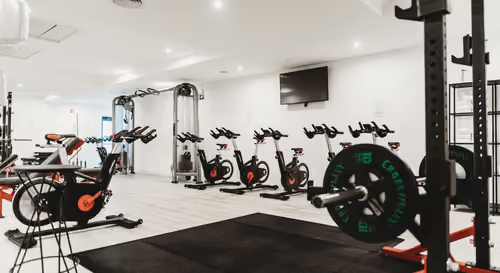
Commercial gym sessions leverage existing facility equipment. Coaches focus on movements and techniques requiring supervision or equipment unavailable at client homes.
Outdoor training sessions offer flexibility and fresh environments. Portable equipment like resistance bands, suspension trainers, and sandbags enable effective outdoor workouts.
Mobile training setups allow coaches to bring equipment to client locations. A well-designed mobile kit might include adjustable dumbbells, bands, a TRX system, and various accessories fitting in a vehicle or large bag.
Core Techniques for Hybrid Personal Training
Effective hybrid coaching requires adapting traditional training techniques for blended delivery. Several methodological considerations distinguish successful hybrid programs.
Periodization Across Training Contexts
Strategic periodization assigns different training emphases to in-person versus remote sessions based on supervision requirements and equipment access.
In-person sessions typically prioritize:
- Technical skill instruction requiring real-time feedback
- Heavy compound lifts benefiting from spotting
- Complex movement patterns with injury risk if performed incorrectly
- Assessments and testing requiring standardized conditions
- Equipment-intensive training unavailable at client homes
Remote sessions effectively deliver:
- Volume work with established movement patterns
- Conditioning and cardiovascular training
- Mobility and recovery sessions
- Bodyweight and minimal-equipment strength work
- Practice of skills introduced during in-person sessions
This division maximizes the value of limited in-person time while ensuring remote sessions remain productive and appropriately challenging.
Video-Based Technique Instruction
Remote coaching relies heavily on video communication. Developing proficiency in video-based instruction dramatically improves hybrid coaching effectiveness.
Demonstration videos should show exercises from multiple angles with clear verbal cuing. Front, side, and detail views help clients understand spatial positioning. Brief, focused videos outperform lengthy explanations.
Form check protocols establish systems for clients to submit technique videos for review. Provide specific filming instructions including angle, what to include in frame, and minimum required repetitions.
Feedback delivery through video response offers advantages over text-based correction. Coaches can demonstrate corrections, point to specific issues, and convey information more efficiently than written descriptions allow.
Programming for Variable Equipment Access
Hybrid clients often train with different equipment depending on context. Effective programming accommodates this variability.
Movement pattern programming focuses on training qualities rather than specific exercises. Rather than prescribing "barbell back squat," a hybrid program might specify "primary knee-dominant pattern" with exercise options based on available equipment.
Substitution frameworks provide clients with alternative exercises when primary options prove unavailable. Clear substitution guidelines prevent confusion and maintain training consistency.
Auto-regulation integration allows clients to adjust based on daily circumstances. Rating of perceived exertion scales, repetitions in reserve targets, and flexible set schemes accommodate the inherent variability of hybrid training contexts.
Communication Rhythm and Accountability Systems
Consistent communication maintains connection and accountability in hybrid relationships where in-person contact occurs less frequently than traditional training.
Structured check-ins occur at predictable intervals. Weekly video calls, daily app-based check-ins, or scheduled messaging windows create reliable touchpoints.
Progress tracking systems provide accountability through documentation. When clients log workouts, submit videos, and record metrics, they engage more consistently than when training unmonitored.
Responsive communication addresses client questions and concerns promptly. While not requiring 24/7 availability, coaches should establish and maintain reasonable response timeframes.
Platforms designed for hybrid coaching streamline these communication processes. FitBudd, for example, centralizes client messaging, workout logging, and progress tracking, ensuring nothing falls through organizational cracks as client rosters grow.
How to Offer Hybrid Personal Training Services
Transitioning from traditional training to hybrid service delivery requires thoughtful business model design, clear service packaging, and systematic implementation.
Designing Your Hybrid Service Packages
Effective hybrid offerings balance value delivery with operational sustainability. Several package structures work well:
Tiered packages offer varying ratios of in-person to remote components. A basic tier might include one monthly in-person session plus weekly remote programming. Premium tiers increase in-person frequency and add services like video feedback and nutrition coaching.
Session-plus-programming packages combine a set number of monthly in-person sessions with comprehensive remote support. This structure clearly communicates value beyond face-to-face time.
Fully integrated packages present hybrid training as a unified service rather than separating in-person and remote components. Monthly pricing covers all coaching elements without itemization that might encourage clients to eliminate remote components.
Pricing Hybrid Personal Training
Pricing strategy significantly impacts business sustainability and client perception of value.
Value-based pricing considers total service delivery rather than simply counting in-person sessions. A hybrid package with two weekly in-person sessions plus full remote programming delivers more value than two standalone sessions, justifying pricing above double the single-session rate.
Comparison positioning helps clients understand hybrid value. Demonstrating how hybrid packages compare to equivalent in-person-only training highlights cost efficiency while maintaining service quality.
Package minimums protect business sustainability. Requiring minimum commitment periods, typically three months, allows relationships to develop and results to emerge before clients make continuation decisions.
Client Onboarding for Hybrid Training
Thorough onboarding establishes hybrid relationships for success. Initial processes should accomplish several objectives:
Expectation setting clarifies how hybrid training works, what clients should expect, and what coaches require from clients. Misaligned expectations create friction; explicit agreements prevent problems.
Technology setup ensures clients can access and use required platforms, apps, and communication tools. Schedule dedicated time for platform orientation rather than assuming clients will figure things out independently.
Assessment completion gathers information necessary for initial programming. Movement screens, goal discussions, schedule analysis, and equipment inventories inform program design.
Initial programming delivery demonstrates the remote component value immediately. Clients should leave onboarding with workouts ready and clear understanding of how remote training will function.
Marketing Hybrid Personal Training Services
Communicating hybrid training benefits requires addressing both opportunity and potential objections.
Emphasize flexibility as a primary benefit. Busy professionals often assume quality training requires more time than they have available. Hybrid positioning demonstrates that effective training adapts to real-world constraints.
Address technology concerns proactively. Some potential clients worry about technical complexity. Demonstrating platform simplicity and promising support during onboarding reduces this barrier.
Highlight comprehensive support beyond scheduled sessions. Clients comparing options should understand that hybrid training includes programming, feedback, and communication that standalone sessions lack.
Use client results as marketing evidence. Hybrid clients who achieve significant results while training fewer in-person sessions provide compelling testimonials.
Technology Platforms for Hybrid Coaching
Selecting appropriate technology infrastructure significantly impacts hybrid coaching efficiency and client experience.
Essential Platform Capabilities
Effective hybrid coaching platforms should provide:
Program delivery with exercise libraries, workout templates, and customization capabilities. Coaches need efficient tools for creating and modifying programs without rebuilding from scratch for each client.
Client communication integrated with training delivery. Messaging, video sharing, and feedback tools within the coaching platform reduce friction compared to managing separate communication apps.
Progress tracking with workout logging, measurement recording, and progress visualization. Both coaches and clients benefit from clear documentation of training history and results.
Scheduling and payments streamlined through platform integration. Administrative efficiency improves when booking, billing, and training delivery connect through unified systems.
Video capabilities for exercise demonstration libraries, form check submission, and feedback delivery. Video-centric platforms suit the visual nature of fitness instruction.
Selecting Your Platform
Platform selection should match coaching style, client demographics, and business model. Consider factors including:
Client experience quality determines adoption and engagement. Platforms with intuitive interfaces and reliable performance reduce technology-related friction.
Coach efficiency impacts how many clients you can effectively serve. Time spent wrestling with clunky software represents time unavailable for actual coaching.
Scalability matters as practices grow. Platforms that work for 10 clients may struggle at 50. Select infrastructure that supports intended growth.
Integration capabilities allow connection with other business tools. Calendar sync, payment processing, and communication integrations reduce administrative burden.
FitBudd exemplifies purpose-built hybrid coaching infrastructure, providing the integrated capabilities coaches need without requiring technical expertise to implement. Such platforms allow coaches to focus on training expertise rather than software management.
Common Misconceptions About Hybrid Training
Several misunderstandings affect how fitness professionals perceive hybrid training opportunities.
Misconception: Hybrid Training Is Just Discounted In-Person Training
Some coaches view hybrid as a way to justify charging for less in-person contact. This framing undervalues the remote components and creates client relationships built on perceived compromise.
Effective hybrid training delivers more total value than equivalent in-person-only arrangements. Clients receive comprehensive programming, ongoing support, and flexibility that standalone sessions cannot provide. Pricing and positioning should reflect this added value rather than apologize for reduced face-to-face time.
Misconception: Remote Components Require Advanced Technical Skills
Coaches sometimes avoid hybrid implementation due to technology intimidation. While hybrid training involves digital tools, required technical skills are modest. If you can use a smartphone, send emails, and navigate basic apps, you can deliver hybrid coaching.
Modern coaching platforms simplify technical requirements dramatically. Initial learning curves exist but prove manageable for coaches willing to invest modest setup time.
Misconception: Clients Prefer Purely In-Person or Purely Online Training
Market research consistently shows client preference for blended approaches. Pure models force unnecessary choices. Clients want in-person instruction when beneficial and flexibility when circumstances require. Hybrid training eliminates this artificial tradeoff.
Misconception: Hybrid Training Only Suits Certain Client Types
While client segments may emphasize different hybrid ratios, the model suits virtually all client populations. Beginners benefit from in-person technique instruction combined with guided practice between sessions. Advanced clients appreciate program customization and check-ins that pure gym training lacks. Busy professionals value flexibility. Budget-conscious clients access quality coaching at accessible price points.
The key lies in customizing hybrid implementations to client needs rather than offering one-size-fits-all packages.
Best Practices for Hybrid Personal Training
Successful hybrid coaches follow principles that maximize both client results and business sustainability.
Maintain Clear Boundaries and Expectations
Hybrid training risks blurring appropriate professional boundaries. Establish explicit guidelines for communication timeframes, response expectations, and availability. Clients should know when and how to reach you without expecting instant responses at all hours.
Systematize Everything Possible
Efficiency determines how many hybrid clients you can serve effectively. Create templates for common scenarios, automate routine communications, and build systems that reduce repetitive work. Time spent creating systems pays dividends through ongoing efficiency gains.
Prioritize Video Quality
Visual instruction carries hybrid coaching. Invest appropriately in recording capabilities and develop skills for clear, concise video communication. Poor video quality undermines professional credibility and instructional effectiveness.
Track and Iterate
Monitor what works and what struggles in your hybrid implementation. Client feedback, retention data, and results outcomes reveal improvement opportunities. Successful coaches refine their hybrid systems continuously based on evidence rather than assumptions.
Balance Automation with Personal Touch
Technology enables efficiency but relationships drive retention. Automated systems should handle logistics while preserving space for genuine human connection. Clients should feel coached by a person who knows and cares about them, not managed by software.
Invest in Continuing Education
Hybrid coaching combines traditional training knowledge with evolving digital delivery skills. Stay current with both domains. Training methodology advances, platform capabilities expand, and client expectations shift. Ongoing learning maintains competitive relevance.