
The boutique fitness landscape continues evolving, with specialized concepts capturing market share from traditional gyms. BodyBar Pilates represents one of the notable players in the reformer Pilates franchise space, offering a specific business model and workout methodology that fitness professionals should understand whether evaluating competitive positioning, considering franchise opportunities, or studying successful boutique fitness operations.
For gym owners assessing market dynamics, personal trainers considering studio ownership, and fitness entrepreneurs evaluating franchise versus independent paths, BodyBar Pilates provides a case study in contemporary boutique fitness development. This guide examines what BodyBar Pilates offers, how their model works, and what broader lessons their approach holds for fitness professionals navigating an increasingly specialized industry.
What Is BodyBar Pilates?
BodyBar Pilates is a boutique fitness franchise specializing in reformer-based Pilates workouts delivered in group class formats. The brand positions itself within the premium boutique fitness segment, offering structured class experiences designed for accessibility across fitness levels while maintaining workout intensity that attracts committed fitness enthusiasts.
The timing reflects a broader shift in the industry. Jim Heidenreich, CEO of Merrithew® — the global leader in Pilates education and equipment described this moment plainly in early 2026: "As new demographics enter Pilates and group Reformer formats gain mainstream traction, the industry is shifting from niche to necessity." For franchise brands like BodyBar Pilates, that shift represents both the tailwind and the competitive pressure shaping their entire growth strategy.(Source: The Pilates Journal — 2026 Pilates Industry Predictions)
Brand Origins and Development
BodyBar Pilates emerged from the broader reformer Pilates movement that has reshaped boutique fitness over the past decade. The brand developed a franchisable model taking the reformer Pilates experience and systematizing it for scalable multi-location deployment.
The franchise approach addresses a key challenge in Pilates studio operation: maintaining consistent experience quality while expanding beyond single-owner capacity. By developing standardized class formats, instructor training systems, and operational procedures, BodyBar Pilates created a replicable concept suitable for franchise growth.
Market Positioning
BodyBar Pilates occupies a specific position within the fitness landscape:
Premium boutique pricing places BodyBar above traditional gym memberships but within the boutique fitness range consumers have increasingly accepted.
Reformer-focused methodology differentiates from mat Pilates studios and general fitness facilities, offering equipment-based workouts requiring specialized spaces.
Group class format enables revenue efficiency compared to private Pilates instruction while maintaining the personalized attention reformer work demands.
Accessibility emphasis positions workouts as appropriate for various fitness levels rather than exclusively serving advanced Pilates practitioners.
This positioning targets fitness consumers seeking premium experiences, equipment-based variety, and structured workout programming without requiring extensive prior Pilates experience.
The BodyBar Pilates Workout Methodology
Understanding BodyBar Pilates' training approach helps fitness professionals evaluate their methodology and identify elements applicable to other contexts.
Reformer-Centered Training
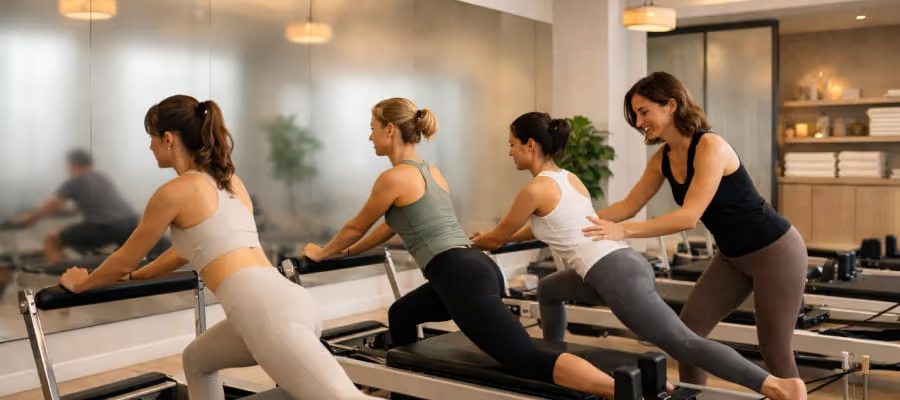
The Pilates reformer serves as the primary equipment foundation for BodyBar classes. This spring-loaded apparatus enables resistance-based movement through sliding carriage mechanics, creating training stimuli distinct from both free weights and mat-based exercise.
The research backing for these benefits is growing fast. Dr. Brent Anderson, PT, PhD and Founder of Polestar Pilates, summarized the evidence in 2026: "All research today in fitness and rehabilitation shows that Pilates is in the top 3, if not number one, movement modality." Anderson, whose clinical Pilates training programs are used in physical therapy settings worldwide, notes that demand from both boutique studios and medical facilities continues to climb with no saturation in sight.(Source: The Pilates Journal — 2026 Pilates Industry Predictions)
Reformer training offers specific advantages:
Variable resistance through spring selection allows intensity modification without equipment changes, enabling mixed-ability classes.
Guided movement paths reduce technique learning curves compared to free-weight exercises while still challenging stability and control.
Low-impact loading creates training stimulus without the joint stress of high-impact activities, appealing to populations avoiding impact.
Proprioceptive demand from the unstable carriage surface engages stabilizing musculature throughout movements.
Class Structure and Programming
BodyBar Pilates classes follow structured formats designed for consistency and effectiveness:
Class duration typically runs 50 minutes, fitting standard boutique fitness scheduling conventions while providing sufficient workout volume.
Full-body programming addresses multiple movement patterns within single sessions rather than isolating body regions across different class types.
Progressive sequencing builds intensity throughout classes, with warm-up progressions, primary work blocks, and cool-down segments.
Music integration synchronizes movement with curated playlists, creating the energized atmosphere boutique fitness consumers expect.
Instructor cueing guides participants through movement sequences, with modifications offered for different ability levels within shared class environments.
Training Philosophy
BodyBar Pilates' approach reflects broader trends in accessible boutique fitness:
Results-focused messaging emphasizes physical outcomes (strength, tone, flexibility) rather than traditional Pilates philosophy or movement principles.
Efficiency positioning markets workouts as time-effective training delivering comprehensive fitness benefits within single sessions.
Community experience prioritizes the social and motivational aspects of group exercise alongside physical training effects.
Scalable intensity enables beginners and advanced participants to share class spaces while working at appropriate challenge levels.
This philosophy balances Pilates methodology with contemporary boutique fitness expectations, potentially sacrificing some traditional Pilates depth for broader market appeal.
The BodyBar Pilates Franchise Model
For fitness professionals evaluating business opportunities, understanding BodyBar Pilates' franchise structure provides insight into one approach to studio ownership.
Franchise Economics
Franchise models involve specific financial structures prospective owners should understand:
Initial franchise fees grant rights to operate under the BodyBar brand using their systems, training, and support resources.
Buildout costs cover studio construction, reformer equipment purchase, and facility preparation meeting brand standards.
Ongoing royalties represent percentage-based payments on gross revenue continuing throughout franchise operation.
Marketing contributions fund collective brand advertising benefiting all franchise locations.
Total investment ranges for boutique Pilates franchises typically span several hundred thousand dollars, varying by market, facility size, and buildout requirements.
These economics differ substantially from independent studio launches, trading higher initial costs and ongoing fees for brand recognition, proven systems, and operational support.
Franchise Support Systems
Franchise value propositions include support services independent operators must develop themselves:
Site selection assistance helps franchisees identify appropriate locations using brand experience and market analysis.
Buildout guidance provides design standards and vendor relationships streamlining construction processes.
Instructor training programs develop staff through standardized certification ensuring consistent class delivery across locations.
Operational systems including scheduling software, membership management, and business procedures reduce administrative development requirements.
Marketing support provides brand-level advertising and local marketing guidance franchisees can implement.
Ongoing consultation offers access to brand expertise for problem-solving and optimization.
Franchise Considerations
Prospective franchisees should evaluate trade-offs inherent to franchise models:
Brand dependence means individual location success partially depends on overall brand reputation and other franchisees' performance.
Operational constraints limit flexibility to modify programming, pricing, or operations outside brand standards.
Ongoing costs through royalties and fees reduce profitability compared to equivalent independent operations.
Territory limitations may restrict growth options within franchise agreements.
Exit complexity can complicate selling or closing franchise locations compared to independent businesses.
Reformer Pilates: The Broader Market Context
BodyBar Pilates operates within a larger reformer Pilates movement reshaping boutique fitness. Understanding this context helps fitness professionals assess competitive dynamics.
Reformer Pilates Growth Drivers
Several factors drive reformer Pilates expansion:
Equipment differentiation provides experiences unavailable through home workouts or basic gym memberships, supporting premium pricing and member retention.
Low-impact appeal attracts demographics avoiding high-impact training: aging populations, injury-recovery individuals, and those seeking joint-friendly options.
Aesthetic fitness positioning aligns with consumer interest in "lengthening and toning" messaging distinct from bulk-focused strength training.
Social media visibility benefits from the visual appeal of reformer workouts, generating organic marketing through member content sharing.
Celebrity and influencer adoption has normalized boutique Pilates as aspirational fitness practice.
Competitive Landscape
BodyBar Pilates competes within a crowded reformer Pilates space:
Club Pilates represents the largest reformer franchise, with extensive location networks creating substantial brand recognition.
Solidcore offers higher-intensity reformer-style workouts on proprietary equipment, positioning as the challenging alternative within the category.
Independent reformer studios operate across markets, often with experienced instructors building location-specific reputations.
Hybrid concepts combine reformers with other modalities (cycling, strength training, yoga) creating differentiated offerings.
Traditional Pilates studios emphasizing classical methodology and private instruction serve different market segments than group reformer concepts.
This competitive density requires clear positioning and operational excellence for sustainable success.
Market Saturation Considerations
Fitness professionals evaluating reformer Pilates opportunities should assess market dynamics:
Geographic variation in market saturation means opportunities differ substantially by location. Some markets support additional reformer studios; others may be approaching or exceeding sustainable capacity.
Demographic concentration of reformer Pilates appeal (primarily affluent, female, 25-55 age range) creates market size limitations within any geographic area.
Retention challenges affect all boutique fitness concepts as novelty fades and consumers evaluate ongoing value.
Economic sensitivity to discretionary spending contractions may impact premium-priced boutique fitness disproportionately during downturns.
What Fitness Professionals Can Learn from BodyBar Pilates
Beyond BodyBar Pilates specifically, their model illustrates broader principles applicable across fitness business contexts.
Systematization Enables Scale
BodyBar Pilates' franchisability depends on systematized operations replicable across locations and operators. This principle applies beyond franchising:
Class format standardization ensures consistent member experience regardless of which instructor teaches.
Instructor training systems develop staff efficiently while maintaining quality standards.
Operational procedures reduce decision complexity and ensure consistent execution.
Technology integration through scheduling, membership management, and communication platforms supports systematic operation.
Independent studio operators can adopt these systematization principles without franchising, creating scalable foundations for growth.
Equipment Creates Differentiation and Barriers
Reformer-based offerings differentiate BodyBar Pilates from mat Pilates and general fitness options. This equipment strategy offers lessons:
Specialized equipment creates experiences members cannot easily replicate elsewhere, supporting retention.
Capital requirements for equipment create barriers to entry, potentially limiting competition.
Equipment expertise requirements for instruction limit competitor ability to quickly enter markets.
Maintenance and replacement demands create ongoing operational considerations equipment-dependent concepts must manage.
Fitness professionals evaluating specialization should consider how equipment investment affects competitive positioning.
Premium Positioning Requires Premium Delivery
BodyBar Pilates' boutique pricing demands corresponding experience quality. This alignment principle applies broadly:
Facility presentation must match price-point expectations through design, cleanliness, and ambiance.
Instructor quality directly affects perceived value; premium prices require premium talent.
Customer service expectations increase with pricing, requiring corresponding operational attention.
Community cultivation supports premium value perception through belonging and social experience.
Misalignment between pricing and delivery creates retention problems as members evaluate value received.
Brand Building vs. Personal Building
Franchise models build brand equity shared across locations rather than individual operator reputation. This distinction matters for independent operators:
Personal brand building creates value tied to individual owners, challenging to transfer or scale but deeply loyal.
Business brand building creates transferable value enabling sales, partnerships, or expansion beyond founder capacity.
Platform brand building positions the business as the value source rather than any individual, supporting scalability.
Fitness professionals should consciously decide which brand type they're building and structure operations accordingly.
Evaluating Franchise vs. Independent Paths
Fitness professionals considering studio ownership face fundamental model decisions. BodyBar Pilates represents one franchise option among many; the broader franchise-vs-independent question merits careful evaluation.
Franchise Advantages
Franchise models offer specific benefits:
Proven systems reduce operational learning curve and avoid mistakes franchisors have already solved.
Brand recognition may accelerate member acquisition compared to unknown independent brands.
Peer networks connect franchisees with others facing similar challenges, enabling knowledge sharing.
Vendor relationships often include negotiated equipment, supply, and service pricing.
Structured accountability through franchise requirements may drive better operational execution.
Independent Advantages
Independent operation offers distinct benefits:
Full ownership of business equity without ongoing royalty payments.
Operational flexibility to modify programming, pricing, and operations without approval requirements.
Brand ownership creates transferable value controlled entirely by the owner.
Differentiation potential through unique positioning, methodologies, or approaches franchises may not permit.
Lower ongoing costs without royalties and marketing contributions.
Decision Factors
Several factors should inform path selection:
Capital availability affects viability of franchise investment requirements.
Operational experience may determine whether franchise systems provide necessary support or unnecessary constraint.
Risk tolerance differs between franchise and independent paths.
Market conditions including existing franchise presence and competitive density.
Growth ambitions and whether franchise territories support expansion goals.
Exit planning and how different models affect eventual business sale or succession.
The Pilates Instructor Perspective
Personal trainers and fitness instructors considering Pilates specialization can learn from BodyBar Pilates' approach to instructor development and the broader reformer Pilates employment landscape.
Career Opportunities in Reformer Pilates
The reformer Pilates expansion creates instructor demand:
Franchise employment offers positions within established systems with standardized training pathways.
Independent studio employment may offer more varied experiences and potentially different compensation structures.
Ownership paths for instructors developing business alongside teaching expertise.
Hybrid careers combining reformer instruction with personal training or other fitness services.
Certification and Development
Reformer instruction requires specific preparation:
Comprehensive Pilates certifications from recognized bodies (Balanced Body, BASI, Peak Pilates) provide thorough foundations but require significant time and investment.
Brand-specific training through franchises like BodyBar Pilates may offer faster paths to instruction within specific systems but with narrower skill development.
Continuing education maintains and expands competence regardless of initial certification path.
Practical experience builds teaching effectiveness beyond certification requirements.
Income Considerations
Reformer Pilates instruction compensation varies:
Per-class rates for group instruction range widely based on geography, studio type, and instructor experience.
Private instruction typically commands higher per-session rates than group teaching.
Full-time employment may include benefits unavailable to contract instructors.
Ownership economics differ fundamentally from employment, with higher potential returns but also higher risk and investment requirements.
Fitness professionals evaluating Pilates specialization should research local market compensation alongside training investment requirements.
Integrating Pilates Principles into Broader Fitness Practice
Personal trainers and coaches not pursuing Pilates specialization can still apply relevant principles from reformer Pilates methodology.
Movement Quality Emphasis
Pilates' focus on movement quality over quantity offers lessons applicable across training contexts:
Precision emphasis improves exercise effectiveness by ensuring correct muscle engagement and movement patterns.
Breath integration enhances core activation and movement quality when consciously applied.
Controlled tempo increases time under tension and challenges stabilizing musculature.
Mind-body connection improves proprioception and movement awareness.
Core and Stability Training
Pilates-derived core training approaches complement other training methodologies:
Spinal articulation exercises improve segmental mobility often lacking in strength-focused populations.
Deep stabilizer activation addresses inner core function that compound lifts may not adequately develop.
Anti-rotation and anti-extension challenges core stability in ways directly applicable to athletic and daily movement.
Client Population Applications
Pilates-influenced approaches serve specific client needs:
Post-rehabilitation clients benefit from controlled, low-impact movement progressions.
Prenatal and postnatal clients can safely train using appropriately modified Pilates principles.
Aging adults appreciate joint-friendly training with balance and mobility emphasis.
Desk workers benefit from postural correction and movement patterns countering sedentary positions.
Platforms like FitBudd enable coaches to deliver Pilates-influenced programming alongside other training modalities, creating comprehensive client experiences regardless of whether clients access reformer equipment.
Common Misconceptions About Boutique Pilates Businesses
Several misunderstandings affect how fitness professionals evaluate the boutique Pilates market.
Misconception: Reformer Equipment Guarantees Success
The assumption that reformer presence alone creates viable businesses overlooks operational requirements.
Reality: Equipment enables offerings; execution determines success. Instructor quality, marketing effectiveness, member experience, and operational efficiency matter more than equipment presence.
Misconception: Pilates Attracts Only Certain Demographics
Stereotyping Pilates clientele as exclusively affluent women underestimates market breadth.
Reality: While certain demographics over-index in Pilates participation, effective studios attract diverse populations including men, various age groups, and athletic populations seeking cross-training benefits.
Misconception: Franchises Guarantee Success
The belief that franchise systems eliminate business risk oversimplifies franchise realities.
Reality: Franchises fail too. Brand systems improve success probability but don't eliminate operator execution requirements, market condition impacts, or capital adequacy needs.
Misconception: Traditional Pilates Training Is Unnecessary for Reformer Instruction
Assuming brand-specific training adequately prepares instructors for career-long development undervalues comprehensive education.
Reality: Broader Pilates education provides deeper understanding supporting better instruction, safer practice, and career flexibility beyond any single brand's methodology.
Taking Action: Engaging with the Boutique Pilates Market
Fitness professionals ready to engage with reformer Pilates opportunities should follow structured approaches.
Research Your Local Market
Assess existing reformer Pilates presence, identify apparent gaps or underserved segments, and evaluate demographic characteristics supporting boutique Pilates demand in your area.
Clarify Your Entry Strategy
Determine whether you're evaluating employment, independent ownership, franchise ownership, or complementary service positioning. Each path requires different preparation and resources.
Develop Relevant Credentials
Pursue appropriate certification based on your entry strategy. Comprehensive certifications provide broader career options; brand-specific training may suffice for employment within specific systems.
Build Financial Clarity
Understand the capital requirements for your chosen path. Studio ownership requires substantial investment; employment requires training investment only. Ensure financial resources match ambitions.
Connect with Industry Participants
Network with reformer studio owners, instructors, and franchise operators to gather real-world insights beyond marketing materials and formal information sessions
Also Read