


If you run a gym or fitness studio, you have probably been asked whether you are on ClassPass. Or you have already listed, noticed the payout is lower than your standard rates, and started wondering whether the exposure is worth the tradeoff.
That tension is real. ClassPass can fill empty class spots and put your studio in front of people who would never have found you otherwise. It cannot build the kind of client loyalty that drives recurring revenue. Understanding exactly what it does and does not do is the decision you need to make.
This guide covers how ClassPass works for both members and gym owners, what the payout model actually looks like, and when it makes sense to use it alongside a direct client relationship platform.
What Is ClassPass?
ClassPass is a subscription-based fitness and wellness platform that connects consumers to thousands of gyms, studios, salons, and spas worldwide using a credit-based membership.
Members pay a monthly fee to receive a set number of credits. They use those credits to book classes and appointments across any partner business on the platform, from yoga and Pilates to strength training, barre, cycling, and wellness services.
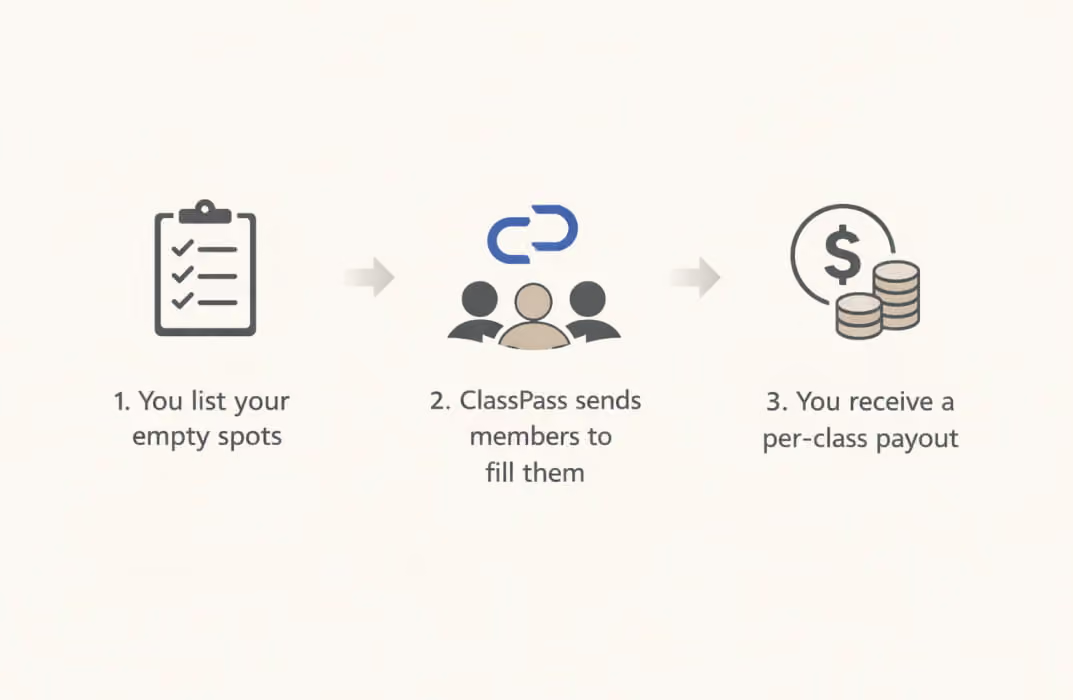
For fitness businesses, ClassPass is a distribution channel. You list your available class spots on the platform, and ClassPass routes members to fill your unused capacity in exchange for a per-class payout.
ClassPass was founded in 2013 by Payal Kadakia. It was acquired by Mindbody in 2021 in a deal valued at approximately $3 billion. In June 2025, Mindbody, ClassPass, and Booker unified under a new parent brand called Playlist.
As of early 2025, ClassPass operates a network of approximately 30,000 partner studios and wellness businesses.
Context on what that network represents: ClassPass's 2026 Industry Impact Report — the platform's first dedicated data analysis of its effect on the fitness economy — notes that the average fitness studio operates at just 37% of total capacity. That utilization gap is the structural problem ClassPass was built to solve. Fritz Lanman, CEO of Playlist (ClassPass's parent brand), framed it directly: "In the fitness industry, the average studio operates at just 37% of total capacity. That represents a massive, untapped growth opportunity." Every conversation about whether to list on ClassPass starts with that number.
How Does ClassPass Work for Members?
From the consumer side, ClassPass is straightforward.
Members sign up for a monthly plan, receive a credit allocation, and use those credits to book classes and appointments at partner businesses through the ClassPass app or website. Credit costs vary by class type, studio demand, time of day, and location.
Member pricing (varies by location, as of 2025/2026):
- Entry plans start at approximately $19/month for 8 credits
- Mid-tier plans range up to approximately $159/month for 80 credits
- Prices vary by city and market
Classes cost a different number of credits depending on demand and the specific business. A high-demand boutique studio in a major city will cost more credits than a lower-demand slot at an off-peak time.
The typical ClassPass member is 25 to 45 years old with disposable income. According to Mindbody, ClassPass users are generally variety-seekers who enjoy trying different workouts and wellness experiences each month, and do not typically have strong loyalty to a single brand or studio.
How Does ClassPass Work for Gym Owners and Fitness Studios?
This is where the model gets more nuanced, and where gym owners and studio operators need to read carefully.
Step 1: You List Your Business at No Upfront Cost
There is no fee to list your business on ClassPass. You create a profile, add class descriptions, photos, and amenities, and connect your existing booking system. ClassPass integrates with over 100 booking systems globally.
Step 2: ClassPass Fills Your Unused Spots
ClassPass uses a proprietary system called SmartTools to manage inventory. The two key tools are:
SmartSpot: Uses machine learning to identify class spots that are predicted to go unfilled based on historical data. It only lists those spots on ClassPass, protecting your direct bookings from being displaced. According to ClassPass, 94% of fitness classes do not sell out, which means most businesses have genuine excess capacity to monetize.
SmartRate: Dynamically adjusts the credit cost of your classes to optimise how much ClassPass pays you per booking. Partners using SmartRate averaged approximately 20% higher ClassPass payouts, more than twice as many new visitors, and approximately 14% higher class fill rates compared to partners not using the tool, based on 2024 data.
Step 3: You Receive a Per-Class Payout
ClassPass pays you for every attendee who books through the platform. The payout rate is negotiated individually and is based on a percentage of your lowest package rate. For example, if your studio charges $150 for a 10-class pack, your per-class rate is $15. If your negotiated payout is 40% of that rate, you receive $6 per ClassPass booking.
This means the revenue per ClassPass attendee is lower than what you would earn from a direct client purchasing your standard packages.
Payments are made bi-weekly or monthly via direct deposit through Tipalti, a third-party payment service.
Step 4: You Control Availability
You set limits on how many ClassPass members can book per session. You maintain full control over which spots are available and can restrict access during peak-demand periods to protect your paying members.
ClassPass Pricing for Businesses: What Does It Actually Cost?
There is no upfront cost or monthly subscription fee to list your business on ClassPass. The cost is structural: you earn less per attendee through ClassPass than you do with your own direct pricing.
The platform positions itself as a tool for monetising perishable inventory, the class spots that would otherwise go unfilled. The logic is similar to airlines offering last-minute discounted fares rather than flying with empty seats.
ClassPass itself clearly uses this framing: the goal is to generate incremental revenue from unused capacity, not to replace your core revenue from direct members.
The Business Case for ClassPass: What the Data Shows
ClassPass publishes several performance metrics that are worth understanding before deciding whether to partner:
- ClassPass has delivered $3.1 billion in total partner revenue globally to date
- 94% of ClassPass users are new to the venues they visit, giving studios access to clients they would not otherwise reach
- Studios using both ClassPass and Mindbody software saw average bookings climb 9.9% year-over-year in January 2025, while studios not on ClassPass experienced an average decline of 1.6%
- Global ClassPass reservations increased 44% over the 12 months to May 2025
- One study showed a 36% increase in clients and a 3.8% increase in direct memberships for fitness partners on ClassPass, with only 4.5% of direct clients switching to ClassPass
These numbers make a reasonable case for ClassPass as a supplementary channel, particularly for businesses with significant unused capacity and strong off-peak availability.
These figures come directly from ClassPass's own 2026 Industry Impact Report and partner blog — the first time ClassPass has published a consolidated data release of this kind. Additional findings from the same report: the number of partners earning over $1 million on ClassPass grew 28% from 2024 to 2025, and 85% of surveyed ClassPass users said they would attend group fitness classes less often without the platform. That last figure is important context: ClassPass is not simply redistributing existing fitness spend. It is, in many cases, creating demand from people who would not otherwise have booked at all — 73% of surveyed users said they would not have spent money on those experiences without ClassPass pricing.
Honest Pros and Cons of ClassPass for Gym Owners
Pros
- Exposure to new clients: Since 94% of ClassPass users are new to the venues they visit, the platform gives you genuine access to an audience that is unlikely to find you through organic search or local word of mouth alone.
- Revenue from empty spots: Rather than losing the revenue from unfilled class spots entirely, ClassPass lets you convert that perishable inventory into income. A $6 payout per empty spot beats $0.
- No upfront marketing cost: There is no listing fee and no advertising budget required. ClassPass handles discovery for you within its platform.
- Data and insights: The ClassPass dashboard provides partners with booking trends, peak times, and user behaviour data to inform scheduling and programme decisions.
- SmartTools protection: When configured correctly, SmartTools should only fill spots that would otherwise go empty, protecting your core member experience.
Cons
- Lower payout per class: The revenue per ClassPass attendee is meaningfully lower than what your direct clients pay. This is by design. But it matters when you calculate the real cost of dependence on the channel.
- Variety-seekers, not loyal members: The typical ClassPass user is described as someone who is not loyal to a specific brand. Converting them into paying direct members is possible, but conversion rates vary and cannot be relied upon as a core growth strategy.
- Marketplace dependency risk: The more revenue you generate through ClassPass, the more exposed your business becomes to changes in ClassPass pricing, terms, or market position. ClassPass has changed its payout structures and terms over the years, and businesses with high ClassPass dependency have little leverage in such situations.
- Brand dilution: When clients book through ClassPass, their relationship is with the ClassPass platform first and your studio second. The ClassPass app is what they open, what they pay for, and what they trust. Your brand is a destination within their marketplace, not the center of their experience.
- Not designed for personal trainers doing 1:1 coaching: ClassPass is built around group classes and appointment-based services. Independent personal trainers managing individual client relationships, online coaching programmes, or nutrition coaching are not the primary use case for this platform.
This dynamic played out visibly in 2025. Athletech News reporting on the Gym Loyalty Month campaign noted that LA studios joining the boycott cited cases where studios "sometimes receive $0 for bookings, even when members pay, and where no-show fees go entirely to the platform." By contrast, ClassPass counters that studios over 80% full with direct members earn a 45% higher ClassPass payout on average than classes under 50% full meaning the platform rewards businesses with strong direct demand, not ones substituting ClassPass for it. The risk of dependency is real precisely for studios that are not already strong on direct bookings. ClassPass works best for businesses that do not need it, and carries the most risk for those that do.
Who ClassPass Works Best For
ClassPass delivers the most value for businesses that:
- Run regular group class schedules with predictable unfilled spots
- Operate boutique studios in markets with strong ClassPass member density
- Want to increase physical foot traffic and generate trial conversions
- Have the capacity to absorb new clients during off-peak periods without disrupting their regular member base
ClassPass works less well for businesses that:
- Primarily coach clients 1:1 or in small groups
- Operate fully online or hybrid coaching programmes
- Want to build a loyal, retained client base rather than a rotating audience of variety-seekers
- Are you growing a personal brand as a trainer or fitness influencer
The Bigger Question: Marketplace vs. Direct Relationship
This is the strategic question ClassPass poses to every fitness business owner who considers it.
ClassPass is a marketplace. Marketplaces are excellent at creating discovery. They are poor at building loyalty because the loyalty belongs to the marketplace, not to the individual business within it.
Amazon sellers know this. Airbnb hosts know this. And fitness studio owners who have built significant revenue through ClassPass often discover the same tension: the platform drives traffic, but the client relationship belongs to someone else.
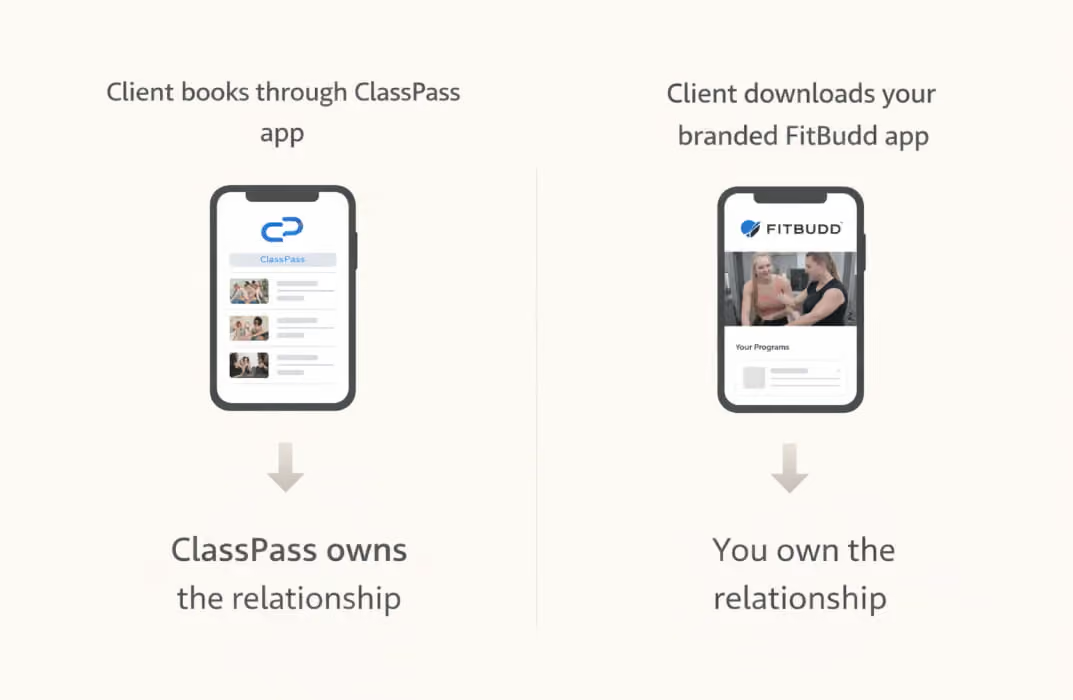
If a client finds you through ClassPass, enjoys your class, and keeps booking through ClassPass, the platform retains that relationship.
If ClassPass changes its terms, increases its credit requirements, or reduces your payout rate, that client's behaviour is determined by what ClassPass does, not by what you do.
Contrast that with a client who downloads your own app, pays you directly, receives your workout programming and nutrition guidance through your branded platform, and communicates with you through your messaging system. That is a relationship you own.
Building that kind of direct relationship at scale is exactly what platforms like FitBudd are built for.
Alternatives to ClassPass for Building Direct Client Relationships
If you are a gym owner, fitness studio operator, or personal trainer looking to grow your client base without relying on a marketplace, here are the approaches that work.
1. Build Your Own Branded App
FitBudd's Super Pro plan lets you launch a fully white-labelled iOS and Android app published under your own business name. Your clients download your app, pay you directly, and engage with your content inside your branded environment. There is no marketplace, no competing studios, and no revenue share on the clients you have already won. See how FitBudd's custom-branded app works.
2. Own the Payment Relationship
FitBudd processes client payments through Stripe and PayPal with zero commission across 200+ countries. Every payment goes directly to you, with no platform taking a cut of what your clients pay. That is structurally different from a revenue-sharing marketplace model. Explore FitBudd's direct client payments.
3. Deliver a Coaching Experience That Creates Retention
Retention is the revenue multiplier that discovery channels cannot provide. A client who stays with you for 12 months is worth more than 10 one-off ClassPass visitors who never convert. FitBudd's platform bundles workout programming, nutrition plans, 1:1 video calling, progress tracking, and client messaging into a single experience that keeps clients engaged.
4. Use Automation to Stay Connected
FitBudd's Smart Flow automation lets you build onboarding sequences, check-in reminders, and follow-up workflows that keep clients engaged between sessions. This is the infrastructure of retention: consistent, personalised contact that a marketplace cannot replicate.
5. Grow Through Referrals, Not Discovery Platforms
Clients who are retained well refer others. The FitBudd coach stories show trainers who scaled from a handful of clients to hundreds, not through marketplace discovery, but through delivering an experience worth recommending. Coach Noble grew from 75 to over 200 clients. Amy Hollings scaled to 1,000 clients. Neither story starts with a marketplace listing.
ClassPass vs. Building on FitBudd: A Practical Comparison
The Bottom Line
ClassPass is a legitimate tool for filling empty class spots and generating incremental revenue from unused capacity. The data supports it: 94% of its users are new to the venues they visit, and businesses that use it alongside
Mindbody software has seen measurable growth in bookings. For boutique studios with regular unfilled slots, it is worth evaluating seriously.
But ClassPass is a discovery channel, not a retention engine. It was not built to help you own the client relationship. It was built to give consumers flexibility across many businesses, which is exactly what makes loyalty difficult to build within it.
The fitness businesses growing sustainably in 2026 are not the ones with the best marketplace listing. They are the ones with the strongest direct client relationships, the clearest brand identity, and the systems to deliver a coaching experience clients do not want to leave.
That is what FitBudd is built for.
Ready to build a coaching business where clients come back for you, not a platform?
Start Your 30-Day Free Trial at FitBudd, No Credit Card Required















.jpg)