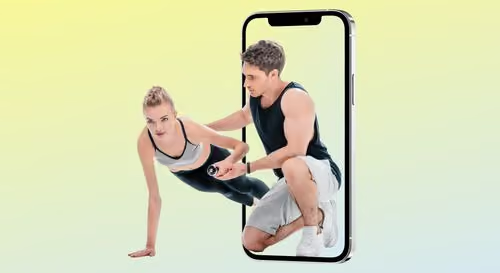

Walk into almost any commercial gym today, and you’ll notice something different. Members are holding up their phones mid-squat. Wearables are buzzing with real-time feedback. Coaching apps are delivering workout adjustments without a single word from a human trainer. The AI gym trainer has arrived, and it’s not here to steal your job. It’s here to make you better at it.
AI gym trainers are transforming the fitness journey for everyone, whether you’re a dedicated gym-goer or someone relying on home workouts. The rise of the workout app is central to this shift, making expert guidance and personalized routines more accessible than ever.
This article is written specifically for personal trainers, gym owners, and fitness coaches who want a clear, jargon-light explanation of what AI gym trainer technology does under the hood, from machine learning and rep counting to form analysis and adaptive programming.
By the end, you’ll not only understand the tech but know exactly how to talk about it with clients and use it to grow your business. Let’s get into it.
What Is an AI Gym Trainer, Really?
Before we dive into the mechanics, let’s clear something up. An AI gym trainer is not a robot standing in the corner of your gym counting reps. It’s a software system — one that uses artificial intelligence to observe, analyze, and respond to workout data in real time or near-real time.
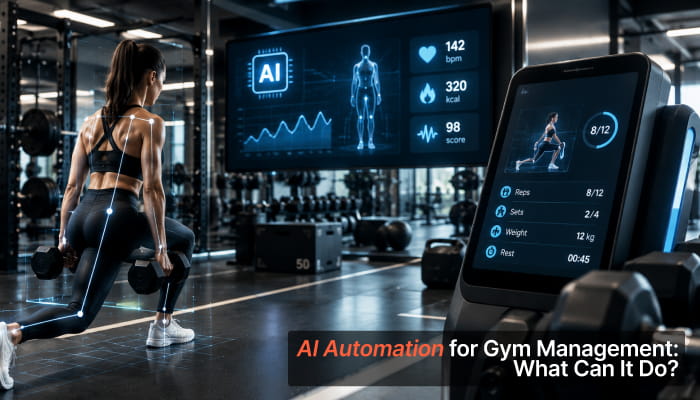
At its most basic level, an AI gym trainer is made up of three core components: sensors that collect data (cameras, accelerometers, heart rate monitors), algorithms that process and interpret that data, and output mechanisms that deliver feedback, adjustments, or recommendations to the user.
What makes it fundamentally different from a regular fitness app — the kind that just lets you log sets and reps — is that it doesn’t just record what you did. It understands what you did, compares it to what you should have done, and adapts what you’ll do next. Most other apps lack the ability to create personalized workouts that adapt to your progress, equipment, and goals in real time, whereas an AI gym trainer can create customized workouts tailored specifically for you. That’s the intelligence part. AI fitness apps leverage advanced machine learning algorithms to create personalized workout experiences that adapt in real-time.
Think of it like the difference between a stopwatch and a coaching assistant. Both help you track time, but only one tells you that your last 400m interval was 8% slower than your target pace and suggests a shorter recovery window next round.
The Machine Learning Engine Behind It All
So what actually makes an AI gym trainer smart? The short answer is machine learning — a type of artificial intelligence where systems learn from data rather than following explicit rules written by a programmer.
Here’s a simplified version of how it works in a fitness context. Imagine you feed a machine learning model thousands of videos of people performing squats — some with perfect form, some with knees caving in, some with forward lean, some with depth issues. You label each video with what’s correct and what’s problematic.
Over time, the model learns to recognize the patterns that distinguish a good squat from a bad one, even in people it has never seen before.
That’s supervised learning: the model is trained on labeled examples. Fitness apps use this to teach their systems what different movements look like and what correct execution requires.
There’s also unsupervised learning at play in more advanced platforms, where the system identifies patterns in a user’s own data over time — noticing, for example, that your client consistently underperforms on Monday mornings, or that their rep quality drops after the fourth set. Nobody programmed these insights in advance. The system found them in the data.
The data inputs feeding these models vary by platform but typically include:
- Camera or video data (for movement analysis)
- Accelerometer and gyroscope data from wearables (for motion tracking)
- Heart rate and HRV data (for recovery and intensity assessment)
- User-reported feedback (perceived exertion, soreness, energy levels)
- Historical performance data (past loads, volumes, session outcomes)
- Fitness history (baseline information and past performance)
- Training experience (user’s background and familiarity with fitness)
- Previous workouts (detailed records of past exercise sessions)
The global AI in fitness market was valued at approximately $13.9 billion in 2023 and is projected to grow at a CAGR of over 25% through 2030, according to multiple market research reports.
According to InsightAce Analytic, the global AI in fitness and wellness market was valued at $10.68 billion in 2025 and is projected to reach $57.80 billion by 2035 — a CAGR of 19.3%. That kind of growth doesn't happen around a gimmick. It reflects genuine, accelerating demand from both fitness professionals and consumers for smarter, data-driven training tools.
Rep Counting and Movement Detection — The Mechanics
Rep counting is usually the first AI gym trainer feature clients encounter — and it's a great entry point for understanding how the broader technology works. Here's a plain-language breakdown.
How the Camera Sees Your Movement
Most camera-based systems use a technique called pose estimation: the app identifies 17–33 key points on your body (shoulders, elbows, hips, knees, ankles) and tracks them continuously through each rep.
When you squat, the system monitors the angle at your hips and knees from the top of the movement down to the bottom and back up. When those angles return to their starting position — that's one rep counted. The same logic scales across dozens of exercises, covering:
- Free weights: dumbbells, barbells, kettlebells
- Bodyweight movements: push-ups, pull-ups, lunges
- Strength and lifting patterns: deadlifts, rows, presses
How Wearables Count Reps Without a Camera
Smartwatches and fitness bands take a different approach. Instead of video, they rely on two sensors: an accelerometer (measures linear movement) and a gyroscope (measures rotation). Every exercise has a unique motion signature — the system learns to tell a bicep curl from a shoulder press based on that signature, then counts repetitions accordingly.
Where Accuracy Gets Tricky
This is consistent with findings in the broader research literature. A peer-reviewed SWOT analysis published in Frontiers in Sports and Active Living (PMC) found that AI models trained on historical data "may not always capture individual differences that can exert a significant impact on the current situation" — including changes in form due to fatigue, injury, or technique shifts. The study's conclusion: "AI should not replace human judgment entirely. Coaches should not abandon their own critical evaluations, but make the final decisions, relying on AI for support.
That 90–97% figure comes with caveats. Accuracy drops when movements are asymmetrical or involve unusual grip positions, the environment is visually cluttered (busy gym floors), or the camera angle isn't optimal for the exercise being performed.
Beyond rep counting, the more advanced best AI gym app platforms can also suggest your next working weight, auto-adjust tempo, and time rest periods — so the system is doing more than just tallying reps.
What This Means for You as a Trainer
Rep counting via AI gym trainer technology is reliable enough for client self-monitoring between sessions — but it's not infallible. The right framing for clients: these tools are assistants, not arbiters. A rep the app counts might still need a quality check. Your job is to build the judgment; the AI personal trainer app handles the data.
Form Analysis — Where AI Gets Impressive
If rep counting is the party trick of AI gym trainer technology, form analysis is where things get genuinely impressive — and genuinely useful for fitness professionals.
Form analysis works by taking the same joint tracking we discussed in the previous section and comparing it against biomechanical benchmarks. The system doesn’t just notice that you completed a rep; it evaluates how you completed it.
Was your knee tracking over your toe? Did your lower back round at the bottom of the deadlift? Did your elbow flare past 45 degrees on the bench press?
AI gym trainers can also identify which major muscle groups and specific muscles are being worked during each exercise, using this data to help track changes in body composition over time.
“The most powerful thing AI can do for fitness is not replace the trainer — it’s give trainers data they couldn’t otherwise collect. Real-time biomechanical feedback at scale changes what’s possible in a coaching relationship.” — Fitness technology researcher perspective
Here’s a practical comparison of how human trainers and AI form analysis tools approach the same feedback task:
Advanced AI tools can analyze video input for instant feedback on movement and can reduce injury risk by up to 25%.
Adaptive Programming — AI That Evolves With the Client
Of all the capabilities that an AI gym trainer system can offer, adaptive programming is arguably the most transformative — and the most misunderstood.
Adaptive programming simply means that the training plan adjusts itself based on what’s actually happening with the client, rather than following a fixed template from week to week.
In practice, this means the system might increase load when performance metrics indicate readiness, reduce volume when recovery data suggests fatigue, extend rest periods when rep velocity drops mid-session, shift the weekly structure when sleep data shows consistently poor recovery, or substitute exercises when movement data flags a form breakdown that could indicate an overuse risk.
AI-powered personal training apps can also track muscle fatigue and prioritize rest days to prevent overtraining, ensuring optimal recovery and performance.
Research consistently shows that individualized training programs outperform generic ones by 20-40% across key performance metrics. AI-driven adaptation makes individualization scalable by delivering truly customized workout plans for every user.
AI Personal Trainer Apps — What's Actually on the Market
The AI personal trainer app market has exploded in the last few years — and the quality gap between the best and worst products is enormous. Some platforms are genuinely sophisticated coaching tools. Others have simply bolted the word "AI" onto a static program generator and called it a day.
As a fitness professional, you need to know the difference — both to protect your clients and to understand what you're competing with (or partnering with).
What the Best Platforms Actually Include
The most capable best AI gym app platforms don't just deliver workouts — they build a complete coaching ecosystem. Here's what to look for when evaluating any AI gym trainer tool:
- Form analysis: Computer vision-based feedback with quantified joint data, not just generic cues
- Adaptive programming: Plans that adjust in real time based on actual performance — not a fixed 12-week template
- Device integration: Seamless sync with Apple Watch, Garmin, and other wearables for richer health data
- Exercise library: Broad coverage including bodyweight, home workouts, free weights, and strength training
- Nutrition tracking: Integrated food logging and guidance — not an afterthought
- Progress analytics: Strength scores, personal records, muscle tracking, and body scan features for a complete picture
- Coach dashboard: Professional-facing tools to monitor multiple clients, flag issues, and message in-app
- Data privacy: Transparent ownership policies and clear terms on how client data is stored and shared
ACSM named Wearable Technology the #1 fitness trend for 2026 — the first time in the survey's 20-year history. ACSM-certified exercise physiologist Jessica Sansone, PhD, explained why: "Real-time physiological data, such as heart rate variability and sleep patterns, is shaping how people train and recover. These tools allow for more personalized adjustments that improve results and reduce injury risk. The key is translating complex numbers into clear, actionable guidance." That translation — from raw data to real coaching decisions — is exactly where trained fitness professionals earn their value.
How to Spot the Red Flags
Not every AI personal trainer app lives up to its marketing. Watch out for platforms that offer no real-time form feedback — only post-session summaries, deliver the same program to every user regardless of performance data, have no professional or coach-facing features whatsoever, or are vague about data ownership and third-party sharing. If an app can't clearly explain how its AI adapts to a specific user's results, it's likely rule-based logic dressed up as machine learning.
A Quick Feature Comparison
Where FitBudd Fits In
Most AI gym trainer apps are built for consumers. FitBudd is built for coaches. It combines the features of a powerful AI personal trainer app — adaptive programming, progress tracking, workout delivery, and nutrition support — with a full business platform: client dashboards, in-app messaging, billing, and branding tools.
If you're a fitness professional looking for a platform that amplifies your expertise rather than works around it, FitBudd is the best AI gym app option built with your role in mind — not retrofitted for it.
What This Means for Fitness Professionals
Let’s address the elephant in the room. When trainers first hear about AI gym trainer technology, the instinctive reaction is often some version of: “Is this going to replace me?” The short answer is no. The more useful answer explains why — and it requires understanding what AI actually can and cannot do.
AI is extraordinarily good at consistency, pattern recognition, and data processing at scale. It can count every rep in every set for every one of your clients simultaneously, flag form deviations the moment they occur, and adjust programming based on objective data without getting tired, distracted, or having a bad day.
AI gym trainers also provide professional-level guidance at significantly lower monthly costs compared to traditional trainers, making personal training more accessible for a wider range of clients.
What AI cannot do is motivate a client who just found out they’re being laid off. It cannot read the subtle signs that someone is pushing through pain they haven’t disclosed. It cannot build the trust that makes a client show up on the hard days. It cannot exercise professional judgment in ambiguous situations. It cannot be accountable. And it cannot care.
Personal training still requires human judgment and the ability to adapt to each client’s unique training style and evolving fitness goals—elements that are essential for a truly personalized fitness journey.
How to Communicate AI Value to Clients
One practical skill every fitness professional needs to develop is the ability to explain AI features to clients in a way that builds confidence rather than confusion. Here are some framing strategies that work well:
- Lead with outcomes, not technology: “This means I can see exactly what your form looked like on every single rep, even when I wasn’t there with you.”
- Normalize the tool: “Think of it like having a GPS for your training — it doesn’t replace your judgment, it gives you better information to make good decisions.”
- Emphasize the partnership: “The AI handles the data. I handle the strategy, the motivation, and the relationship.”
- Highlight support for your fitness journey: “AI-powered apps like FitBudd support you throughout your fitness journey, helping you stay motivated with ongoing encouragement, community features, and personalized coaching tailored to your goals.”
- Address concerns proactively: If a client seems uneasy about being recorded or tracked, explain the privacy safeguards and let them opt out of features they’re uncomfortable with.
Platforms like FitBudd make this communication easier by building client-facing features that are intuitive and non-intimidating — the technology works in the background while the interface stays human-centered. The best AI gym app for coaches should feel invisible to the client and powerful to the trainer.
The Limitations and Ethical Considerations
This mirrors a core finding from a 2025 narrative review on AI and athlete health published in the journal AI: over-reliance on algorithmic outputs creates a risk of "automation bias" — where coaches or clients defer critical decisions to systems that lack contextual and clinical knowledge. The review concluded that "oversight mechanisms are essential conditions for the responsible deployment of AI in sport," not optional safeguards.
No honest discussion of AI gym trainer technology would be complete without addressing what it still gets wrong — and there's quite a bit. Understanding these gaps doesn't mean dismissing the technology; it means using it responsibly. Here's a clear-eyed look at where current systems fall short.
Context Blindness: The Gap No Algorithm Can Close
An AI gym trainer analyzing your client's squat depth has no way of knowing that they had knee surgery eight months ago, that they were up with a sick kid until 3am, or that they're experiencing hip impingement that hasn't been diagnosed yet. Form analysis tools can flag deviations from biomechanical norms, but they cannot interpret those deviations the way a skilled human trainer would. Only a real coach can provide the nuanced, empathetic support needed for complex situations that go beyond what algorithms can detect. This is perhaps the most important limitation to communicate clearly to clients — the AI gym trainer sees movement patterns; it doesn't see people.
Bias in Training Data
Most form analysis models powering AI personal trainer app platforms were trained predominantly on data from young, able-bodied adults of certain demographic profiles. This is a problem the fitness tech industry is only beginning to grapple with seriously. It means these systems may be measurably less accurate for older adults, people with physical disabilities, or individuals with body types that weren't well-represented in the original training data. For fitness professionals working with diverse client populations, this is a practical accuracy concern — not just an abstract equity issue.
The Over-Reliance Risk
Clients who become dependent on real-time AI gym trainer feedback may struggle to develop the proprioceptive awareness and internal body sense that ultimately defines skilled, sustainable movement. If someone can only maintain good form when an app is watching, that's a coaching problem, not a success story. Good trainers use AI feedback as a teaching tool, not a crutch — helping clients understand why certain form cues matter, not just that the best AI gym app flagged them. The goal is to build self-awareness, not dependency.
Nutrition: The Missing Piece in Most AI Platforms
Many AI personal trainer app platforms focus exclusively on movement and performance data, with limited or no integration of nutrition tracking and guidance. This creates an incomplete picture of a client's health and progress. Without connecting dietary habits to fitness outcomes, even the best AI gym app is only telling part of the story. Fitness professionals should look for platforms that either include nutrition functionality or integrate cleanly with dedicated nutrition tools to ensure they're working with the full picture.
Data Privacy: A Professional Obligation
When clients use an AI personal trainer app, they're generating detailed physiological and behavioral data — movement patterns, recovery metrics, biometric trends. Trainers have a professional obligation to understand how that data is stored, who has access to it, and what the platform's data-sharing practices are. Other apps may not always be transparent about data ownership or privacy policies, so choose platforms — like FitBudd — that have clear, transparent data ownership policies and put client privacy first. This isn't just good ethics; in many regions, it's also a legal requirement.
Mental Health Awareness: Where AI Has Zero Capacity
Finally, AI gym trainer technology currently has essentially zero capacity for mental health awareness. It cannot recognize the early signs of overtraining syndrome, body dysmorphia, disordered eating, or exercise addiction. Human trainers can — and do. This is not a trivial gap. Fitness professionals often serve as informal mental health touchpoints for their clients, and that role requires human presence, empathy, and judgment that no AI gym app can replicate.
In fact, as AI handles more of the data-processing layer of coaching, it arguably frees trainers to invest more deeply in exactly this kind of human-centered support work.
The FitBudd 2026 AI Adoption in Fitness Coaching Report — one of the first primary research studies dedicated to AI adoption in the fitness coaching profession — found that 91% of fitness coaches now use AI in some capacity, with 77% agreeing that AI can never replace a human coach. That last figure was described as the strongest point of consensus across the entire dataset. Adoption is nearly universal. But so is the conviction that the human coach remains irreplaceable.
The Future Belongs to Informed Trainers
Here’s what we’ve covered: an AI gym trainer is a software system that combines machine learning, computer vision, and sensor data to observe, analyze, and adapt workout experiences. It counts reps through pose estimation and motion signature detection. It analyzes form by tracking joint angles and comparing them to biomechanical benchmarks. It adapts programming dynamically based on objective performance and recovery data.
None of this replaces what a skilled fitness professional does. But all of it changes how fitness professionals can work — giving you better data, more scalable oversight, and a stronger foundation for the coaching conversations that actually move clients forward.
The fitness professionals who will thrive in this environment are not the ones who ignore AI or the ones who outsource everything to it. They’re the ones who understand it well enough to use it intelligently, explain it confidently to clients, and build it into a coaching practice that’s more effective, more scalable, and more valuable than ever before.