
Why Dumbbell Back Exercises Are Some of the Best Back Workouts With Free Weights? Cables, barbells, and machines aren’t required for real back progress. Research shows dumbbell exercises activate 20–30% more stabilizer muscles than machines, and that stabilizer engagement is what builds functional strength, corrects imbalances, and creates the v-taper look. The best back workouts with free weights can be done at home or in the gym. Dumbbell workouts are versatile and ideal for both beginners and advanced lifters, making them a versatile way to build back strength.
The mechanism behind that activation difference is well established. Electromyography (EMG) studies which measure electrical activity in muscles during contraction — consistently show higher stabilizer engagement during dumbbell and free-weight exercises compared to machine-based equivalents, because free weights require the body to control the load across multiple planes of motion rather than a fixed guided path. A meta-analysis published in the NSCA's Strength & Conditioning Journal, authored by Brad Schoenfeld, PhD, CSCS, FNSCA — one of the world's most cited researchers in resistance training science confirmed that this multi-muscle engagement is one of the primary drivers of functional strength development across training populations. The stabilizer demand isn't a side effect of dumbbell training. It is a core benefit.
The back spans the lats, traps, rhomboids, erector spinae, and rear delts. Training it effectively means horizontal pulls, hip hinges, and stretch-based movements. Dumbbells give you the range of motion and unilateral capability to hit all of these. A well-designed strength training routine should target all these areas for balanced back development and improved posture.
Whether you want a stronger dumbbell back workout routine for the gym, an at-home back workout with minimal equipment, or you’re a trainer building client programs, here are the 10 best dumbbell back exercises, ranked by muscle coverage and practical value, and how to incorporate them into a comprehensive weight training plan.
A full dumbbell back workout routine using these exercises is included at the end. For best results, follow a structured training program that guides your progression and recovery for consistent improvement.
Back Muscles Targeted: What You're Training and Why It Matters
Barbell vs. Dumbbell Back Exercises: Key Differences and When to Use Each
Want better back gains? Your choice between barbells and dumbbells matters more than you think.
Both tools build muscle. But knowing when to use each? That's where the real results happen.
Dumbbell back exercises give you something barbells can't: true independence. Each side works on its own. No more letting your stronger side carry the weaker one.
You get a real range of motion, too. Adjust your grip. Find your sweet spot. Your joints will thank you, especially if you've dealt with injuries before.
Here's the bonus: your core works overtime. Each arm moves independently, so your stabilizers fire up hard. Better posture, stronger spine, real-world strength that carries over to everything you do.
Barbell exercises have one thing: pure strength. Nothing beats a heavy barbell row for building serious back thickness. Progressive overload becomes simple when you can just add more plates.
The downside? Your body follows one fixed path. Not everyone's built the same way. Push too hard with poor form, and you're asking for trouble.
So when do you use what?
Barbell exercises when you want to move serious weight and build your foundation. Dumbbell back exercises when you need variety, want to fix imbalances, or target muscles through their full range.
Smart trainers use both. Heavy compounds for strength, dumbbells for precision and balance.
Home gym or fully loaded facility, understanding these differences separates good trainers from great ones. Your back (and your clients) will feel the difference.
The 10 Best Dumbbell Back Exercises
1. Single-Arm Dumbbell Row
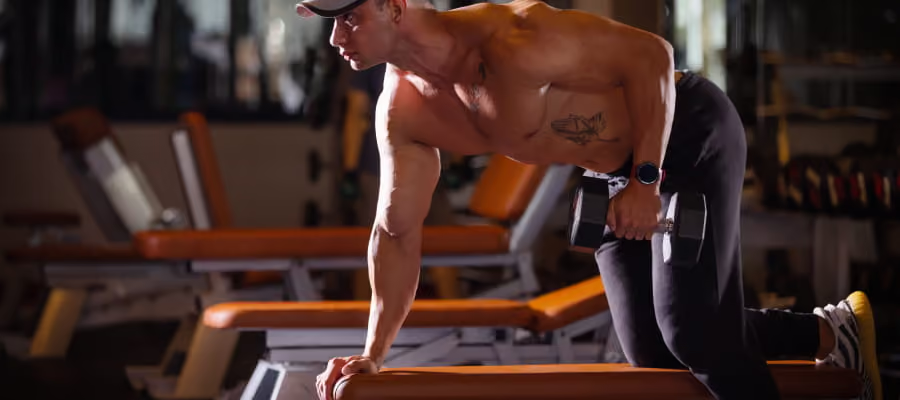
The single-arm row is the cornerstone of any dumbbell back workout routine. Unilateral training isolates each lat separately, which is crucial for correcting side-to-side imbalances and improving back symmetry. It also allows a greater range of motion than a bilateral row.
Muscles: Lats (primary), rhomboids, traps, rear delts, biceps
Sets & Reps: 3–4 sets × 8–12 reps per side
How to: One knee and hand on a bench. Row the dumbbell toward your hip, leading with your elbow, keeping your elbow close to your torso to maximize back engagement. Slowly lift the dumbbell for better muscle activation and safety. Lower with control.
Pro tip: Think ‘elbow to ceiling’ rather than ‘weight to chest’; this keeps the focus on the lats rather than the biceps

Tony Gentilcore, CSCS, co-founder of Cressey Sports Performance and owner of CORE gym in Boston, is direct about why the single-arm dumbbell row belongs at the top of any back training plan: "Dumbbell rows in general are perfect for ironing out strength imbalances that often exist between sides and you'll get some additional core work in the form of lateral stability." He adds a critical coaching note that separates productive rows from wasted sets: "Keeping the spine in neutral and not rowing with the upper traps is the key. Please don't go extremely heavy and short arm the weight." Load selection and form discipline, not maximum weight, determine whether each rep actually builds the back.
2. Dumbbell Bent-Over Row
The bilateral dumbbell bent-over row lets you move heavier loads, making it the primary strength-builder in a back workout with dumbbells. The hinge position trains the erector spinae and core isometrically throughout every rep.
Muscles: Lats, rhomboids, mid traps, erector spinae, biceps
Sets & Reps: 3–4 sets × 6–10 reps
How to: Stand with your feet shoulder-width apart. Hinge at the hips so your torso is slightly bent over, keeping your back flat. Your arms should start straight down from your shoulders, palms facing your body. Maintain a neutral position for your spine and head, forming a straight line from head to hips. Pull both dumbbells toward your hips, squeezing your shoulder blades at the top. Lower with control.
Pro tip: Focus on proper form throughout the movement. An overhand grip emphasizes the upper back; a neutral grip shifts more load to the lats. Vary your grip across training cycles
3. Chest-Supported Dumbbell Row
The chest-supported row is one of the best back muscle exercises with weights for pure upper back isolation. The incline bench prevents momentum, forcing your rhomboids and mid traps to do all the work.
Muscles: Rhomboids, mid and lower traps, rear delts
Equipment: Incline bench set to 30–45 degrees
Sets & Reps: 3 sets × 10–15 reps
How to: Starting position: Lie face-down on the bench with your chest against the pad and arms hanging straight down. Row both dumbbells up and back, squeezing your shoulder blades at the top. Make sure to squeeze your shoulder blades together for maximum contraction.
Pro tip: Pause for a full second at the top of every rep. This builds mind-muscle connection in the often-underdeveloped mid-back
4. Dumbbell Deadlift
The dumbbell deadlift trains the entire posterior chain without requiring a barbell, an effective bench for lower back exercises alternative and a foundation for lower back strength.
Muscles: Erector spinae, glutes, hamstrings, lats, traps
Sets & Reps: 3–4 sets × 6–8 reps (strength) or 3 sets × 10–12 reps (hypertrophy)
How to: Stand with your feet flat on the ground, hip-width apart, and knees slightly bent. Hold the dumbbells in front of your thighs with your arms extended. Hinge at the hips while maintaining a neutral spine, and slowly lower the dumbbells along your legs. Drive through your heels to stand, squeezing glutes at the top.
Pro tip: Keep the dumbbells close to your body throughout this, which reduces shear force on the lower back and keeps the movement efficient
5. Dumbbell Romanian Deadlift (RDL)
The dumbbell Romanian deadlift trains the posterior chain with emphasis on the hamstring and lower back stretch, one of the best back workouts with free weights for injury prevention. The fixed knee bend maximizes the stretch on hamstrings and erectors.
Muscles: Hamstrings, glutes, erector spinae, upper back
Sets & Reps: 3 sets × 8–12 reps
How to: Hold dumbbells at your thighs with a slight bend in your knees. Maintain a neutral position for your spine and head throughout the movement. Push your hips back and hinge forward. Slowly lower the dumbbells until you feel a strong stretch in your hamstrings. Drive your hips forward to stand.
Pro tip: The RDL is a hip hinge, not a squat. Your knees stay soft but largely fixed throughout the movement
6. Dumbbell Pullover
The dumbbell pullover trains the lats from a fully stretched position through a full range of motion, something rows can’t replicate. An essential dumbbell-only back exercise that also hits the serratus anterior and chest.
Muscles: Lats (stretch-focused), serratus anterior, chest, triceps
Sets & Reps: 3 sets × 10–12 reps
How to: Lie across a bench (or the floor at home). Hold one dumbbell with both hands above your chest, palms facing each other. Keep your arms extended throughout the movement. Lower it in an arc over your head until your biceps are near your ears, then slowly lift the dumbbell back to the starting position.
Pro tip: Take 3 seconds to lower the weight; the slow eccentric maximizes lat stretch and muscle growth stimulus
7. Dumbbell Shrug
The dumbbell shrug directly trains the upper trapezius. Strong traps stabilize the shoulder blades during every rowing movement, making trap development a multiplier for all other back exercises with dumbbells.
Muscles: Upper and mid trapezius muscles (traps)
Sets & Reps: 3–4 sets × 12–15 reps
How to: Stand with your feet shoulder-width apart. Hold dumbbells at your sides. Raise your shoulders straight up as high as possible, hold for a second, then lower slowly. Avoid letting your shoulders roll or move forward; keep the movement straight up and straight down.
Pro tip: Focus on proper form to maximize trap activation and prevent injury. Heavier weight and a brief hold at the top are more effective than speed momentum defeats the purpose of this isolation exercise.
8. Dumbbell Reverse Fly
The reverse fly targets the rear deltoids and reinforces scapular retraction essential for posture correction. Despite being one of the most underused workouts with dumbbells for the back, it directly counteracts the rounded-shoulder posture from prolonged sitting.
Muscles: Rear deltoids, rhomboids, mid traps
Sets & Reps: 3 sets × 12–15 reps
How to: Hinge forward at the hips, arms hanging. With a slight bend in your elbows, raise both dumbbells out to the sides until your arms are parallel to the floor. At the top of the movement, squeeze your shoulder blades together. Lower with control.
Pro tip: Use lighter weights to maintain control and proper form. Most people cheat this movement heavily. A controlled, full range of motion with a 15-lb dumbbell outperforms a sloppy set with 30 lbs.
9. Renegade Row
The renegade row combines a plank with a row training back, core, and anti-rotation stability simultaneously. One of the best at-home back workouts for a compound challenge. It’s also the most taxing exercise on this list. Place it later in your session.
Muscles: Lats, traps, rhomboids, core (anti-rotation), triceps
Sets & Reps: 3 sets × 6–8 reps per side
How to: Start in a high plank position with a dumbbell in each hand. Your body should form a straight line from head to heels. Keep your core engaged throughout the movement. From the plank position, row one dumbbell to your hip, keeping your hips level. Lower the dumbbell and repeat the movement on the opposite side to ensure balanced muscle engagement.
Pro tip: Use hex-shaped dumbbells for stability. The narrower your foot stance, the harder the core anti-rotation demand
10. Dumbbell Face Pull (Incline Bench Variation)
The incline bench variation with dumbbells delivers nearly identical results to cable face pulls. It targets the external rotators, the most under-trained muscles in most dumbbell back workout routines, and is critical for long-term shoulder health.
Muscles: Rear delts, mid and lower traps, rotator cuff, external rotators
Sets & Reps: 3 sets × 12–15 reps
How to: Starting position: Lie face-down on a low incline bench with arms extended straight down, holding light dumbbells with palms facing each other. Begin with arms extended, then pull both dumbbells up and back simultaneously, flaring elbows at shoulder height like drawing a W.
Pro tip: Keep the weight very light. This is a health and posture exercise, not a strength exercise. Form breaks down fast when the weight is too heavy
Complete Dumbbell Back Workout Routine
Use this dumbbell back workout routine as a standalone back session or pull day, 1–2x per week. Rest 60–90 seconds between sets for hypertrophy; 2–3 minutes for strength-focused sets.
For a longer version of this session that includes lower-body work, see our full-body dumbbell workout at home and our gym weight machine workout routines for gym-based alternatives.
Trainer Note: Build and Deliver These Routines to Clients
If you're a personal trainer or online coach, FitBudd's workout builder lets you create, customize, and assign dumbbell back workout routines like this one to clients in a few taps with exercise instructions, sets, reps, and progress tracking delivered through your own branded coaching platform.